Key takeaways
- Customer journey mapping is a foundational part of our process. Your map becomes your reporting and infrastructure blueprint.
- My process for customer journey mapping is still surprisingly manual. I think this is one example where there’s no replacement for having real conversations.
- Working with Growth Division, or another third party, helps you make sense of your map. It’s relatively easy to create a map on your own, but it’s harder to understand where the comms gaps are, and what a normal dropoff looks like.
- What you do next matters most. Customer journey maps should provide a springboard for experimentation, not be left to gather dust in a shared folder.
Customer journey maps are not just a plan, or a visualisation of a marketing strategy; they’re a reporting and infrastructure blueprint. They’re the starting point for a martech stack, reporting setup and CRM system that feels like it’s working with you, not against you.
(Even in 2026, when customer journeys are different from person to person, and inevitably non-linear.)
There are different approaches to creating a customer journey map. What follows is largely my own technique, but also incorporates input from one of Growth Division’s channel experts, Jon Farrar. Jon runs Canopy, a revenue operations agency, so he approaches this task through more of a CRM lens, ideal for our larger clients who often have ‘leaky’ journeys and unwieldy martech stacks.
I’m the co-founder of Growth Division, a growth marketing agency for startups. We’ve helped over 130 startups to unlock growth through rapid and structured growth experiments. Customer journey mapping isn’t typically the part of our process that clients are most excited about, but it’s a crucial foundational step for Phase 1 of working together.
Whether you’re creating your own customer journey map or just curious about the GD process, let’s unpack how we approach this.
How customer journey maps add value at different growth stages
Pre-launch: a visualisation of the acquisition strategy
Pre-launch customer journey maps give a rough idea of how you expect the customer journey to go, and act as a visualisation of the marketing strategy. These maps are largely speculative and likely to be fairly simple.
Pre-seed & seed: building a solid CRM & reporting foundation ahead of fundraising
This is where teams start getting more serious about their data to build a strong case for their fundraising. I’ve previously written about how fundraising has changed in the last decade or more, and how potential investors are more detail-oriented, making clean and granular data essential.
For these startups, the customer journey map is the first step to building a solid CRM and reporting setup. They need a strong foundation that’s designed to scale with them – this may mean upgrading to a new CRM tool, or just making better use of the one they have.
Series A, B & C: watertight reporting for investors & removing silos between teams and tools
Scale-ups sitting at this point need to get their reporting together, and quickly. They need to be able to rely completely on the data they have and pull it from one single source of truth.
Often, they’re also struggling with silos at this point. They’ve gone from a small team bouncing ideas around in the same room to separate departments that need to rely on good systems to keep the information flowing between them, and keep everyone on the same page.
And the cost of manual work is becoming apparent, too. Every member of the sales team losing an hour a week to manual follow-ups doesn’t feel too painful when it’s a one- or two-person team. Then suddenly the team is 10 people strong, and the senior leadership realise they’re losing 40 hours (one person’s full working week) to inefficiency.
Case study: Oddbox
Oddbox came to us with one clear aim in mind: to get their boxes into businesses, not just homes.
🎯After mapping the Oddbox customer journey, we introduced a new CRM system and automated sales process that moved the team away from manual email follow-ups and spreadsheets.
✅ This saved each marketing & sales team member around 2 hours every day, and created a smooth sales journey for their B2B prospects.
How useful a customer journey map is depends on how you use it
Whether teams see real value from a customer journey map partly depends on its quality, but it largely depends on how teams go on to use it.
A customer journey map should be used as:
- A blueprint for the business’s CRM setup. Mapping out the customer journey should be the start of bringing everything together under one roof, removing silos, and streamlining the tech stack to make reporting simpler.
- A way to identify (and fix) comms gaps. A customer journey map helps us to spot gaps, which can then be filled. So if we realise that leads aren’t getting an automated message to confirm their demo call, and this is contributing to low attendance, we need to set up an automation to fix that.
- A way to identify (and replace) manual processes. We’ve saved teams hours each week with relatively easy automations that cut lots of manual work, and there are even more opportunities here with the introduction of AI agents.
- A ‘single source of truth’ for any grey areas. Grey areas such as: what is the responsibility of marketing and what is the responsibility of sales? Or, when does a customer go from a marketing qualified lead (MQL) to a sales qualified lead (SQL) and then to a product-qualified lead (PQL)?
- A basis for experimentation. When you can clearly see each stage of the customer journey, and exactly how many people are sitting in each one, you can spot the leaks and start running structured experiments to improve the flow.
- A way to map GTM activities to measurable outcomes. We need to understand how channels and activities perform relative to each other, and not just relative to past performance. We built GREX to help with this stage.
Case study: SeedLegals
SeedLegals came to us in a period of high growth. They needed to optimise their sales and marketing systems and streamline operations to make their sales process more efficient.
🎯After remapping the SeedLegals customer journey and streamlining their martech stack, we planned out sales and marketing processes that would save the team time and increase efficiency.
✅ We built these journeys out in SeedLegal’s CRM system, automating as much as possible. This not only saved the team time, but the smoother journey led to a conversion rate uplift.
My process for creating a customer journey map
Now that we’re clear on how startups benefit from customer journey maps, let’s get into my process for making them.
1. Agreeing on the goal of the customer map
Customer journey mapping falls within Phase 1 of our work with clients. This is a period of time (typically one month), after we first start working together, which is devoted to:
- Creating a customer journey map
- Streamlining the client’s martech stack based on this map
- Setting their strategy on a channel-by-channel basis
All the work we do in this phase (and beyond) hinges on the client’s current goals, and the customer journey map is no exception, so establishing the ‘why’ early on is important.
2. Speaking to every person in the team
We’re an AI-forward agency, and clients are always surprised by how manual I keep this next step. Essentially, I want to speak to every relevant person in your team to understand exactly how customers move through your marketing, and then (in the case of B2B) your sales process.
If I can speak to a selection of your best customers, this is an excellent bonus. This stage helps me to develop a true, deep understanding of your product and your customers.
3. Overlaying these insights with key data
Next, I marry up this information with the data I have available. Remember, I’m recreating the most regular customer journey here, so I need the data to confirm everything that I’ve learned from speaking with the team, and challenge assumptions where needed.
4. Plotting channels and activity
At Growth Division, all our client marketing activities are structured around the Bullseye Framework, an experiment-led growth marketing approach to finding (and doubling down on) your best marketing channels.
This is why I choose to map each different channel to each stage in the customer lifecycle journey, while also going granular on which specific activity (or activities) is moving the customer along at each point.
We use Pirate Metrics (the AARRR framework) to visualise this:
- Acquisition
- Activation
- Retention
- Referral
- Revenue
📕 Find out more: The exact process I've used to choose the marketing channels for 200+ startups
5. Building out two visual customer journey maps
Now I have all the information I need, the next step is to bring this to life visually. I usually use Miro, but there are plenty of alternative tools out there, such as Canva.
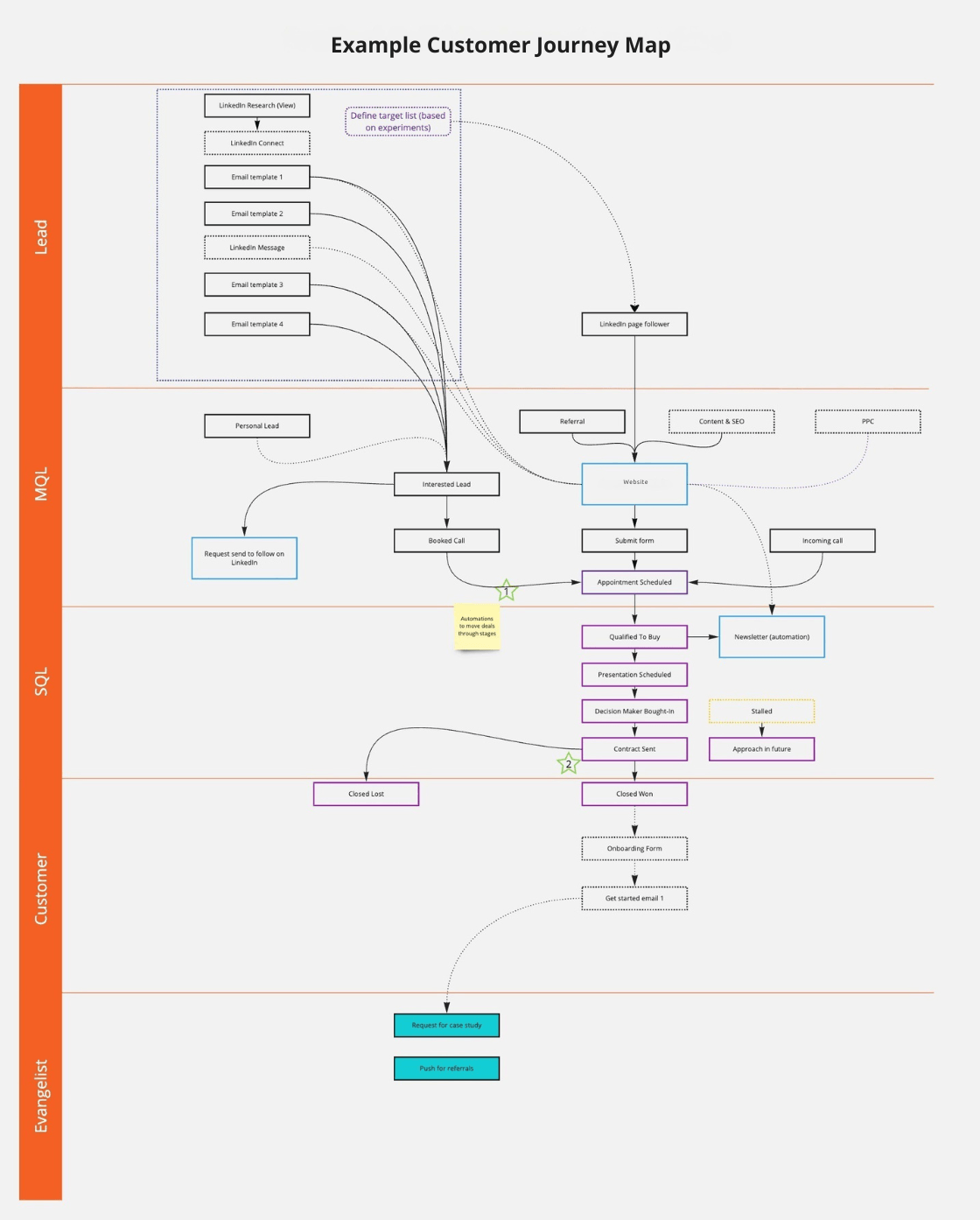
I build two customer journeys at this point: the existing customer journey map, plus a new and improved version to work towards.
6. Presenting this back & identifying weak spots
This step is where working with an external team really pays off.
Most businesses could map their own customer journey relatively easily. But without knowing what a smooth customer journey looks like in their industry, or what ‘good’ looks like when moving customers through each stage of the funnel, this document goes nowhere: it just becomes a record of what exists, rather than a tool for driving change.
What happens next?
Now we have your current customer journey map, plus a vision for how it should ideally look. So how do we use this customer journey map to drive change?
Phase 1: Aligning the CRM & martech stack with the ideal customer journey
First, we want to get your customer journey looking more like the ‘ideal’, streamlined version I mapped out.
We spend time reorganising your CRM and streamlining your martech stack. We introduce enrichment tools (or make the most of your CRM’s native one if the level is high enough), and typically introduce outbound tools to work alongside them. It’s this partnership of enrichment and outbound tools that regularly proves to be a winning combination.
We also make sure that your CRM is really acting as your single source of truth, so all other activities can then work around this. Clients feel a real difference after this step – like their CRM and martech stack is finally working with them, not against them.
Phase 2: Carrying out growth experiments
Mapping your existing customer journey gives us a sense of which elements in that journey currently feel lacking, and plotting it against each stage of the marketing funnel shows us exactly where we need additional marketing support and focus.
All of this informs which marketing channels we prioritise for your business, and which experiments we in turn prioritise for each channel.
This is the work we do in Phase 2. By this point, we’ve run a Bullseye Strategy Session with you to identify your most promising marketing channels (using the Bullseye Framework). From there, it’s a case of rapidly experimenting across each channel so we can either validate or invalidate it.
We form a fractional growth team from our vetted network of channel experts. Working with channel experts is key because it means – in technical terms – they can cut straight to the good stuff. They’re experimenting, yes – but from a place of highly specific experience in that channel, rather than as a generalist ‘giving it a go’.
The growth team is headed up by a growth strategist (like a fractional CMO). The customer journey map gives everyone something to anchor around, surfacing where the biggest opportunities for experimentation lie.
📕 Find out more: How I test and validate channels using the Bullseye Framework
Final thoughts
In 2026, customer journeys are rarely as linear as we’d like. But mapping both the typical customer journey and the ideal customer journey is still a highly valuable process for startups and scale-ups – provided the maps are then used, and not left to gather dust in a shared folder.
Instead, they should become a springboard from which to experiment and to improve the flow through your marketing funnel. Treat it as your single source of truth, something for the whole team to anchor around – and be sure to keep it updated as you learn and develop it.
Your CRM should be working with you, not against you. If you’d like to discuss how Growth Division can help identify weak spots in the customer journey, assemble a fractional growth team, and find scalable channels, book a short disco call today. You can also read our Clutch reviews to get a sense of how we’ve helped other startups like yours.



.png)
.png)