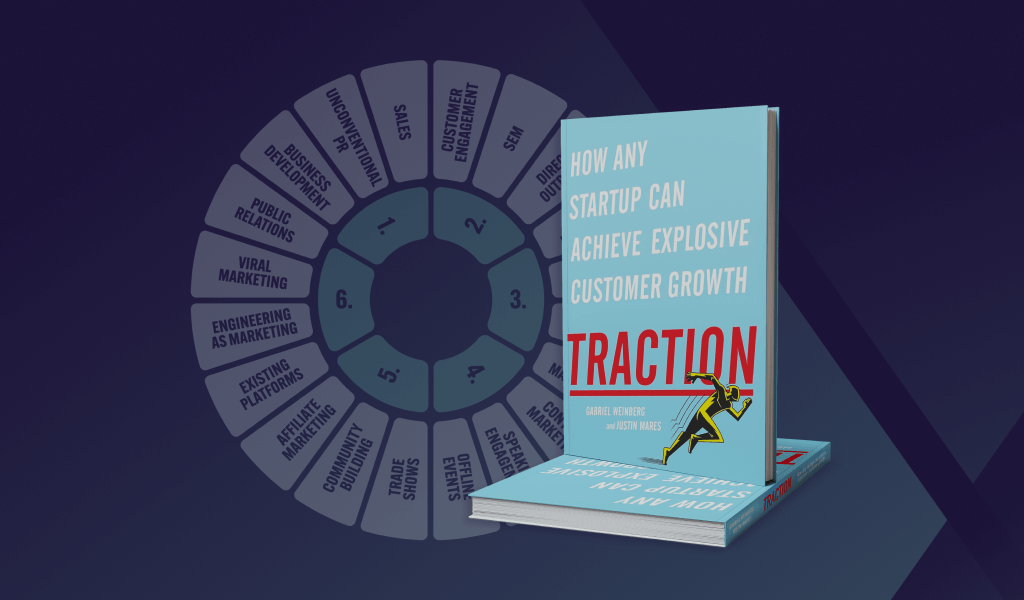
Traction is a book I first read in 2017, and still recommend to startup founders today. It’s a part of the fabric here at Growth Division; I’ve heard one of our partners refer to it as ‘The Growth Division Bible’.
The insights within this book by Gabriel Weinberg and Justin Mares completely changed the trajectory of the startup I co-founded and was growing throughout the second half of the 2000s. Its core framework, the Bullseye Framework, still underpins how we now work as a growth agency today.
It’s a brilliant book, and I owe it a lot. But I now recommend with a few caveats. After all, it was published 12 years ago; we’re operating in a different world, with different rules.
During our time working with over 130 high-growth startups, we’ve taken the Bullseye Framework and adapted it to work for fast-growing businesses today.
The context: 2014 vs 2026 in the world of startups
Cast your mind back to 2014. Personally, I was in my second year at uni in Bath, pulling out my best moves to Uptown Funk.
It happened to be a very good time to launch a startup, not that this was on my agenda at that particular moment. B2B SaaS was taking off, new categories were being created, and investors didn’t want to risk missing out on ‘the next Uber’.
And this was the context in which Traction was published. It’s fair to say things have shifted a fair bit since then:
1. Investors are more wary
The late 2000s and early 2010s were dominated by startup success stories, with big names like Uber and Airbnb seeing exponential user growth.
But then 2019 saw the downfall of WeWork, a company that, to any outsider, seemed incredibly successful.
And there were some other high-profile collapses around this time, too. The infamous and chilling story of Theranos unfolded, MoviePass fell victim to its low margins and bad modelling, and Quibiti (which has raised $1.75B before launch) felt the devastating effects of poor retention and bad product-market fit.
It was a wake-up call for investors. They stopped being wowed by user numbers alone, and started digging deeper: ‘What’s your LTV/CAC?’, and ‘When do you expect to become profitable?’. How you acquire users, and how much you spend to acquire them, started to matter more in these conversations.
The overall venture capital deal value is much higher today than it was in 2014, but it’s concentrated across proportionately fewer startups, and is more likely to go to those in a later stage, or those with a higher confidence rating.
2. B2B SaaS is saturated
Outside of AI, startups today are generally challengers launching into mature markets, rather than creating entirely new ones.
This places more emphasis on the work that comes before you test your first channels. Honing your ICP, getting your messaging right, and nailing what makes you different… these aren’t things to gloss over quickly as a challenger brand. You won’t get them bang on the first time, but you need to anchor your messaging around something meaningful and persuasive to unseat the default option in the space.
3. Attribution is more difficult
Many marketing channels were comparatively basic in 2014 (let’s not forget, Instagram ads only launched in 2013!), but in many ways, we could actually see more than we can now. Attribution was a lot simpler, especially as we moved through the following few years, and experienced the joy of multi-touch and cross-device tracking. I miss it.
But 2020 arrived, that Apple update came along, and the lights went out. It’s hard to make big, conclusive decisions when you can’t always see the full picture.
How we adjusted the Bullseye Framework for 2026
Traction outlines a new process for startup marketing that centres around the Bullseye Framework. Tom and I give some extra context on this framework in the video below, but here’s how it works in a nutshell:
- You start by choosing 3-6 marketing channels to test
- You experiment rapidly to unlock growth in these channels
- After an agreed period of time, you take a call on whether these channels work for your business
- If they do, you double down on them and move them to the inner ring of the bullseye. If they don’t, you cut them and start testing a different channel
The original Bullseye Framework leaves little room for nuance. It was revelatory and clear: either this channel works, or it doesn’t and we should cut it.
This needed updating for the marketing world we find ourselves in 12 years later, where such calls aren’t simple to make. Over time, we have taken the original Bullseye Framework and added additional layers and considerations:
1. We updated the channel selection
The original Bullseye Framework included 19 traction channels:
- Target Market Blogs
- Publicity (PR)
- Unconventional PR
- Search Engine Marketing (SEM)
- Social and Display Ads
- Offline Ads
- Search Engine Optimisation (SEO)
- Content Marketing
- Email Marketing
- Viral Marketing
- Engineering as Marketing
- Business Development & Partnerships.
- Sales
- Affiliate Programs
- Existing Platforms
- Trade Shows
- Offline Events
- Speaking Engagements
- Community Building
Here’s what we changed:
Sales —> Sales + Direct Outreach as separate channels
- In the book, ‘sales’ is described as in-person selling. Direct outreach, via email or platforms such as LinkedIn, is a powerful way to open those early conversations – but it’s quite a separate discipline and process.
Offline Events —> Events
- Traction was written before the explosion of hybrid and remote working patterns, so this definitely needed an upgrade.
Email Marketing —> Customer Engagement
- In the context of the Bullseye Framework, ‘email marketing’ was solely assigned for customer retention. We felt more goes into this than just email, so we broadened the definition of this channel.
2. We grouped each traction channel by type
We split these 20 channels into 5 different categories:
- Direct
- Paid
- Organic
- Content
- Viral
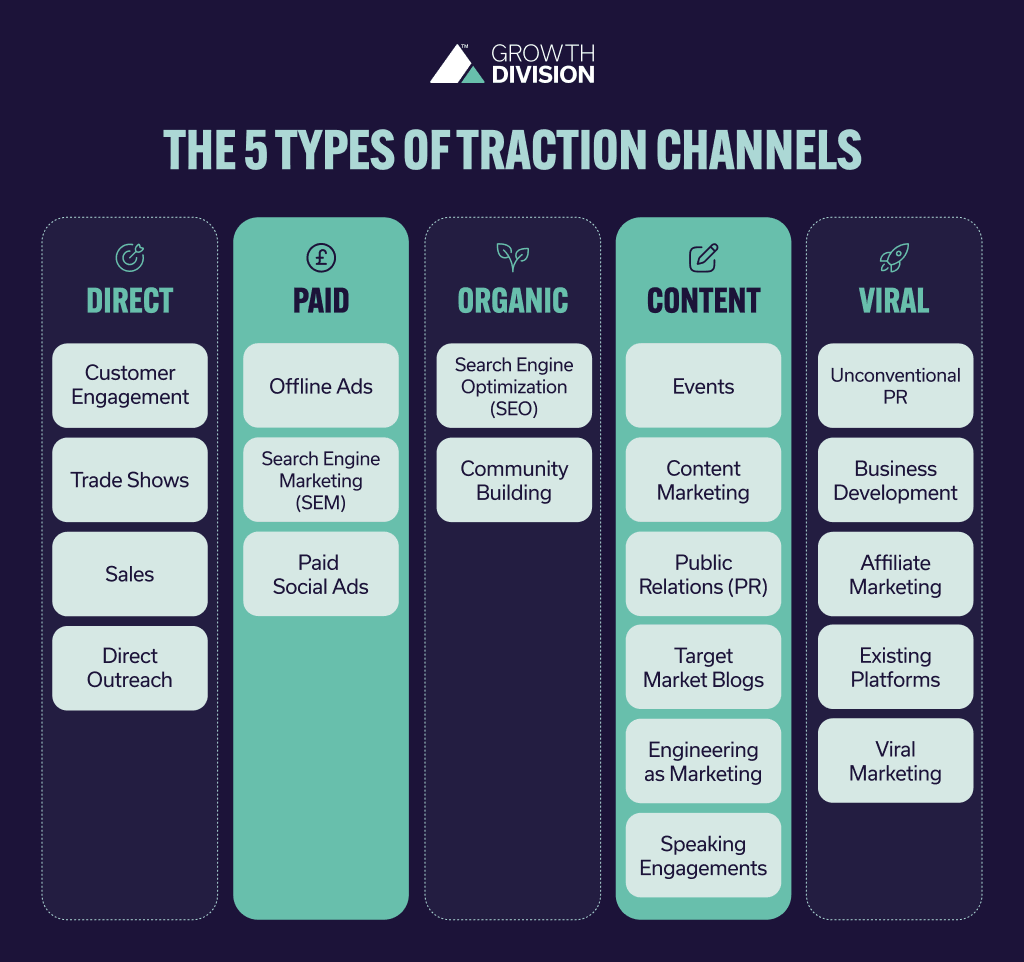
I believe it’s really important to have some spread across these different categories when you choose that initial marketing mix. This is so that:
- You spread risk. Relying only on paid channels leaves you vulnerable to legislative changes and squeezed margins as more players enter the field. Success on viral channels can be hard to repeat and predict. Choosing across at least two categories makes a lot more sense.
- You spread the payoff. It’s easy to deprioritise organic channels because they take longer to pay off, but they will reduce your average CAC when they do.
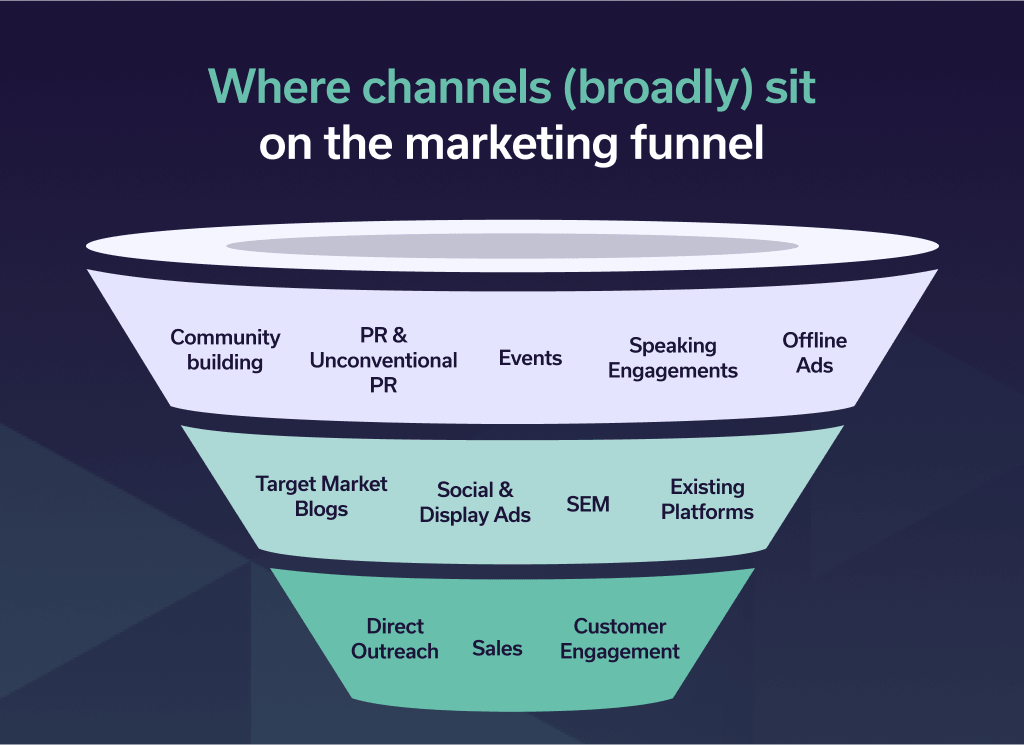
3. We started considering each channel’s place in the funnel
The original Bullseye Framework doesn’t take into account how individual channels work together.
Again, I respect the simplicity here. It’s easy to spend too much time overthinking and strategising when you’d actually be better off moving more quickly.
But some consideration is needed here in 2026. You want your funnel to be balanced (although weighted towards your immediate goals), and you need to understand the role each channel plays in that journey. Below, you can see where I’d generally place most channels on the funnel, but actually, many of them can sit across multiple different stages.
Content marketing is always the example I use here:
- A ‘How to do X’ article might bring in new traffic organically
- A report or download might help increase subscriber count
- And a new case study might help convert those who are already further along in their decision process
All are examples of content marketing, but each serves a different purpose. By understanding the role the channel needs to play upfront, you can then flex the strategy accordingly.
4. We took a holistic view of performance
When it comes to assessing channel performance, the original Bullseye Framework takes a pretty black-and-white approach: this channel is either directly contributing to the goal right now, or it isn’t. And if it isn’t, let’s cut it.
But what happens when these calls are harder to make? Attribution is harder for digital channels now, but it has always been a challenge for non-digital ones.
So while I’ll never leave a failing channel running, I also want to see how the full picture looks at any given point.
Let’s say we’re ghostwriting for a founder’s LinkedIn profile, and it’s going well in terms of impressions and engagements, but we can’t directly attribute any conversions back to these posts. The original Traction mentality would say to cut this channel, as we can’t prove the value to the overarching goal at that time.
But let’s say we’re also running direct outreach through this LinkedIn profile, which is successfully landing demo calls and opening conversations, which are then leading to conversions. If those messages were coming from an account that hadn’t posted in the last three years, would the results be the same? No chance.
I’m meticulous about tracking, but I also apply some common sense, and trust my judgement here (honed by working with over 130 startups at this point!). Basically, it’s that word again: nuance.
📕 Up next: How We Use The Bullseye Framework to Test & Validate Channels
Final thoughts: the ideas that endure
While there are certainly elements of Traction that I have adapted, the core ideas still feel radical and actionable, even 12 years later.
When I think of this approach to startup marketing, there are 3 overarching ideas that really stand the test of time:
Experimentation is the only way
We believe in the benefit of rapid experimentation so much so that we built our dream tool to log, track, and prioritise client experiments in one place.
The only way for startups to unlock growth is to experiment rapidly, both by trying new ideas and by iterating on the ones that have been proven to work. And not in a ‘let’s try a newsletter’ kind of way, but in a systematic and scientific one.
Systemisation gets it done
Systemisation is a key theme within the book, and I think it’s a useful one. As a founder, it’s easy to get paralysed when it comes to setting a marketing strategy, and overwhelmed by the sense of needing to be everywhere all at once.
The Bullseye Framework frees you from this pressure and stops you from spending too long theorising. It’s a highly systematic and actionable approach that gets marketing efforts moving and keeps them moving.
Your channel mix doesn’t have to be like your competitors’
Most startups operate in the same spaces. Traction may place a lot of importance on systemisation, but it’s also very creative. It reminds us of just how many scalable marketing channels are potentially open to us if can let go of where we think we should be showing up, and start taking inspiration from outside our lane.
Get in touch for a free Bullseye workshop session
Growth Division's founding partner Tristan wrote this article and is an expert in Go-To-Market planning for startups. He leads the Bullseye sessions with prospective founders. He will help you set objectives, plan your budget and then build a suitable channel mix. Book a call here.



.png)
.png)