Lots of startup founders pick a marketing channel before they've built a strategy. They just dive into execution. That's backwards. And it's the reason most early-stage marketing spend delivers nothing useful.
The instinct makes sense. You've got a product, you've got some budget, and you want customers. But jumping to channels without a go-to-market (GTM) strategy is like driving to an unknown destination without a map.
A GTM strategy answers three questions: who you're targeting, why they should care, and which channels will reach them efficiently. Get these right first, and everything else gets easier.
What is a go-to-market strategy?
A go-to-market strategy is a plan for acquiring your first scalable customers. It covers your target audience, your positioning, and the channels you'll use to reach them. A marketing plan is the tactical document that sits underneath it, not the other way around.
It’s common to see founders treating GTM as a launch event. You announce the product, run some ads, post on LinkedIn. But a real GTM strategy is an ongoing system that runs experiments, learns from data, and adapts.
The goal isn't to find every channel at once. It's to find one reliable, scalable channel first, then another, then build the engine from there.
Why most startup GTM strategies fail
There are three ways most founders approach this problem. None of them work well on their own.
The first is hiring in-house. You recruit a marketing manager or Head of Growth. But you're locking in one specific skill set, and the moment the data says to pivot channels, you're stuck.
The second is working with a specialist agency. Fast to start, but agencies are channel-biased. A PPC agency will always tell you to keep running PPC.
The third is using freelancers. Flexible and relatively cheap, but genuinely skilled growth freelancers are hard to find. Most people who claim to be experts aren't.
So you either overspend on agencies, stall with the wrong hire, or waste time vetting freelancers who underdeliver. There's a better path.
GTM strategy is a positioning problem, not just a channel problem
Here's what most "GTM strategy" content gets wrong. It focuses almost entirely on channels and ignores positioning.
Positioning is why a specific customer should choose your product over every alternative, including doing nothing. Without it, your channel experiments will generate noise, not signal. You'll run ads that click but don't convert, and you'll blame the channel rather than the message.
Before you rank channels or run a single experiment, you need to be clear on three things. (1) Who is the highest-value customer you can reach today? (2) What is the specific problem you solve for them, stated in their language? (3) And why should they trust you over anyone else?
These aren't branding questions. They're acquisition questions. The answers directly determine which channels will work and what the creative and copy need to say.
If you skip this step, every channel you test will underperform. The data will look confusing. And you'll end up changing channels when you should be changing the message.
The Bullseye Framework: a structured approach to channel discovery
The Bullseye Framework is a channel-discovery methodology built specifically for startups. It's the process we use at Growth Division, our growth marketing agency, before any client begins execution. It treats channel selection as a hypothesis to be tested, not a decision made upfront.
Here's how it works.
You start by mapping every possible channel. Paid media, content, SEO, email, outreach, partnerships, product-led growth. Not all of them are right for your business at your current stage.
Next, you rank channels by three criteria: potential for scale, cost to test, and speed to signal. The ones that score highest across all three move to the front of the queue.
Then you run small, structured experiments, each with a clear hypothesis, a timeline, and a measurable success metric. You're not spending big yet. You're spending smart.
The data tells you what's working. You double down on the signals and drop what isn't converting. Over time, you build a channel stack that's proven rather than assumed.
What makes this different from the way most founders approach channel selection is the order of operations. Most founders pick a channel first based on what they've seen work for other companies. The Bullseye Framework forces you to evaluate channels against your specific business before committing spend. That single shift saves most startups months of wasted budget.
📕 Learn more about how Growth Division runs the Bullseye process
How to design a growth experiment
A growth experiment is not a campaign. It's a structured test with a defined hypothesis, a clear success metric, and a fixed time window. Getting this structure right is what separates learning from guessing.
Every experiment should follow this format. State what you expect to happen, state why you expect it, and state how you'll measure it. For example: "If we run LinkedIn outreach to seed-stage founders who've recently raised, we expect to generate 10 qualified calls in 30 days, because our strongest client segment matches this profile."
That precision matters. It forces you to commit to a measurable outcome before you start. And it tells you exactly when to declare the experiment a success or a failure.
A few rules for running experiments well.
- Run one variable at a time. If you change the channel, the audience, and the message simultaneously, you can't learn anything. Pick one variable, hold everything else constant, and measure.
- Set a kill threshold before you start. Decide in advance what a failed experiment looks like. If you hit that threshold, stop the experiment. Don't move the goalposts once the data comes in.
- Document everything. The learning compounds over time. A failed experiment that's documented properly is more valuable than a successful one you can't replicate.
- Don't run too many at once (unless you have the resources). Two or three experiments running in parallel is manageable. Ten can be chaos. Focus produces better data.
The goal of experimentation isn't to find a winning channel in week one. It's to build an evidence base that tells you, with increasing confidence, where to put serious money.
The three phases of a GTM strategy
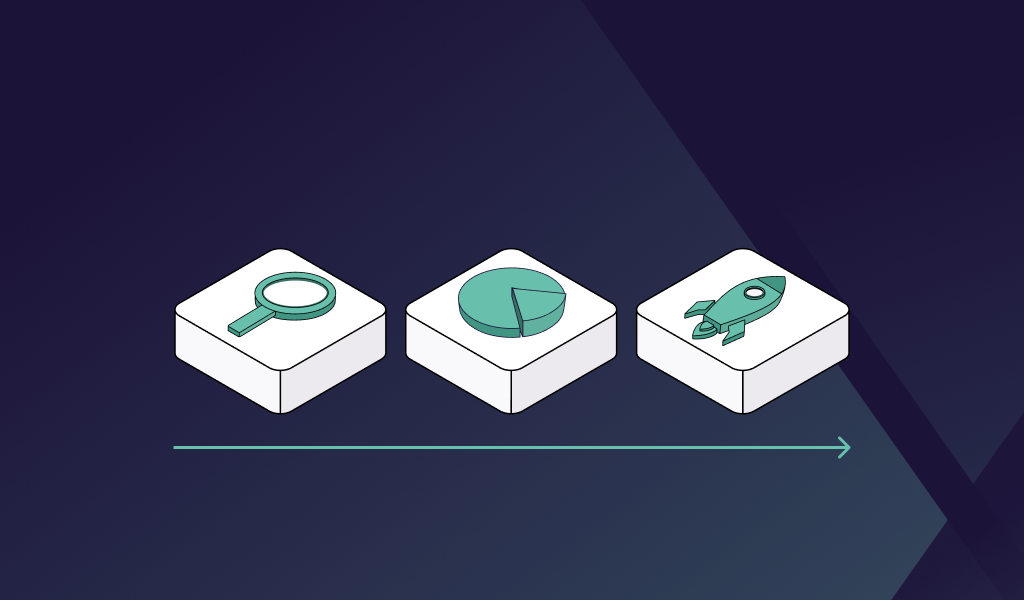
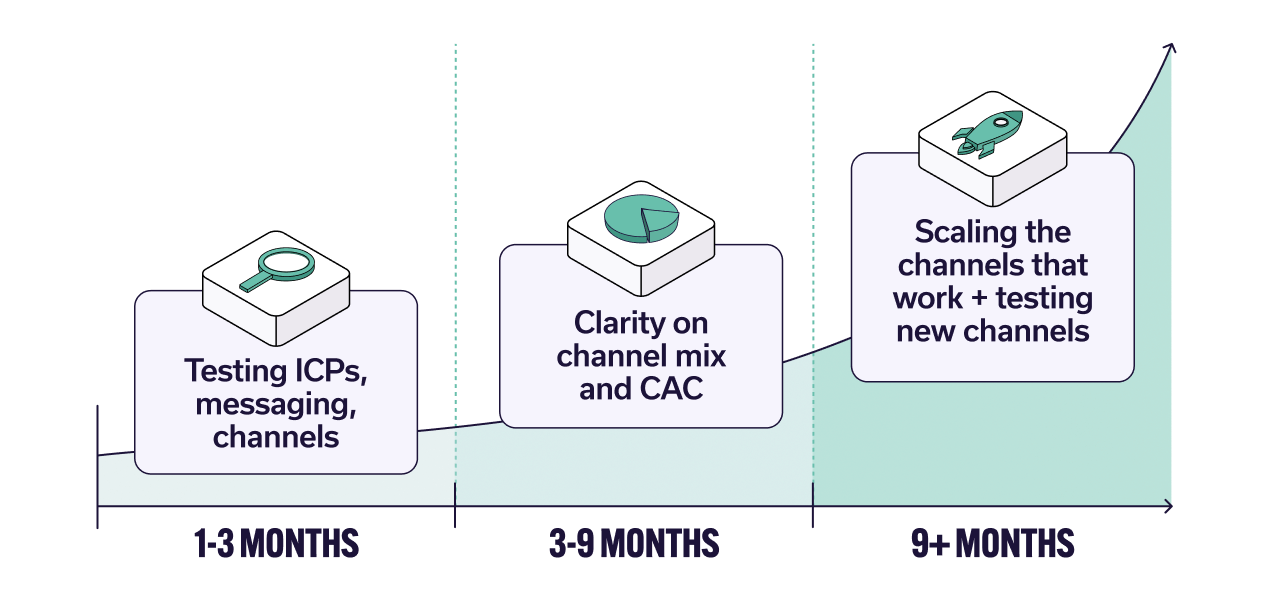
A GTM strategy doesn't unfold all at once. It moves through three distinct phases, each with a different goal.
Phase 1: Testing (months 1 to 3)
This phase is about generating signals, not revenue. You run experiments across several channels. Each one is small, fast, and measured against a specific hypothesis.
Expect most experiments to fail. That's not a problem, it's the point. Each failed experiment removes a wrong answer and gets you closer to a right one.
Don't try to scale here. You'll amplify the wrong thing. Stay lean, move fast, and track everything.
Phase 2: Channel Clarity (months 3 to 9)
By now the data has spoken. One or two channels are outperforming the others. This phase is about tightening those channels, reducing your customer acquisition cost (CAC), and building repeatable systems around what works.
This is also when you formalise your messaging. Your positioning should now be informed by real conversations with real customers, not guesswork. The customers who converted through your best-performing channel will tell you exactly what to say to get more of them.
Reducing CAC during this phase is critical. A channel that's working at £200 CAC might be worth scaling at £80 CAC. The work here is optimisation before amplification.
Phase 3: Scaling (month 9 onward)
You've found your channels. You've reduced CAC. Now you scale spend with confidence.
The experiments continue, but you're no longer searching. You're optimising. This is also when you start building your next channel, because single-channel dependency is a fragile position.
At this stage, most startups make the mistake of freezing their team. The channels have changed, but the skills required haven't been updated. Keep evaluating whether the team you have matches the channels you're scaling.
Building the right team for GTM execution
Most startups underestimate how quickly their team needs to change as the GTM evolves. What you need in the testing phase isn't what you need at scale.
In the early months, you need a channel-agnostic strategist, someone who designs experiments without being biased toward any particular channel. Generalist in-house hires often can't do this. They were hired for a specific skill set, not to run channel-discovery experiments.
The strategist role is different from a channel specialist. A strategist owns the process, designs the experiments, and interprets the data. A specialist executes brilliantly within a defined channel. You need both, but the strategist comes first.
As you move into channel clarity, you bring in specialists. Paid media experts, SEO leads, conversion specialists. But only for the channels the data has already validated.
The mistake most founders make is building the team they think they'll need in six months. Build the team you need right now. Adapt as the data comes in.
Common GTM mistakes to avoid
A few patterns show up again and again with startups that struggle to find scalable growth.
- Skipping the strategy phase. Too many founders jump straight to execution. They're running ads before they've defined who they're targeting. The result is spend without signal.
- Scaling too early. There's a difference between a channel that's working and one that's ready to scale. Scaling before you've reduced CAC burns budget. It also creates a false read on what's actually performing.
- Changing everything at once. When results disappoint, the instinct is to change the channel, the messaging, and the audience simultaneously. But that destroys your ability to learn anything. Change one variable at a time.
- Relying on a single channel. Single-channel dependency is one of the biggest fragility points for scaling startups. Algorithms change, audiences saturate, and channels get more expensive. Always be building the next one.
- Confusing activity with progress. Posting daily on LinkedIn, sending hundreds of cold emails, and running a dozen ads simultaneously feels like momentum. But without a clear hypothesis and a success metric, it's just noise. Activity without structure doesn't compound.
Frequently asked questions
What's the difference between a GTM strategy and a marketing plan?
A GTM strategy defines who you're selling to, why they should care, and how you'll reach them. A marketing plan is a tactical document that sits underneath it. You need the strategy before the plan makes sense.
When should a startup build its GTM strategy?
Before you start spending on channels. Ideally, before you hire your first marketing person. The strategy should inform the hiring decision, not the other way around.
How much should I budget for the testing phase?
There's no single right answer, but a rough guide: £3,000 to £5,000 per month across two or three experiments. The goal in testing is signal efficiency, not volume. Spend enough to get meaningful data, not enough to scale something unproven.
How long does it take to find scalable channels?
Realistically, expect three to nine months to move from testing to channel clarity. That timeframe assumes structured experiments with clear success metrics. Ad hoc testing takes much longer.
Do I need a GTM strategy if I already have customers?
Yes. Early customers often come through founder networks, not repeatable channels. What got you to £100k ARR won't get you to £1M. A GTM strategy is the system that identifies scalable acquisition beyond your immediate network.
What's the Bullseye Framework?
The Bullseye Framework is a channel-discovery methodology built for startups. It maps all possible channels, ranks them by potential and testability, and runs structured experiments to find what works. We use it at the start of every Growth Division engagement.
What if our experiments aren't generating clear data?
Usually that's a positioning problem, not a channel problem. If nobody's clicking, the message isn't landing. If they're clicking but not converting, the offer or the audience is wrong. Go back to the positioning questions before changing the channel.
Conclusion: Build the system, not just the spend
Most GTM failures are strategy failures, not execution failures. The targeting was wrong, the channel was assumed rather than tested, and the team was built for the wrong stage.
A structured GTM strategy, built around the Bullseye Framework, is the most reliable path to scalable growth. It takes longer to get right than launching your first ad campaign. But it costs far less in wasted spend and gets you to channel clarity months faster than running on instinct.
The founders who scale reliably aren't the ones who found the right channel by luck. They're the ones who built a system for finding it.
If you're a tech startup looking to find scalable channels without channel bias or unvetted freelancers, we can help. Growth Division runs the full GTM process, from the first Bullseye Call through to scaling. Book a call with the team to find out where you stand.



.png)
.png)