
Key takeaways
- Even with the best intentions, martech stacks quickly become unwieldy. This leads to siloed data and a lack of visibility over what’s actually driving results.
- Marketing teams are using AI for creating and consolidating. Its strength lies in pattern recognition and prediction, but it’s often not part of martech stacks at all.
- The main barrier to adding AI to martech stacks is integration. But not all teams have tried this at all. Data concerns also hold teams back.
Growth Division has helped over 130 startups grow in the last five years, and we’ve developed a strong process for this: we run a Bullseye Workshop to help teams find their most promising channels, we bring in the best experts to run those channels, they build out their strategy and start experimenting rapidly to find what works.
We’re a growth marketing agency, and this is the part of our process that we’ve become known for. But before most of this begins, there’s important foundational work to be done; namely, we typically need to spend time streamlining our client’s martech stack.
Having a streamlined martech stack is about more than just saving money and time. It’s how teams organise and make sense of their data, and move customers through their funnel.
And there’s huge potential to take things further with the addition of an AI decision layer. But the numbers show this is something most marketing teams have yet to take advantage of.
Let’s look at exactly how AI adds value here, what’s holding teams back, and how to get started (if you haven’t already).
What is a martech stack?
A martech stack, short for marketing technology stack, is simply all the tech platforms you use to run your marketing.
In an ideal world, you’d plan out a martech stack from scratch (including how each platform ‘talks’ to each other), and build it from there. In reality, these tend to grow organically as more channels are introduced, more team members join, and priorities shift and change.
As a result, they can quickly become expensive, unwieldy, and inefficient. Part of our initial challenge with a new client is to get them back under control, and to get reliable data in one centralised place.
Where data gets stuck (and how this holds teams back)
Many marketing teams continue with marketing channels or activities that don’t tangibly add value to their business for much longer than they should.
Often, this is down to a sense of ‘needing to be everywhere that their competitors are’.
But it’s also down to siloed data. When the performance of each marketing channel is recorded in isolation, you can only see wins and losses relative to the channel’s past performance, and not relative to marketing activities as a whole.
Instagram impressions are up +10% MoM, so this channel appears to be doing well. But does that 10% actually influence the pipeline? And by how much relative to other activities?
On the flip side, false negatives are also a very real risk. You run two different paid ad channels, and one seems to have a much higher CPA. You cut the seemingly weaker channel and plough that budget into your more successful channel, only for the CPA of that channel to then skyrocket. The ‘worse’ paid ads channel had been propping up the ‘better’ one the whole time, but this link wasn’t clear.
When you’re relying on your data to validate or invalidate entire marketing channels, and determine which growth experiments were actually successful, you need to be able to trust the numbers you’re seeing. And your team needs to have this data visible and usable at all times.
What a streamlined martech stack actually looks (and feels) like
Setting up a better martech stack, one where each platform learns from and feeds into the others, goes some way to mitigating the problem of stuck data.
With a streamlined martech stack, you can expect:
- One single source of truth for all marketing performance
- Less time spent on manual reporting
- Fewer platforms overall
- More confidence in your numbers (MQLs vs SQLs vs PQLs, etc)
- Smoother operations: customers and leads receive better responses more quickly
Case study: Breezy
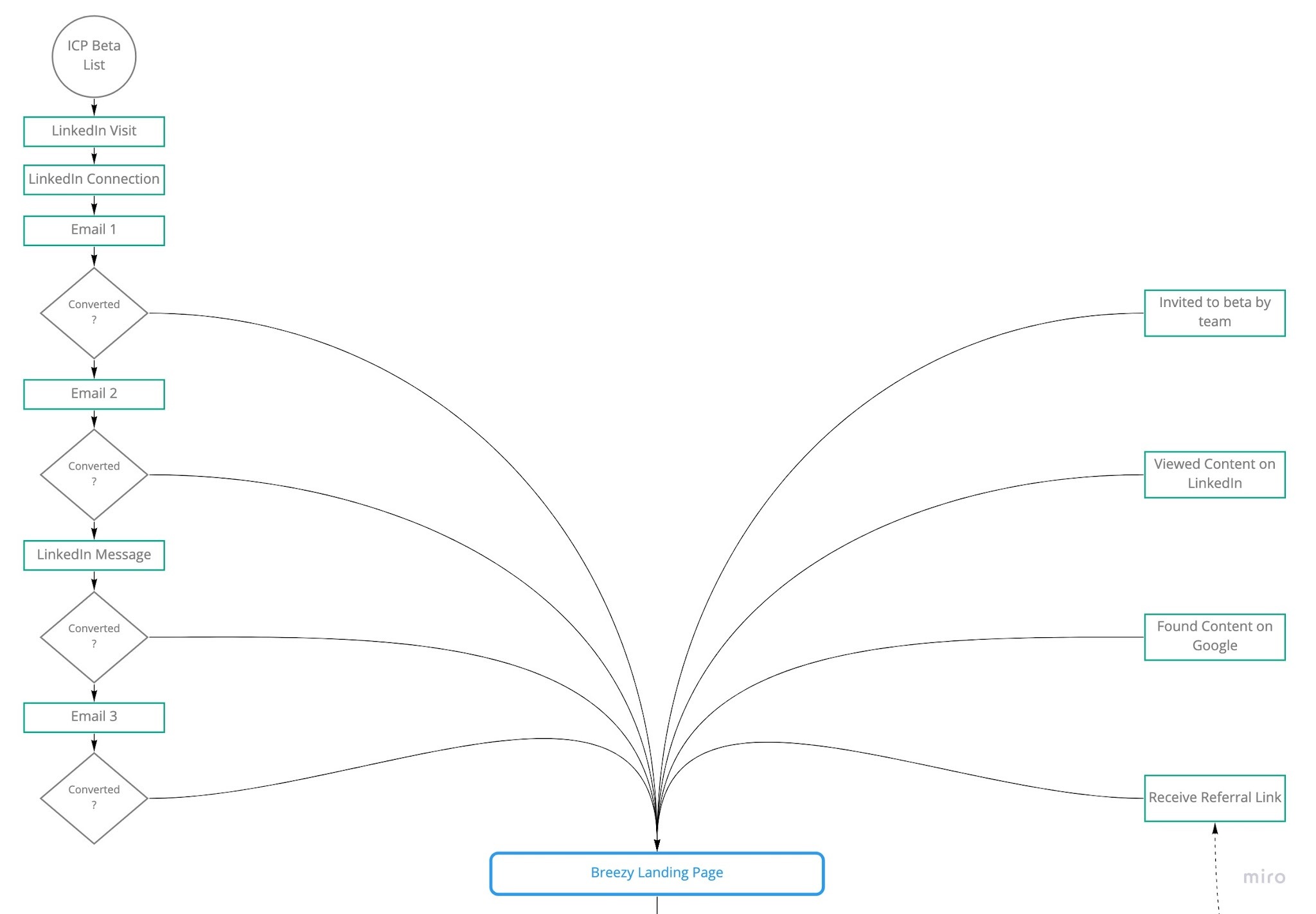
Breezy came to Growth Division for support with marketing funnel automation. The goal was to automate the process of encouraging customers all the way through the marketing funnel, maximising conversion rates at each stage and therefore maximising the effectiveness of their marketing. These customers were to be nurtured from a waitlist for a beta launch, all the way through a product onboarding process.
🎯The idea was that with more of this work automated, more resource would be freed up to focus elsewhere. We helped them define their stack, then chose tools to work at each stage of the marketing funnel, as you can see in the diagram below:
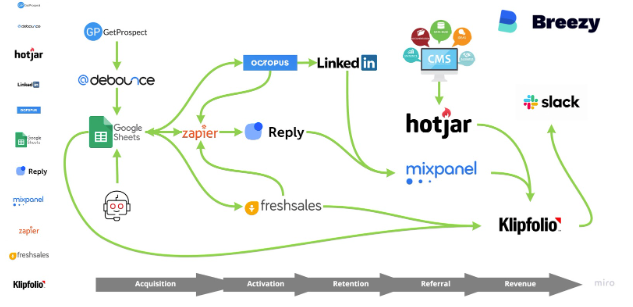
✅ We built Breezy’s bespoke martech stack from the ground up. It combines top-of-funnel ‘soft’ content and detailed ‘hard’ analytics provided by Mixpanel. This proved to be a potent combination with growing lead volumes and fantastic customer understanding.
AI & Martech stacks: the missed opportunity
The most popular way B2B marketers use AI is for copywriting and content production, image generation, and editing. Most marketing teams are using AI for creating, not consolidating (or systematic analysis):
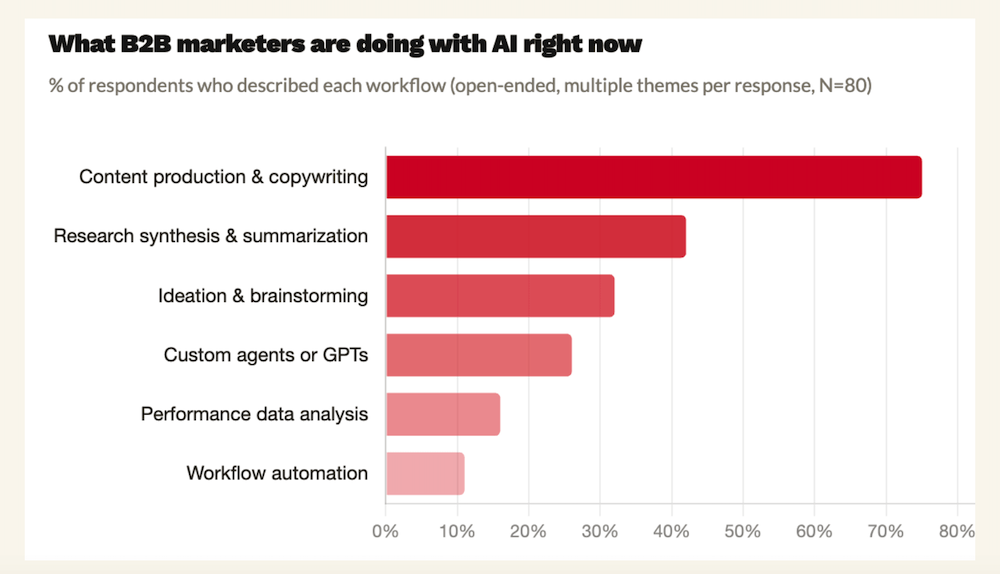
This same survey found that the most desired AI skill among this audience is the ability to build AI agents (42%).
Around 26% are already using AI to build custom GPTs and agents. But in most cases, those agents are improving business or personal efficiency by removing manual processes.
For example, they might scan a customer service inbox and send a reply with information that’s related to that issue.
This is all good stuff. The customer service team gets more done in less time, the business saves money, and the customer gets a prompt response. But at the end of the day, it’s outsourcing menial work to a tool that probably can’t do it quite as well as we can (albeit, it can do it faster). The personal touch gets missed. The request isn’t always interpreted correctly, leading to an increasingly frustrated customer.
Where AI actually excels: pattern recognition and prediction
My LinkedIn feed is dominated by marketing and ops teams using AI to become more efficient. But some of the most profound AI-led changes to our society are happening elsewhere.
C the Signs is an AI-powered early cancer detection tool that’s trusted by GPs across the UK. It considers a patient’s information, symptoms and medical history, then provides a recommendation to the GP on whether they should be referred for additional cancer testing. C the Signs is trained on scores of existing patient info, and has learned to predict the probability of cancer being present.
And it’s good at it: GP practices using C the Signs achieved a 12% increase in cancer detection rates, from 58.7% to 66.0%, without increasing referral activity.
So why is the AI layer missing from most martech stacks?
When they’re trained on the right material (and enough of it), AI tools can easily outperform us when it comes to pattern recognition and prediction.
Yet if I asked the vast majority of our new startup clients (who are generally AI-forward, by the way): does your stack/analytics layer allow you to measure successful outcomes with AI? The answer would almost always be: no.
So why is this still not an integral part of most companies’ martech stacks?
Issue #1: Integration problems
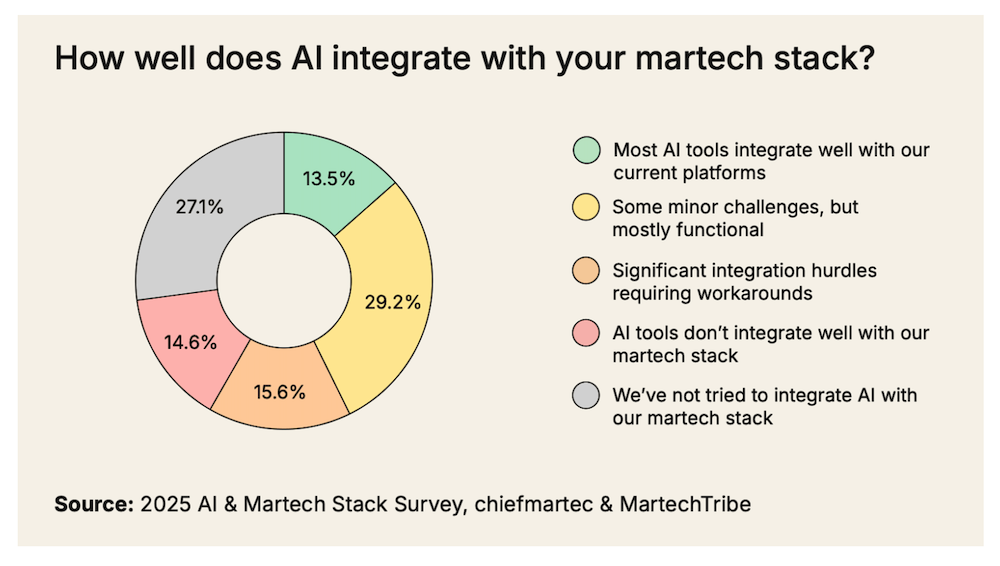
The graph above points us in the direction of the biggest issue. A significant number of teams haven’t actually tried to bring in AI (this percentage is actually much higher among B2C brands), but a greater number still have experienced technical difficulties at the integration point.
This (more recent) ABM-specific survey tells a similar story: 43% of respondents said they struggled to connect AI with their existing martech stack.
The simple fact of the matter is that this stuff is not easy. It’s not easy to get all your data into one place, make it clean and usable, and train an AI to draw important conclusions from it (free from hallucinations and other detrimental quirks).
AI technology may be everywhere, but it’s also in its infancy. Remember, just a few short years ago, you had never heard of ChatGPT, as hard as that is to imagine now. We’re all learning to work with something new.
Issue #2: Data privacy concerns
A 2025 ‘AI pulse’ report by KPMG revealed that 69% of business leaders are concerned about data privacy when using AI tools.
So it’s no wonder that giving an AI tool full access to your analytics and sensitive customer data feels difficult for many. And in turn, it’s no wonder that getting sign-off isn’t a quick process, potentially slowing down the integration of AI into the stack.
How AI should integrate into your martech stack
Crucially, creating an ‘integrated AI martech stack’ doesn’t mean ripping up what you already have and starting again. Remember, the difference here is just introducing an AI decision layer.
A traditional martech stack shows you what’s happening and follows the rules you set for it. If this user opens three welcome emails but doesn’t take any action, send them a text. If someone adds the blue shirt to their basket, include the matching shorts in your abandoned cart email.
When we add the AI context layer to this equation for our clients, decisions are still made automatically, but on a case-by-case basis. The email is sent at the perfect time for that particular customer. The ideal blend of products is recommended based on exactly what similar shoppers have enjoyed previously. Good results automatically become learnings that feed into future actions.
Volume and quality of data are everything
There’s a temptation to rush to the AI-assisted stage. But we need to remember that this decision layer only works smartly when it’s trained on high-quality data, and lots of it. Otherwise, you’re simply amplifying mistakes and the impact of misinformation.
When we start working with a new client, we spend time reviewing the data provided by each platform in their martech stack, making sure that it’s reliable, high-quality, and usable. For a very early-stage startup, the reality is that it’s going to take some time to build up sufficient data for the AI layer to actually become helpful.
Claude connectors: a stress-free option for startups?
Claude connectors promise to make it easier to centralise your marketing data. They are official integrations powered by the Model Context Protocol (MCP), which gives Claude access to all the tools in your martech stack with just a few clicks.
You get a frictionless integration experience, and Claude helps you to link the platforms together before actually helping to run your marketing, and draw insights. You can even build your own connectors to bring in any internal tools or databases.
However, we’re seeing marketing teams struggle to access the data in a consistent way, and individual contributors still working in silos
How the AI layer supports experimentation (+ potential limitations for startups)
We know that systemised experimentation is the only way for startups to unlock real growth. This isn’t just a well-documented theory; it’s the practice we’ve used to help over 130 startups to scale.
When it comes to evaluating the success of different experiments, the AI layer of your martech stack is an incredibly strong support. It’s joining the dots between activity and impact, clearly showing what is actually moving the needle.
But when it comes to suggesting future experiments, it’s blinkered. Because it’s trained on the activity you’ve done before, it can’t think too far outside of this box. When you’re in the early stages of growth, there’s little for it to go on at all. And this is where the value of working with human channel experts early really comes into its own.
We built GREX to plug this gap
For established marketing teams with ballooning marketing tech stacks, the power of AI is vast. If you can connect your tools in the right way and train your AI model with the correct data, you will leap ahead of the competition. Yet, mature growth teams still struggle to implement a growth process they’re proud of (only 15% of growth leaders are happy with their growth marketing process).
For marketing teams in this position, and those in the messy middle, we’ve developed our own AI agent growth marketing partner: GREX.
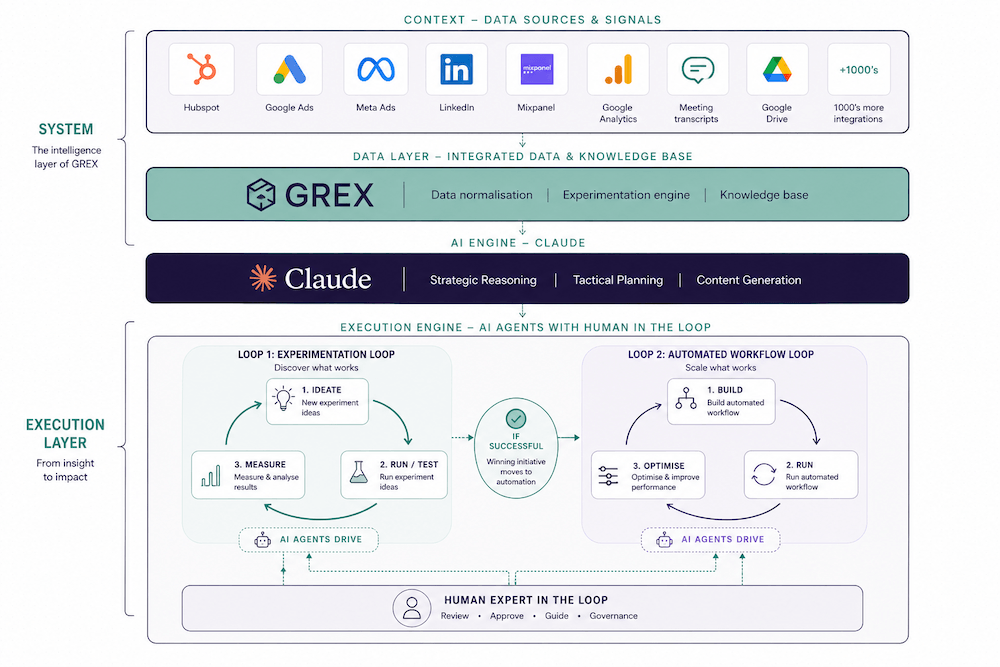
GREX is the AI data layer in your martech stack, but crucially, its ‘knowledge’ extends beyond your own data set. And that’s because it’s trained on our own growth experiment logs, meaning GREX has been trained on over 1,300 startup experiments to date, and counting.
Every recommendation GREX makes is grounded in data from experiments carried out by channel experts, but personalised to your own startup’s performance, ICP, and goals. It’s designed to generate smart, personalised ideas, and to keep everyone in your team accountable (and our Claude connector is launching soon!). Learn more about GREX.
Your martech stack should be working with you, not against you. If you’d like to discuss how Growth Division can help streamline your martech stack, assemble a fractional growth team, and find scalable channels, book a short disco call today. You can also read our Clutch reviews to get a sense of how we’ve helped other startups like yours.



.png)
.png)