Why Startup Marketers Aren’t Happy With Their Growth Experimentation Process (and How We Fixed It)
There is a wild disconnect between the number of startups that believe in the concept of growth marketing and running experiments, and the number that are actually doing it well. The system is stacked against them - here's how we fixed it.

There is a wild disconnect between the number of startups that believe in the concept of growth marketing and running experiments, and the number that are actually doing it well.
So often, I see real experimentation get watered down to: ‘let’s give Reddit a go!’, or ‘let’s try posting a video!’.
And it’s not down to a lack of enthusiasm or understanding from startup growth leads; it’s because they have so many barriers to building a repeatable, useful growth experimentation process.
In this post, I’m going to unpack why startup marketers struggle with this according to our own research, first-hand experience, and many conversations with growth leaders and founders.
I’ll also outline the system we’ve honed at Growth Division, a growth marketing agency for startups, to make experimentation a core part of how we work with clients.
It’s relevant both if you’re curious about what it’s like to work together, but also if you’re looking for lessons to take back to your own marketing team. Let’s get into it.
📕 Up next: The Bullseye Framework Explained: Why Growth Division Follows This Framework
Where do startups lose their way with growth marketing?
Growth marketing is a data-driven and experiment-led approach to cracking your key marketing channels. It’s how new startups find traction, and established companies achieve dominance.
In fact, a Kameleoon survey found that 90% of high-performing companies say experimentation is critical to their success. This certainly tallies with my experience as a co-founder (of both a SaaS startup and an agency), and the conversations I’ve had with growth leaders at renowned companies like Airbnb and Uber; these companies got where they are by experimenting smartly and quickly.
The key detail to mention here is that Kameleoon only surveyed businesses with over 100 employees – and no doubt, entire growth teams dedicated to running these systemised experiments.
And that, of course, is the beginning of where startups struggle to replicate their success – but it’s not the whole story.
Your team setup is (probably) stacked against you
We started Growth Division because my co-founder and I saw a gap between the experiment-led success of these high-growth companies and what startups could realistically accomplish on their own.
It’s a gap we felt when growing our own startup, and something we’ve heard anecdotally from other founders over the years.
In our experience, startups either have:
- A one- or two-person generalist marketing team that doesn’t have the experience (or bandwidth) to experiment effectively and confidently across multiple channels, making it hard to draw meaningful conclusions about what does and doesn’t work.
- Or, they’re corralling a fractional and freelance team of channel experts, each with their own approach, processes, and timeframes. Syncing for team calls and onto one central platform just isn’t happening.
- Or, they’re working with an agency that wants to slot them into their own processes, and (understandably) play it safe. They’re afraid to fail, which goes against the whole growth marketing experimentation philosophy.
“I think it's very hard to find a marketing agency that is willing to help strategise the experimentation required in marketing. Most are competent at putting ads live and providing the metric, but Growth Division put the effort in to determine what ads were going to be most effective and adjusted as they learned more.” – Theo Inglis, Co-Founder of Housecure. Read the case study.
It’s deeper than the classic ‘no time and no money’ problem
Last year, when we surveyed 32 growth marketing startup leaders, only 15% said they were very satisfied with their implementation of a growth marketing process – despite 73% saying it was important or very important to their business.
Now, this statistic isn’t so surprising in isolation; I don’t know many people who would say they’re ‘very satisfied’ with anything, whether it’s their business or their breakfast.
But when we dug into why they felt this way, the answers were revealing. As it turns out, it’s the ‘process’ part that’s letting leaders and teams down – and not just because of the usual startup issues of lack of time and money:
- 45% of growth marketers cited ‘team aren’t educated on the process’ as the main blocker for getting their team to adopt a growth marketing process
- 54% of respondents agreed that reporting on results was an issue (with bandwidth playing a huge part here)
- 19% said they struggled to get enough leadership buy-in on growth marketing
- Only 25% said they were satisfied or very satisfied with their prioritisation process
Something I would add to this list, after looking in from the outside, is the inability to benchmark well.
When you’re in your own startup’s bubble, you can only evaluate results in relative terms. While it’s not healthy to obsess over another company’s strategy and numbers, I do believe it’s important to understand what ‘good’ looks like to other teams.

📕 Up next: The Exact Process I’ve Used to Choose the Marketing Channels for 200+ Startups
How we approach growth experimentation for our startup clients
We have made experimentation a cornerstone of how we work with startups at Growth Division because:
- We know it’s integral to a good, sustainable growth strategy
- We know it’s something they struggle to handle alone
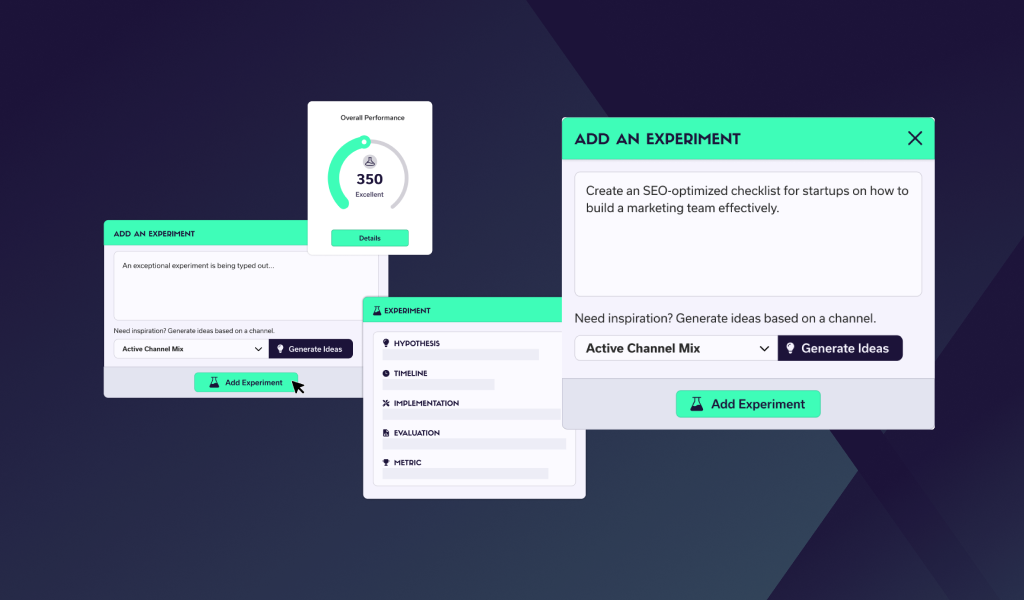
From growing our own startup to helping to grow over 130 since, we’ve worked out many of the classic kinks in the experimentation process (including creating our own tool that’s actually designed for ideating, tracking, and logging growth experiments, GREX AI).
Here’s how we run growth experiments for our clients. Hopefully, this gives you some ideas for how to run yours more smoothly, too.
1. We cement our stakeholder buy-in
Our clients generally come to us because they understand growth marketing and want an experiment-led approach, but we still include this line in their proposal to make sure we’re all on the same page:
“We will rapidly try lots of ideas. Please be patient while we unlock successful experiments and find a scalable channel to market.”
Each of our channel experts is also vetted for their growth mindset (something growth leads told us was one of their biggest blockers). In return, they’re given permission to fail, and freedom to try new things.
Visibility is key here, too – both for sharing insights between channel experts, and for giving our clients a bird's-eye view of what’s happening. If you’re running your own growth experimentation process, you absolutely need a central dashboard that becomes the focal point for team meetings and updates.
We use our own tool, GREX AI, which shows pending, current, and completed experiments in a kanban board. In your monthly Growth Review, every member of your Growth Division team will run through what experiments are in progress for their channel, any that have been completed, and any that are coming up next month.
During and after working together, you will have a clear log of past experiments and their results. You can filter by channel, date, the person who created the experiment, and more.
2. We create SMART experiments
An idea is not an experiment; it’s just the very first ingredient.
A proper experiment requires:
- A hypothesis (ideally a data-backed one)
- A clear variable (what will change – ideally only one thing)
- The target result, key metric, and the current baseline
- A clear timeframe
- The actual result
- A short analysis of why this did or didn’t work, and the next steps
Writing this up is not a quick step (although GREX AI does help cut it down), but it’s perhaps the most important one of all.
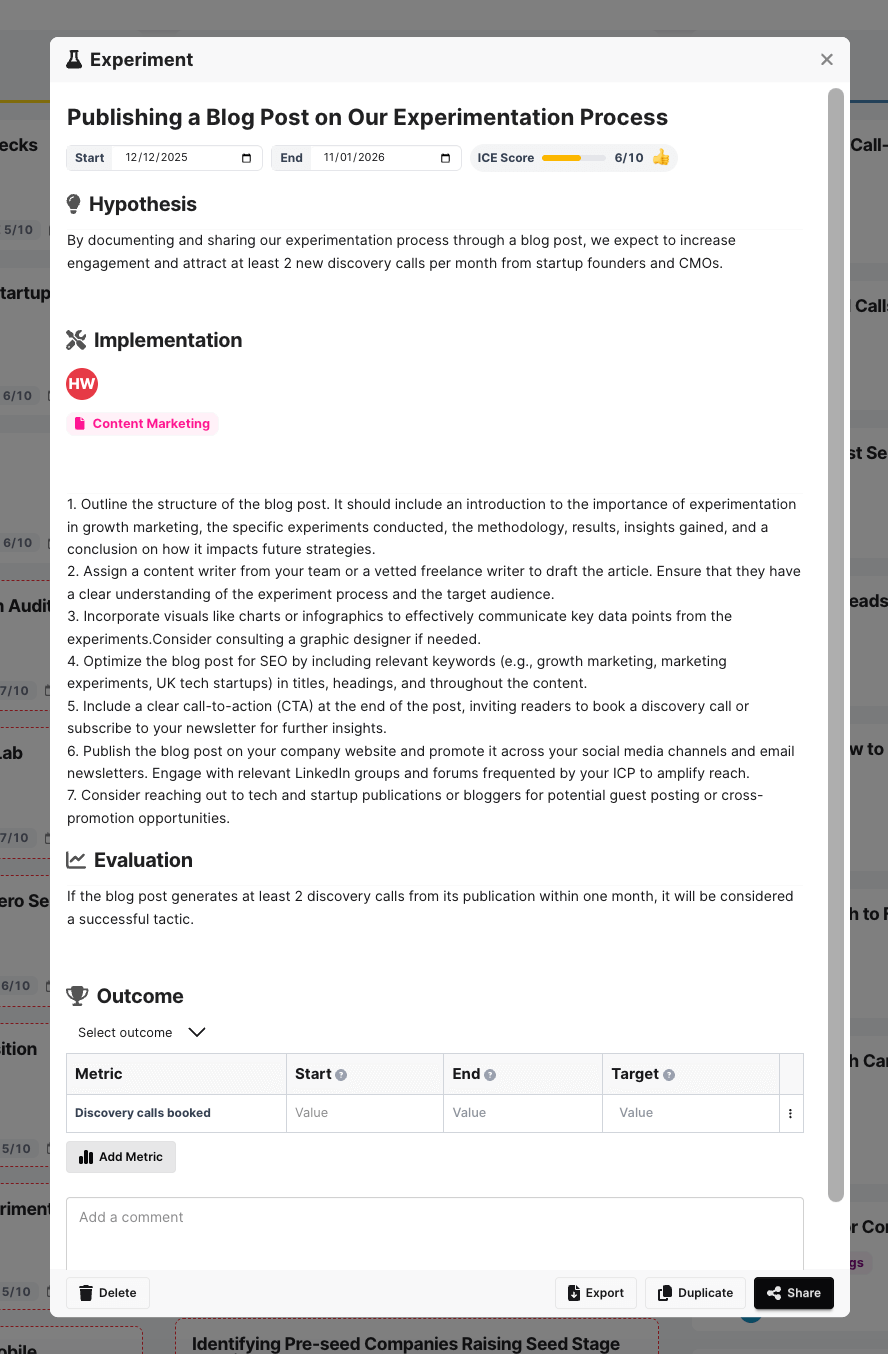
Only with a proper record of what was attempted, and what the result was, can teams build up a meaningful picture of what works for them – one that can be picked up and understood long in the future by people who weren’t involved in the process at the time.
Curious to see which experiments are moving the needle for our agency, and for our clients?
Subscribe to our newsletter, Thoughts on Growth. Every month, my co-founder and I take turns to share:
⭐ How we’re tracking against our own North Star Metric here at Growth Division
🎯 One growth channel insight
📖 One growth resource we rate
💡 One growth experiment we ran for ourselves or our clients, and the results
Subscribe to Thoughts on Growth
3. We prioritise carefully
Every startup marketing team has a ton of ideas for what to experiment with. In my experience (and according to the leaders we surveyed), ‘lack of ideas’ is very rarely the problem.
The problem is prioritisation. It’s the ability to look at a list of hundreds of potential ideas and cherry-pick the ones with the best chance of moving the needle.
I’ve seen the difference that having true channel experts on board makes at this stage.
Experts can spot patterns and bring across their own playbooks, insights, and relevant learnings from outside their industry.
With them on board, the conversation doesn’t start and end with “well, what ads is [major competitor] running?”, or trying to impersonate the viral tactics of those brands that always do the rounds on LinkedIn. They bring sharp insights and a trained ‘gut instinct’.
And this – alongside the high-quality execution – is exactly why we only work with dedicated channel managers at Growth Division. We have a vetted network of 80+ experts, independent professionals at the top of their game, that we can plug into new projects as needed.
There’s a reason only 25% of growth leaders were satisfied or very satisfied with their prioritisation process – and working with experts is the best way I know to fix that.
4. We document findings meticulously
Documentation is the final piece of the puzzle, but it’s one of the easiest to overlook. Your current team is focused on making an impact in the now; if an experiment fails, they’re hungry to push forward to find the gold.
Nearly half (48%) of leaders agreed that keeping a clear documentation or wiki of experiments is important (a percentage I personally think should be much higher), but in our one-on-one conversations with these leaders, we found that this is the task that’s most likely to slip through the net:
“I know I should be keeping a record of what I’m doing, but I just don’t have the time” is a sentiment that came up again and again.
Our channel experts write up the results of each experiment, no matter if it was a success or a failure. GREX AI makes it easy to see the baseline, target, and actual metrics for each one at a glance.
5. We go back to the top and do it all over again
When I first started practising growth marketing, I’d see a successful experiment as a box ticked. My internal monologue would go something like:
“Awesome! I understand what works for this channel now. Time to crack on with something different.”
But I quickly learned that one successful experiment is a signal to follow, rather than a goal completed. This is the key to building a growth experiment system where the impact compounds.
Growth Division’s channel experts are always pushing for better results for their channels, building and iterating upon every successful experiment to unlock even better results. Yes, we test quickly to find what works – but we don’t stop testing once we know what does.
Experimentation remains a part of your monthly cadence, no matter how long we’ve been working together.
“It's never been a case of 'oh it works great now', even with a channel campaign's success, the GD team are continuously looking to make the channels sing even better - it's a constant iteration environment which is in keeping with the Weavr culture and approach to all projects.” – Anna Carless, Head of Marketing at Weavr. Read the case study.

So in conclusion, our clients get:
✅ The ability to test marketing channels quickly and effectively with experts at the helm, and the flexibility to switch different channels in and out of the mix.
✅ Their own GREX AI board, with a kanban-style overview of the ideas bank, which experiments are in progress, and which have (and haven’t) been successful.
✅ Access to our AI growth marketing agent, GREX, who helps to ideate and prioritise experiments with your growth team, pulling in data from well over 1000 successful experiments we have run for other clients in the past.
✅ Monthly Growth Reviews to run through what’s being tested that month, and how current experiments are progressing.
✅ Day-to-day updates with their Growth Division team over Slack.
Next steps
If working with over 130 startups has taught me anything, it’s that systemised growth experimentation is not just a nice-to-have; it’s how startups shortcut some of those painful months of slow growth, and generate real traction.
It can be the difference between coming out top in your category and running out of runway before you even get the chance to show what you’re made of.
If your growth experimentation process isn’t where you’d like it to be right now, here are some questions to ask yourself:
- How can I get myself, my stakeholders, and my team invested in this process?
- How can I make it a central part of how we work, including finding a visual hub for recording everything?
- What experiments have we already tried that need documenting and iterating on?
- How can we challenge our idea of what ‘good’ looks like in each channel?
- What is a manageable experimentation cadence so we can build a consistent team habit?
Good ideas are important, yes – but a consistent, repeatable process is what will win out in the end.
Looking for advice on which marketing channels to test, and how? Let’s audit your marketing strategy together. We can explore your current channel selection, and look at some ideas of what to text next. Book your (free) 30-min call.



.png)
.png)