
“You’ll know it when you feel it”.
“Everything felt so much more effortless”.
“It just felt… right”.
Is it love, or is it product-market fit?
For some founders, product-market fit is a lightbulb moment, with everything finally slotting into place. In my experience, it’s often more gradual, until it isn’t – like a ball of snow tipping over the top of a hill and picking up momentum as it rolls down.
Either way, it’s famously hard to define. They say you’ll know it when you feel it, or if you have to ask, you haven’t got it… but what does it feel like? What signs can you expect? How do you know if you’re getting close? Where does it show up in your data?
The most common sign we talk about is the old 40% rule: “If 40% of users say they’d be very disappointed if they could no longer use your product, congrats, you’ve got PMF.” But who’s actually running that survey, and who actually knows what to do with the result?
Product-market fit is something we look for in potential clients here at Growth Division, our growth marketing agency. It’s in their best interest, and it’s in ours; big product changes and pivots can roll back the progress you make in marketing. It’s much better to ‘turn the tap on’ once you believe you have product-market fit.
Having spoken with many hundreds of founders, worked directly with over 130 here at Growth Division, and also co-founding two startups, here’s my take on what product-market fit actually looks and feels like.
Positive signs on the journey to product-market fit
The following points are great signals that you’re on the right path to product-market fit, but they don’t necessarily mean you’re there quite yet:
1. Landing your first paying customer
Lenny’s Podcast is a go-to for product and growth insights. At this point, Lenny Rachitsky, the host, has built up an amazing database of product info from some of the biggest B2B SaaS companies around. In this graph, he has plotted a few key milestones for over 20 of them:
- Live product
- First customer
- First feeling product-market fit

As you can see, in a few cases, product-market fit coincided with the first customer. In the vast majority, it didn’t. Generally, there is still work to be done even after that first (very important, very exciting) subscription. Some founders like to think they have PMF based on user growth, but if they’re not paying you anything, then it’s not a market.
You’ll also notice that the feeling of product-market fit never came before the first paying customer. I’ve worked with over 130 startups at this point, and this absolutely aligns with my experience. This is the natural order.
2. Positive product feedback from users
You should absolutely build a product that your future customers will love using. But most of us learn the hard way that enjoying a product and actually paying for it are two different things.
Great feedback is awesome – but it’s a positive signal, rather than the end of the road. If you’re a B2B SaaS product, consider who is paying for this (or signing off on this), and how they feel about it. Do they consider it indispensable? Do not confuse product-user fit with product-buyer fit, and don’t assume customers always tell you exactly what they want, either.
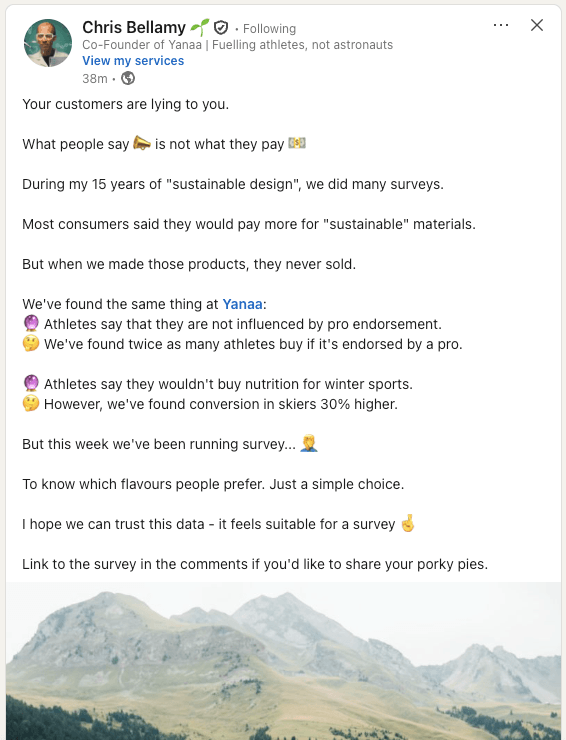
Chris Bellamy, co-founder of Yanaa, has called out a great potential example of a mismatch here: sustainability.
It’s something users say they value, but how many are willing to swallow the price increase it requires? Does it actually drive purchasing decisions for the average target user, or just make us feel better about buying an item – new skincare, a sleek electric toothbrush – that we already wanted for other reasons?
When it comes to your startup, I don’t have the answers. But you should be hellbent on finding them.
3. Free signups & demo bookings
See above. Being curious about a product, being open to hearing more about a product, even trying a product for free – all of these are different from actually paying for a product (and being in a position to pay for it).
How it feels when you have product-market fit
As a two-time founder (once B2B, once B2C), I have felt product-market fit in action, and I’ve also spoken to plenty of other founders about when and how they first felt it, too.
Here are the themes that often come up:
1. Demo calls become easier
You’re not left hanging with ‘maybe’ and ‘we’ll get back to you’. The conversation becomes: ‘How quickly can we get this moving’? As clichéd as it sounds, it’s the feeling that your product is selling itself.
I’ve noticed this starting to happen on demo calls for our growth marketing tool, GREX AI. What’s especially cool to see is that the people I’m speaking with on these calls are almost selling the product back to me before I’ve even finished my pitch.
2. Customers actively recommend your product
Not only are customers proactively reaching out to you, but you notice more people recommending your product organically. You can capture this info on signup, but you may well also notice it in mentions on social media, in communities, or on Reddit. You get DMs asking for early access. This is such a powerful inflection point for your business.
For B2C businesses, this may come with changes in how you interact with media outlets. Where it once felt like shouting into the void, you may find that opportunities start coming to you, rather than needing to go out and chase them.
3. Customers request new features
If your customers are actively requesting new features and products, and providing constructive feedback, this is a clear sign that they are invested in your brand or product and plan to stick around. If they’re happy to give you their card details upfront, then even better.
4. Customers stay for longer
For SaaS and subscription products, an increase in retention is generally a sign that you’ve achieved (or are getting closer to) product-market fit, especially when the cost of acquiring customers doesn’t also rise proportionately. For ecommerce brands or other types of businesses, there’ll be an equivalent metric, such as the proportion of returning customers.
Which metrics to track
There’s no one singular metric that definitively shows you have achieved product-market fit. That said, I recommend keeping an eye on the following as an indicator:
- Referrals. What percentage of your new customers came from a recommendation?
- Net Promoter Score (NPS). What percentage of your existing customers would actively recommend you?
- LTV/CAC. What is the lifetime value of a customer compared to the cost of getting them on board?
- Addressable market size. Is the market actually big enough? Just as it’s important to be clear about who your product is for, it’s also important that this leaves enough people to sell to.
Not there yet? Here’s how to get closer
The journey to product-market fit takes time, but it often isn’t linear. If you feel like progress has stagnated, it’s time to try one or a combination of these things:
1. Improve your understanding of the problem you’re trying to solve
Surveys are a quick way to gather customer insights, but they should be considered alongside other, more in-depth methods, which allow for more nuance.
I’ve heard of founders literally shadowing people who fit their ICP as they go about their job or complete a relevant task. If you can’t get this close, at least jump on a call and probe a bit more deeply into what you’re being told. The Jobs-to-be-done framework is definitely worth referring back to if you’re stuck.
Whether you’re asking questions in a survey or on a call, the infamous Henry Ford quote comes in handy here: ‘If I had asked people what they wanted, they would have said faster horses’. Use this research to become experts in the problem you’re trying to solve, and the people you’re trying to solve it for. Don’t use it to crowdsource solutions.
Don’t treat this as a ‘one and done’ task. Build a consistent and meaningful feedback loop into your planning – not just because problems change (they do), but because sometimes it only takes one throwaway comment for everything to click into place.
2. Improve how your product solves this problem
Your product shouldn’t be a nice-to-have; it should be something your customers feel they couldn’t do without once they’ve tried it. This is the standard to aim for.
3. Change the problem you are trying to solve (or who you’re solving it for)
No founder wants to hear this, but sometimes the reason you’re not getting product-market fit is simply that the problem you’re solving isn’t painful enough.
This may well mean pivoting your product in a significant way. This feels uncomfortable, but it’s a shift that many of today’s most successful startups have been through.
Naturally, it’s best to test this shift before committing to anything radical. An MVP product combined with direct channel marketing is the best way to do this.
Once you’ve found it? Here’s what comes next
The best way for me to describe product-market fit is the feeling of a pull, rather than like you’re pushing. Marketing truly becomes easy and enjoyable at this point. Now, it’s just a question of getting the word out to as many of them as possible: it’s time to turn the marketing tap on.
And that involves a big decision: how should you structure your marketing team? Should you go with an agency, with freelancers, or hire in-house? My co-founder, Tristan, has written a great guide to the pros and cons of each option. I’d also recommend exploring this guide to choosing your marketing channels if you’re approaching that stage.
If you’re starting to feel product-market fit and would like to discuss what comes next, book a no-obligation call with another senior member of the Growth Division team. We’re all current or former founders; we’ve been exactly where you are right now, and we always welcome the opportunity to pay forward all the advice we’ve received over the years. Book a 30-minute call here.



.png)
.png)