Key takeaways:
- An AI marketing operating system is an AI model that plans and executes marketing activities semi-autonomously. It makes strategic decisions based on the information it is fed initially, and the data it then receives on the impact of these activities.
- The AI focus for startups is shifting away from individual experimentation and content creation. Marketing teams are seeking ways to integrate AI as a system that can add real strategic value, as well as save time on execution.
- The issue early-stage startups have when building out these systems is a lack of data. Without a broad history of growth experiments, it takes the system longer to figure out the best activities to double down on.
Most businesses I talk to are using AI for content creation, and building individual agents. Essentially, as an efficiency tool rather than a strategic partner.
But I believe we’re approaching an inflection point. Founders and growth leads are looking to integrate AI more smartly into their marketing, not just to save time, but to add genuine value.
I’m the co-founder of Growth Division, a growth marketing agency for startups. We’ve been building our own AI marketing operating system that’s designed for early-stage businesses that aren’t quite ready to work with an agency.
In this post, I’m going to break down:
✅ What an AI marketing operating system is
✅ How ours works
✅ And how it changes the day-to-day running of your marketing operations
So, what is an AI marketing operating system?
An AI marketing operating system is an AI model that plans and executes marketing activities semi-autonomously. It makes strategic decisions based on the information it is fed initially, and the data it then receives on the impact of these activities. It’s something you can build in-house or use existing tools for.
Essentially, it lets AI do what it does best: follow the data. Instead of a bunch of laser-focused agents carrying out isolated tasks, you have a whole automated marketing system that’s constantly learning and adapting to the information it receives.
You know how people talked about ‘treating AI like an intern’? Running a good AI marketing operating system feels closer to having an actual marketing team on side, rather than just a tool designed to take orders.
What’s the difference between AI agents and an AI marketing operating system?
AI agents form a part of the overall operating system. Think of them as the hands, where other earlier stages act as the brain.
When acting outside of a system, agents can only carry out their hyper-specific task to your instructions, and not automatically evolve their activities in light of new information. They can’t take a broader strategic overview.
If you’re enjoying this post, you’ll love Thoughts on Growth, our monthly newsletter sharing:
⭐ How we’re tracking against our own North Star Metric here at Growth Division
🎯 One growth channel insight
📖 One growth resource we rate
💡 One growth experiment we ran for ourselves or our clients, and the results
The anatomy of a strong AI marketing operating system
Beyond having an ‘intelligence layer’ and an ‘execution layer’, there’s no one-size-fits-all for an AI marketing operating system.
We built GREX based on our experience of working with 130+ fast-growing startups, so it’s designed to work best for early-stage businesses that still need to experiment to find what works.
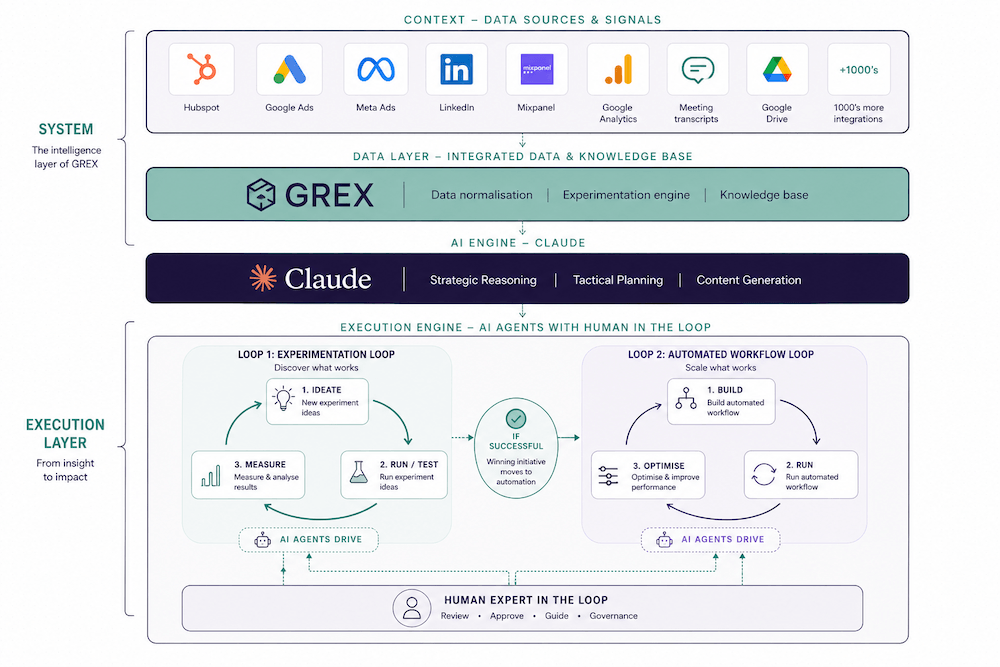
Let’s take a look at each section in more detail:
The intelligence layer
This first layer is all about organising data and context to make the outputs and actions as strong and on-brand as possible.
1. The context – data sources & signals
This is where we collect and plug in all of your existing data sources and marketing platforms.
Let me say now, in no uncertain terms: your AI marketing operating system will only be as strong as the data you’re able to give it. If your reporting feels like it’s working against you, and your martech stack feels generally bloated and unwieldy, fix these issues first.
📕 Up next: How to Integrate AI Into Your Martech Stack (and Why Most Startups Haven’t Yet)
2. The data layer & knowledge base
This is the section that really makes the difference, and means you’re only using AI (here, Claude) to make strategic marketing decisions once it has a rich understanding of your business, adapted for real-time.
Here, GREX is normalising the data and signals you’re feeding into the system, cleaning them and labelling them into something that can be understood and used by Claude in the next section. We collaborated with a CTO for this stage, but it is possible to code a solution yourself.
This is also where additional context about your business lives. You’d feed it a record of your past experiments, your objectives and North Star Metric, and the inside scoop on your competitors.
When building their own systems, startups would hit a problem at this point, as they don’t yet have a huge amount of data to go on.
That’s why GREX doesn’t just hold your own data; it also holds more generalised growth experimentation data. We’ve recorded over 1,300 growth experiments and their outcomes for various types of startups, and we fed this information to our data layer.
3. The AI engine: Claude
This is where AI steps in for strategic guidance. The data layer and knowledge base feed Claude, which develops marketing actions in line with the information it’s receiving, and also generates a first draft of any content required. We suggest Claude as a frontier model, but it's not required, and this layer can work with all AI models.
The execution layer
Now we’re in the execution layer, where different AI agents work to execute your day-to-day marketing activities. Many startup marketing teams are getting to the point of building AI agents (or at least, wanting to build AI agents), but without the intelligence layer, these rely on continuous input to do their job well.
4. Loop 1: Experimentation
We know that the only way for these teams to unlock significant growth is through carrying out rapid, structured growth experiments. With this in mind, we prioritised adding an extra step between the intelligence layer and the automated workflow step.
In this step, the instructions and any necessary content are provided by Claude, but the activity is set up as an experiment, rather than an ongoing automation. If the experiment is classified as a failure, the loop is designed to learn from the feedback and design a new iteration. If it’s successful, we move to the next stage.
5. Loop 2: Automation
Only when an experiment is successful does it then move into the second loop and become an automated part of the marketing activity.
Over time, you’ll build up a bank of these automated mini systems that are unique to your business and based on your successful experiments.
But again, the problem here is that early-stage businesses need good systems, but don’t yet have the data and volume to know exactly what these should be. So we have a library of proven systems, created by our channel experts, to get the ball rolling.
These experts have years of experience delivering results for startups. And we know because we’ve been working alongside them here at Growth Division.
Each expert writes up a playbook (detailing strategy & tactics), which forms the basis of the System (the method & process).
💡 Here’s an example of our Systems:
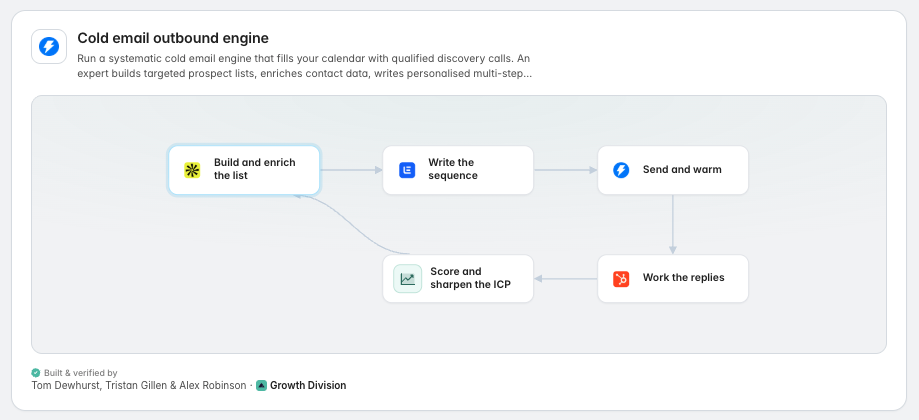
This is our cold email system, which is designed to fill your calendar with discovery calls on (almost) autopilot. It has 5 steps, involves 4 different tools, and 1 human checkpoint (signing off the list of contacts). See the full library of systems here.
6. Monitoring, reporting & learning
The results from these marketing activities feed back into the intelligence layer, meaning the system is continuously learning from what’s happening in real-time. This also means that you can see exactly which combination of activities is behind each conversion, or positive shift in metrics.
And an important caveat here: while the strategy and execution are somewhat automated, humans still play a critical role in the process. Each automated system includes a set number of checkpoints where human sign-off (in our case, by one of our expert channel managers) is required before the process goes any further.
📕 Up next: How We Use The Bullseye Framework to Validate Marketing Channels
Day-to-day life with an AI operating system that works
The most effective way to visualise how an AI operating system works is to picture how it would change your team’s day to day workload.
Most small startup marketing teams now:
- Your growth lead notices that a certain type of direct outreach message is getting a better response with one of your ICPs.
- At your weekly marketing meeting, they pass this information across to the freelancer who runs SEM.
- They agree to try it out, but suggest creating a landing page that’s more tailored to this new messaging.
- The growth lead prompts Claude to produce the copy and, after some back and forth, passes this across to the web designer.
- The web designer has capacity early next week to build the page, which they do.
- The founder signs off the page, and the growth lead passes it back to the SEM freelancer, who sets the new ads live.
The same team with a good AI operating system:
- The growth lead approves an A/B test pitting two distinct types of messaging against each other in direct outreach messages.
- When one comes back much stronger, they’re notified. After a quick discussion with the founder, they approve rolling out this messaging to SEM.
- A landing page is auto-generated in the brand’s style and tone that the growth lead can tweak as needed, along with the accompanying ad copy.
- The head of marketing is invited to sign off before this is set live.
A word on human oversight
‘AI only works well when combined with human oversight’ is something we’ve all heard as part of the ongoing discourse on the role of AI.
But I actually think that, in a system like this one, AI and humans bring distinct strengths.
Speed is the obvious AI strength, yes, but it’s not the only one. But feed it enough data, and its insights also start to outweigh our own; it can spot patterns before us, and can also stop us from latching on to false positives or negatives.
But having expert channel managers in the mix still matters, and it’s ultimately still what makes the difference. They’re the ones who can actually think outside the box and make the call to zig instead of zag. Their well-trained guts can’t easily be replicated.
Automate what you can, but leave room for things that don’t scale
And a final word of advice for early-stage founders: leave space for things that don’t scale.
It’s smart to automate what you can, but you can’t outcode the value that comes from actually getting involved with your audience and talking to your potential customers.
AI is a powerful tool, but it can’t feel product-market fit kicking in. And it’s no substitute for you – human, IRL, you – doing everything you can to win over those first customers, and then doing everything you can to keep them happy.
So, follow the legendary advice of Paul Graham, which still stands strong 13 years after publishing: do things that don’t scale.
Flyer outside the conference, run the breakfast event, start the Strava community, book the customer call or send the letter. When AI is used well for marketing, it should free you up to do more of exactly this type of activity: the meaningful, gritty, unscalable kind.
🎯 If your startup’s marketing is at a crossroads and you’re debating your options (agency? freelancers? in-house?) and wondering how AI could/should fit into it all, let’s talk. Book a call with my co-founder here.



.png)
.png)