Pre-Launch Startup Marketing: 8 Ways to Start Experimenting
Your startup's launch day is when the real learning begins, so it doesn't make sense to bring in a marketing agency at this point (it will make the inevitable pivoting more difficult). But there's plenty you can start testing on your own. Here's my pre-launch marketing advice.


Key takeaways
- Your launch day is when the real learning begins. Your product will probably change a lot after this point; 81% of founders pivot at least once.
- It doesn’t make sense to bring in a marketing agency before this point. There’s still too much to learn. You want to stay agile and avoid sunk cost fallacy.
- There’s plenty you can test yourself in the meantime. Use existing AI skills and systems to free up your time for things that don’t scale.
I speak to a lot of first-time founders who are approaching their startup’s launch day.
They’re in a haze of product perfecting and buzz building, and they’re full of hope. I know they’re picturing that spike in traffic, the ding ding ding of orders or sign-ups, the relief, the joy, the champagne popping. I’ve been there, too.
But a startup launch is not a book launch. This is not the day you send your finished product out into the world to find its fate, come what may. In many ways, it’s really day one; you’ll most likely come out of it with a longer list of bugs than customers. This is normal.
And that’s why the vast majority of startups shouldn’t work with Growth Division, or any marketing agency, at this point. Here’s my advice on how to approach marketing your pre-launch startup instead.
Going from 0-1: My pre-launch marketing advice
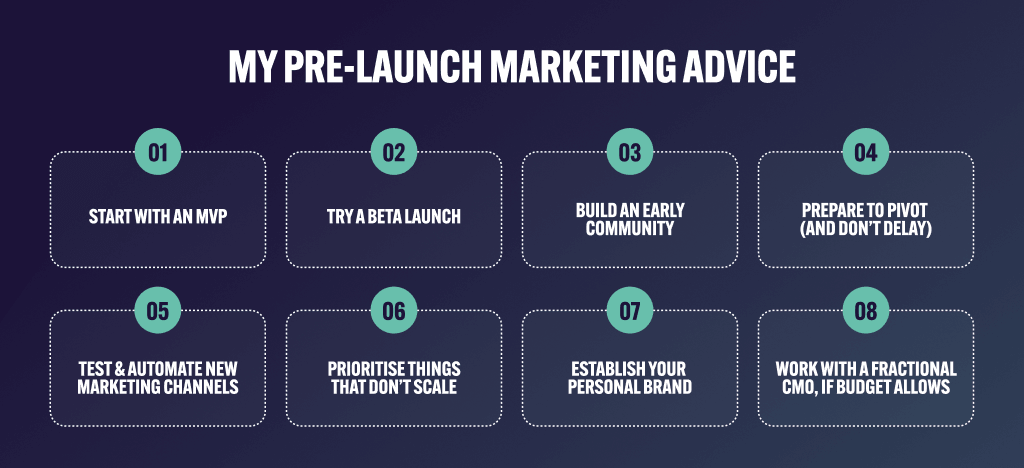
1. Start with an MVP
Your most important ‘research’ only happens once you have launched the product. It’s almost impossible to really understand whether you have product-market fit before this point.
The attitude-behaviour gap
That’s partly because people don’t always know what they actually want or need before it appears. Or they may overestimate how important something is to them; aka, the attitude-behaviour gap.
Sustainability is a classic example. If you asked the average person, ‘Is a sustainable lifestyle important to you?’, the vast majority (this survey has it at 78%) would say, “Of course!”. But real purchasing decisions don’t reflect this; a much lower percentage are actually willing to foot the higher bill that comes with sustainable production methods.
The new category struggle
The other problem? People don’t know what they don’t know, which is a problem if you’re creating a truly new category. Like Henry Ford’s famous quote in relation to cars – “if I had asked people what they wanted, they would have said faster horses” – the real insights come when there’s a baseline to build from. When your product actually exists, and your customers can say: “Now can you make it do xyz?”.
You only find this out once the product is live and you can gather real feedback about who is using it, how they’re using it, and why they’re using it (or, as importantly, why they aren’t). If you need to pivot (which is almost inevitable – see point 4), starting with an MVP means you’ll have more budget left in the tank, and more flexibility to revert on what you’ve already done.
2. Try a beta launch
Framing your launch as a ‘beta launch’ or ‘limited run’ has a double benefit; it helps to manage expectations (beta launch = work in progress), and it also builds buzz and a feeling of exclusivity and urgency.
💡 This is also the approach we took when launching GREX this year. Instead of waiting for the product to be perfect before launching, we sought out 10 design partners to help us trial the platform in its beta stage in exchange for detailed feedback. This process is ongoing, but the feedback has already helped us shape the platform into something even more useful.
3. Build an early community
Start building a real community before your product launches. And no, not just a standard social media presence; you want something that gives you more immediate two-way conversation.
💡 Before recently launching the women’s supplement brand DIZZY, founder Claudia Bickers had a WhatsApp group of 60 women who shared their health experiences and desires, and ultimately helped shape the flagship product. By launch day, she had 200 people on her sign-up list, with no paid ad spend.
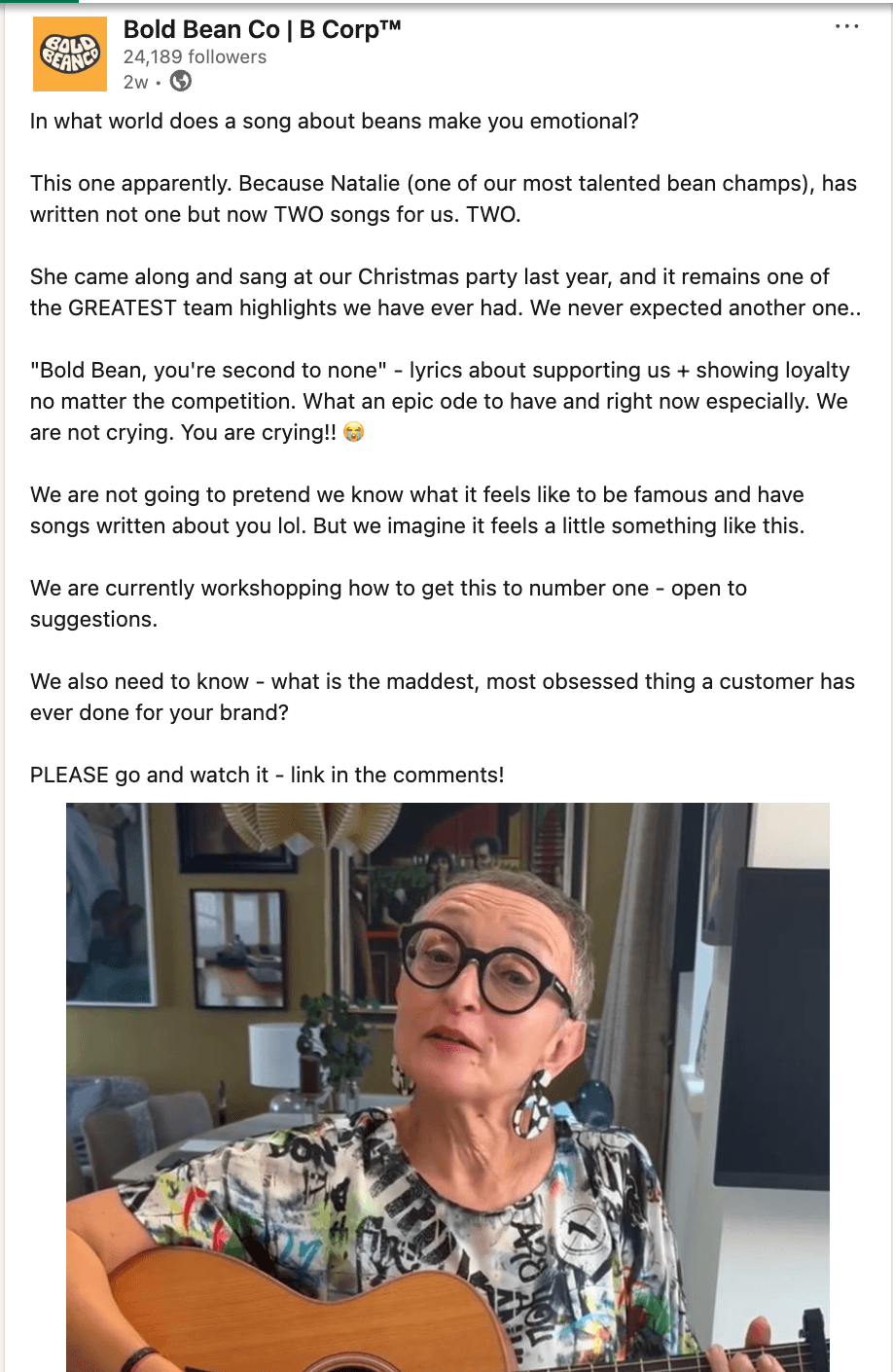
💡 Bold Bean Co.’s founder, Amelia Christie-Miller, was sharing beany recipes on an Instagram page long before her first product hit the jars. And community is something the brand continues to do brilliantly today: they have a Facebook group for bean lovers to exchange recipes, and a list of ‘Bean Champs’ who are top of their gifting list. They even featured a selection of community recipes in their bestselling second cookbook, Full of Beans.
💡 When we worked with sportswear brand Presca, their Strava community was a huge part of their brand awareness strategy from the start. The word ‘community’ gets thrown around a lot, but this really feels like one, with ‘kudos’ flowing freely, bonkers challenges embraced with enthusiasm, and plenty of in-person meet-ups, too.
4. Prepare to pivot (and don’t delay)
81% of founders pivoted from their original idea at least once, and 42% wish they had done it sooner.
None of us is immune to the Sunk Cost Fallacy; the more you’ve put into your original idea, emotionally and financially, the harder it is to make the call to change direction. But avoiding doing so can quickly eat up precious runway. A leaner pre-launch allows you to learn and change without it feeling like a huge loss.
💡 This is something we had to put into practice ourselves this year. Our first growth experiment tool, GrowthEX, was getting great feedback, but clients wanted it to do more. They wanted something that actually linked up with their reporting, rather than becoming another platform to update. And so, we shifted our focus to the second iteration: GREX AI.
5. Test and automate new marketing channels
As an early-stage founder, testing new marketing channels inevitably falls to you. And while you won’t be able to run these channels as well as an expert, you can test the waters and get a sense of what’s worth investing in later.
AI tools and systems can really help you here. When we founded our first startup 10 years ago, Tom and I were scrabbling around testing marketing channels with no real knowledge of how some of them worked. We made progress, but it was scrappy. As soon as we were in a position to, we hired freelance experts instead.
Today’s founders have existing, proven AI systems and skills to use. This is the idea behind GREX; the platform learns from your own data, but has a library of automated marketing systems to get started with, developed in partnership with our experienced channel experts. It’s a great way to bridge that painful pre-funding period before it’s right to hire in-house or bring in an agency.
📕 Up next: The Exact Process I’ve Used to Choose the Marketing Channels for 200+ Startups
6. Prioritise things that don’t scale
The beauty of being able to automate more of your marketing at this stage is that it buys you back time to do things that don’t scale. This is a drum I refuse to stop banging.
Things that don’t scale might include:
- Going to (and hosting) in-person events
- Interacting with a real community of potential users (a Slack group, Facebook or WhatsApp group) where you don’t sell, you just listen.
- Flyering!
- Guerrilla marketing: giving out free samples, flash mobs, holding out cardboard signs
- Reconnecting with people in your existing network
- Ask for referrals from people who are connected to your ideal audience
7. Establish your personal brand
Stories stick. You’re already in the thick of yours, so don’t wait to start sharing it. Commit to building in public, including the mistakes, the messy parts, and the changes in direction. Your product may change, but your own brand is evergreen.
An established personal brand is something investors are actively looking for, too. Carve out the time to post on LinkedIn, and don’t overthink it; experiment, see what resonates, learn how to write better hooks. Have fun with it!
Like so much of startup life, it’s so important to not let the planning get in the way of the starting and the doing.
8. Work with a Fractional CMO, if budget allows
You don’t need a marketing agency, and you probably don’t want to commit to a full-time hire just yet. But a Fractional CMO who’s prepared to roll up their sleeves? This can absolutely be worth spending money on.
Be careful, though: lots of Fractional CMOs are true to what they should be, and they are purely strategic and team management specialists; they don’t run actual campaigns. You need to find someone who is a generalist marketer who is ready to get their hands dirty and do the work. As a rule, during the scaling phase, we are against bringing in a generalist. But at the launch phase, it can be the exact resource that is needed.
💡 We started working with NOAN, an AI-native workspace for high-growth companies, when the company was still in the pre-seed stage. It wasn’t the right time for a full team, but being paired with AI-native growth strategist Andy Masson helped NOAN grow new trial activations by 400% in just 6 months.
📕 Up next: Navigating the Wild West of Fractional CMOs
Going from 1-100: Marketing after your launch day
In the period after launching, you’ll most likely:
- Start to feel product-market fit, or understand what needs to change to make that happen
- Have some understanding of which marketing channels are likely to work for your brand, but not yet have experimented much with them
- Be hitting a ceiling in what you can achieve yourself with your marketing channels
At this point, many businesses start looking for their first generalist marketing hire, with a job title like ‘Marketing Manager’ or ‘Growth Lead’.
It’s a logical next step, but it’s not what I’d recommend for a startup at this stage because:
- You’re still working out which channels work best for your brand. One marketer can’t be an expert in all channels, so you can end up in a situation where you’re running a bunch of different ones half-heartedly, spreading yourself too thin, and not able to draw real conclusions about which channels actually work for your business.
- Working with channel experts is a shortcut to results. Rapid growth experimentation is the best way to unlock sustainable growth as a startup. Working with an expert who has deep expertise in each channel is the best way we’ve found to shortcut the painful learning phase and get good results more quickly.
- You need flexibility. The beauty of working with fractional and freelance experts is that you can easily cut what isn’t working and scale up what is. Hiring doesn’t come with the same flexibility.
🎯 Working with freelance channel experts at the right moment for our first startup was the best investment we ever made, and it was this journey that inspired us to set up Growth Division. We assemble flexible, fractional growth teams and use the Bullseye Framework to uncover your most effective marketing channels. Book a short discovery call to find out more.



.png)
.png)