Top 7 Growth Marketing Agencies for Startups in 2026
Choosing a growth marketing agency is a highly strategic decision. Get it right, and you compress years of learning into months, but get it wrong, and you lose time, money, and confidence.
Before getting into the list, one important thing to note is that no list like this is ever truly objective, especially when it includes our own company. This isn’t an attempt to crown a single “best” agency. Instead, it’s a practical attempt to map which agencies are genuinely well-regarded in the startup ecosystem, and what types of companies they tend to work best for.
These are the names I consistently hear positive feedback from founders, operators, and investors. Some we know well, some we don’t, but all have clear strengths and potential trade-offs. The right choice will depend entirely on your stage, goals, budget, and risk tolerance. Hopefully, this helps you narrow the field faster and make a more informed decision.

By Tom Dewhurst, Co-founder, Growth Division · Updated October 2026
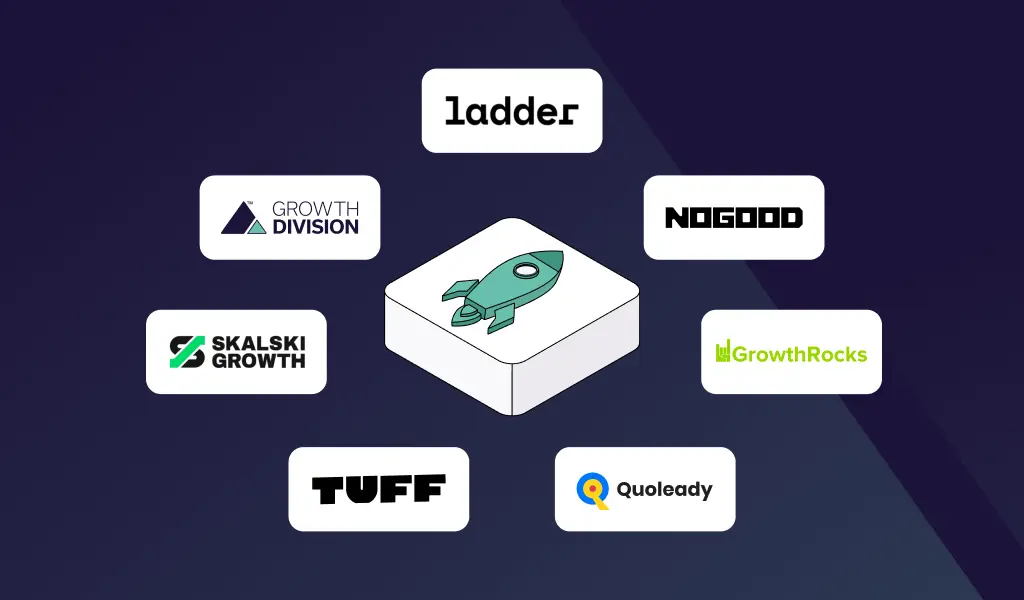
Short answer: pick the growth marketing agency whose specialism matches your bottleneck. For finding which channels to invest in, choose Growth Division. For scaling paid acquisition and performance creative, choose Ladder. For brand-led, full-funnel creative and performance, choose NoGood. For product-led growth (activation, onboarding, referrals), choose GrowthRocks. For SEO and visibility in AI answers, choose Quoleady. For consistent execution of a strategy you've already validated, choose Tuff. For analytics, attribution and martech, choose Skalski Growth.
Disclosure: Growth Division is our agency. It's listed first for transparency, not as a ranking. No agency paid to be included.
There's no single best growth marketing agency. The useful question is "best at what?" This shortlist sorts seven agencies by what each does best. If you'd rather choose by funding stage, see our guide to the best growth agencies for startups.
How we compiled this list
- Agencies we've worked alongside or competed with across 130+ startup and scale-up engagements since 2019.
- Agencies recommended by clients and peers when they were building their own shortlists.
- Each agency's own site, public case studies and pricing pages, checked October 2026. We only repeat what an agency says about itself. Where pricing isn't public, we say "On request".
- Inclusion criteria: works with startups, has a clear specialism or method, and is explicit about who it isn't for.
What to look for
- Name your bottleneck first. Is it "we don't know which channel works", "paid has stalled", "our data is a mess" or "we need someone to execute"? Each points to a different agency.
- Check the agency's own "not for" list. Good agencies turn work away. If they say yes to everything, they'll default to what they sell.
- Specialist or multi-channel? A specialist goes deeper on one channel. A multi-channel team helps when you haven't proven a channel yet.
- Ask how they'll prove it's working within 90 days, and against which single metric.
Compare the shortlist at a glance
| Agency | Specialism | Best-fit client | HQ | Starting price |
|---|---|---|---|---|
| Growth Division | Channel discovery and structured experimentation | Seed and Series A founders without a senior marketer | London | £4,000/month (+VAT) |
| Ladder | Paid acquisition and performance creative testing | Consumer, fintech and marketplace startups with meaningful paid budgets | New York | $10,000 minimum project |
| NoGood | Brand-led, full-funnel creative and performance squads | DTC, consumer, healthcare and fintech companies with strong PMF | New York | ~$20,000/month (average retainer) |
| GrowthRocks | Product-led growth experiments: activation, onboarding, referrals | Product-led companies with founders close to growth | On request | |
| Quoleady | SEO and AI-search (LLM) content for SaaS | B2B SaaS, seed to Series B, with a long-term inbound bet | On request | |
| Tuff | Embedded execution of validated strategy, especially paid | E-commerce and B2B startups, seed to Series B, scaling paid | On request | |
| Skalski Growth | Analytics, attribution and martech with performance marketing | Data-conscious founders, seed to Series B, often multi-market | On request |
1. Growth Division: best for finding which channels deserve investment
Tristan Gillen and I started Growth Division in 2019 after spending five years (2015–2019) building our own startup, Ordoo. We knew the budget and resource limits of that stage, and we saw most startups experiment randomly, hire too early or over-invest in one channel before it's proven. Our model is built to stop that: a Growth Strategist uses the Bullseye Framework to pick 3–6 channels to test, runs structured experiments, and scales the winners through a network of 80+ vetted freelance channel experts.
We work as an embedded growth partner, not a traditional agency. Every experiment becomes a documented learning, so decisions move from founder intuition to evidence. Delivery runs on GREX AI, our growth operating system, with a named senior person reviewing all AI output. We report weekly against a North Star Metric.
At a glance - Website: https://growth-division.com/ - HQ: Clerkenworks, 40 Bowling Green Lane, London EC1R 0NE - Specialisms: channel-agnostic growth strategy (Bullseye Framework), structured experimentation, Growth Strategist plus channel experts, GREX AI - Best-fit client: seed and Series A startups without a senior marketing leader, building their first real growth engine, where hiring in-house feels premature - Pricing: transparent retainer, typically £4,000–£9,000 (+VAT) a month for 3–6 channels - Proof: Weavr (4 channels validated, 35x ROAS on search, 390+ MQLs in 12 months); Optic (Google Ads CPL from $70 to $10, daily signups tripled); Addland (CPAs down an average 26.5% a month while paid spend scaled 11x) - Not a fit if: you already know your top 1–2 channels and only want execution, you're optimising at scale rather than discovering what works, or you want guarantees instead of insight.
2. Ladder: best for scaling paid acquisition and performance creative
Ladder was built on the idea that growth teams can't rely on static plans in fast-moving markets. Its adaptive growth team changes month to month based on live performance data, with continuous testing across acquisition, conversion, retention and creative. Internal systems and AI tooling pull performance data together to decide what to test next. It has run this model for startups and large brands, with a strong bias to performance-led execution.
At a glance - Website: https://ladder.io/ - HQ: New York - Specialisms: high-velocity paid media testing, performance creative iteration, conversion optimisation, AI-assisted test prioritisation - Best-fit client: seed to growth-stage consumer, fintech and marketplace startups with meaningful paid budgets, where creative fatigue is the bottleneck and speed matters more than exploration - Pricing: minimum project $10,000 - Not a fit if: you're unsure paid should be a core channel, your budget limits testing velocity, or you want a slower, system-first approach.
3. NoGood: best for brand-led, full-funnel creative and performance
NoGood positions itself against the traditional agency model. Instead of fixed services or channel retainers, it builds a bespoke growth squad around each client's problem, blending performance marketing, content, creative and analytics into one team. Its work sits where creative quality and performance results are closely linked, across startups, scale-ups and enterprises in consumer, DTC and tech categories.
At a glance - Website: https://nogood.io/ - HQ: New York - Specialisms: integrated brand, creative and performance; full-funnel experiments where storytelling matters; multi-disciplinary squads - Best-fit client: DTC companies and consumer, healthcare and fintech brands scaling with strong product-market fit, where brand perception affects acquisition cost - Pricing: average retainer $20,000+ a month - Not a fit if: you're very early and still validating fundamentals, you need narrow channel-specific expertise, or your budget is tight.
4. GrowthRocks: best for product-led growth experiments
GrowthRocks came out of the early growth hacking movement. It positioned itself away from digital marketing generalists and towards multi-specialist growth hackers who combine technical, product and marketing skills. Building its own VC-backed SaaS product, Viral Loops, shaped its focus on referral mechanics and growth loops. It favours speed, learning through experiments and product-led thinking over fixed marketing plans.
At a glance - Website: https://growthrocks.com/ - HQ: - Specialisms: fast experimentation sprints, activation and onboarding, referral programmes, growth hacking training for teams - Best-fit client: Series B startups and product-led companies where the product is the main growth driver and founders want momentum quickly - Pricing: On request - Not a fit if: you need a long-term operating system, deep specialism in one channel or deeply embedded delivery.
5. Quoleady: best for SEO and visibility in AI answers for SaaS
Quoleady helps SaaS companies grow through content-led acquisition. It combines traditional SEO with LLM-focused optimisation, so content targets both search engines and AI tools such as Google AI Overviews. It treats content as research rather than volume: topic and prompt research, authority signals, content production, digital PR and performance tracking, aimed at inbound demand that compounds over time.
At a glance - Website: https://www.quoleady.com/ - HQ: - Specialisms: SEO and LLM-first content strategy, high-intent inbound content, digital PR, optimisation for Google and AI answer engines - Best-fit client: B2B SaaS startups, seed to Series B, where inbound is a core go-to-market bet and the founder has a long-term horizon - Pricing: On request - Not a fit if: you need pipeline now, your ICP and messaging aren't clear yet, or you want multi-channel experimentation.
6. Tuff: best for consistent execution once your direction is clear
Tuff is built on the idea that growth is a process you design. It works as an expert-led, on-demand growth team that plugs into a business like an internal partner, for companies that want traction without building a full in-house function too early. The emphasis is on research, prioritisation and disciplined execution, with clear reporting on what's working, what isn't and why.
At a glance - Website: https://tuffgrowth.com/ - HQ: - Specialisms: executing validated growth strategies, continuous testing and optimisation, acting as an extension of in-house teams - Best-fit client: e-commerce and B2B startups, seed to Series B, scaling paid channels that already work, where direction is clear but execution lags - Pricing: On request - Not a fit if: you're still working out your growth model, you need strategic discovery, or budget limits how much execution you can buy.
7. Skalski Growth: best for analytics, attribution and martech
Skalski Growth starts from the view that growth stalls less because products are weak and more because teams lack a joined-up growth stack and clear ownership. It works as a plug-in growth team, combining performance marketing with analytics, funnels and martech so decisions rest on data you can trust. Its work often extends into how teams operate, with a focus on capabilities that last beyond the engagement, including international and multi-market growth.
At a glance - Website: https://skalskigrowth.com/ - HQ: - Specialisms: analytics and attribution foundations, performance marketing, martech, multi-market growth - Best-fit client: data-conscious founders and operators, seed to Series B, where untrusted data or attribution is blocking decisions - Pricing: On request - Not a fit if: you're pre-data or pre-PMF, creative is your main growth lever, or you need positioning or go-to-market discovery.
Which should you choose?
- If you don't know which channel to bet on → Growth Division.
- If paid works and creative fatigue is the bottleneck → Ladder.
- If brand perception drives your acquisition cost → NoGood.
- If the product is your growth engine → GrowthRocks.
- If inbound is your long-term bet and you can wait for it to compound → Quoleady.
- If you know the plan and just need it executed well → Tuff.
- If you can't trust your data or attribution → Skalski Growth.
FAQs
What does a growth marketing agency do for a startup?
It finds and scales the channels that bring customers, using experiments rather than a fixed plan. A good one tests several channels, measures each against one metric and cuts what doesn't work. A specialist agency does the same, but inside one channel or discipline.
How much does a marketing agency for startups cost in 2026?
Our retainer is typically £4,000–£9,000 (+VAT) a month for 3–6 channels. Ladder's minimum project is $10,000 and NoGood's average retainer is $20,000+ a month. GrowthRocks, Quoleady, Tuff and Skalski Growth price on request. Ad spend is almost always on top of the fee.
How do I vet a growth marketing agency?
Ask who will work on your account each week and how senior they are. Ask for a case study from a company at your stage and in your model (B2B, DTC, product-led). Ask what they'd tell you to stop doing. Read their own "not a fit" criteria: if they don't have any, be wary.
Should I hire a specialist agency or a multi-channel growth agency?
If you've proven a channel and need more from it, a specialist (paid, SEO, analytics) will go deeper. If you haven't proven a channel yet, a multi-channel team that tests several first is less risky. Many startups do both in sequence: discovery first, then a specialist to scale the winner.
When is a startup too early for a growth marketing agency?
If you don't have product-market fit, clear positioning or any data yet, most agencies on this list will tell you to wait. At that stage a strategy-only engagement or fractional advisor costs less and answers the questions that come first.
Not sure which channel to bet on? Book a free 1-hour Bullseye Strategy Session → /contact-us
Agency details checked October 2026 from each agency's own site and public listings. They change, so confirm before you sign.

.png)

.png)