Most startups don't fail because the product was bad. They fail because they raised money, brought on investors, were given crazy targets to hit and were forced to scale before they'd proven their product actually was needed in the market.
Startup Genome studied thousands of startups. It found that premature scaling hits 70% of the ones that fail. That means spending on growth before you know which channel actually converts.
Marketing is where that mistake usually starts. Founders either skip it entirely until revenue stalls, or throw budget at every channel at once and hope something sticks.
Both extremes come from the same root problem. Nobody wrote down who the buyer is, or what to say to them. Nobody defined how to know if a channel is actually working, either. That gap is what this guide fixes, one step at a time.
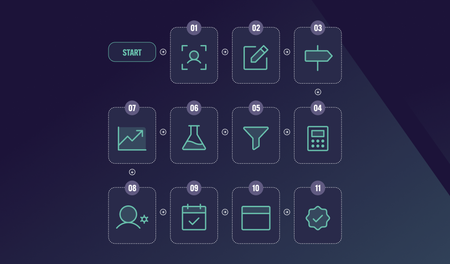
This guide walks through the essential steps instead. Work through them in order, and you'll have a real starting point rather than a scattered list of tactics.
None of this requires a big team or a big budget. It requires sequence, and the discipline to test before you commit real money to any single channel.
1. Get specific about who you're actually selling to
Vague targeting is the single biggest waste of early marketing budget. "Small businesses" or "developers" isn't an ICP, it's a category with thousands of different buyers inside it.
Write down the specific job title, company size, and trigger event that makes someone need you right now. A trigger event might be a recent funding round, a new hire, or a tool they just outgrew.
Talk to five customers who already bought from you, or five prospects who almost did. Ask what almost stopped them, and what finally convinced them.
That conversation usually reveals more than any amount of guessing. Update your ICP based on what you actually hear, not what you assumed going in.
Write it down as a one-page document, not a mental note. Include the buyer's title, company size, the tool they're likely replacing, and the trigger event that starts their search.
It also helps to name who you're not for. A negative ICP saves you from chasing leads that will never close. No budget fixes a lead that was never going to buy.
2. Write your positioning in one sentence
If you can't explain what you do and why it matters in one sentence, neither can your prospects. Long, hedged positioning statements are a sign the thinking isn't finished yet.
A useful format: "We help [specific buyer] do [specific outcome] without [specific pain]." Test it on someone outside your company, ideally with no context on what you build.
Watch their face, not just their words. Confusion shows up before it gets said out loud.
Revisit this sentence every time you enter a new market or add a major feature. Positioning drifts as the product grows, and nobody notices until messaging stops converting.
A quick sanity check: could a competitor say the exact same sentence about their own product? If so, it's not positioning yet, it's just a category description.
Push until the sentence names something only you can credibly claim. That's usually a specific outcome, a specific buyer, or a specific way you get there.
3. Map your go-to-market strategy before you touch a channel
Picking channels before you have a strategy is how budget disappears fast. A go-to-market strategy forces a harder question first. What's the fastest path to your first repeatable customer?
That answer looks different depending on your buyer. A self-serve product with a $50 price point needs volume and low-friction signup. An enterprise tool with a six-month sales cycle needs outbound and account-based targeting instead.
Write your strategy down before you spend a dollar. It should name your ICP, your core message, and your first two or three channels. It should also say how you'll know if it's working.
Two common motions cover most startups. Product-led growth relies on low-friction sign-up and in-product conversion. Sales-led growth relies on outbound and a human closing the deal.
Pick the motion that matches your price point and sales cycle, not the one that sounds more exciting. Most early-stage B2B companies default to sales-led until the product is self-explanatory enough to sell itself.
4. Set a budget you can actually defend
Founders often either underspend out of fear, or overspend chasing every new channel a competitor mentions. Neither approach gives you a clean read on what's working.
Start with what you can afford to lose testing, not what you hope will work. For context, a full fractional growth team typically costs $5,000 to $10,000 a month. A single channel specialist runs around $1,000 a month.
Those numbers give you a floor for comparison, whatever route you take. Whatever the number, split it across a small number of tests rather than one big bet.
Track spend against pipeline weekly, not quarterly. Early-stage budgets are too small to survive a quarter of silent underperformance before anyone notices.
A rough split for most early-stage teams: half on paid testing, a quarter on content, and a quarter held back. Keep that reserve free for whatever the first month of data tells you to double down on.
Adjust the split as soon as you have real numbers.
The most common budget mistake isn't overspending. It's spreading a small budget across too many channels, so none of them ever gets enough signal to prove itself.
5. Pick two or three channels to test first, not ten
Every channel looks promising when you've never actually run it. That's exactly why testing ten at once produces no useful data on any of them.
Choose based on where your ICP already spends attention, not what's trending. A few starting points worth considering:
- Cold outreach, when your buyer is identifiable and your sales cycle is long
- LinkedIn organic content, when your buyer is a decision-maker following the category
- Paid search, when buyers already search for a known solution category
- SEO and content, when the sales cycle is long enough to support a compounding channel
Pick two or three, not all four. Give each one enough budget and time to produce a real signal before judging it.
Resist the urge to add a fifth channel the moment week one looks slow. Most channels need three to six weeks before the data means anything, especially anything with a sales cycle attached.
That patience is hard for founders under investor pressure. It's also the difference between a real signal and a false negative you killed too early.
One channel worth adding to the list above: direct referrals from your existing network. It costs nothing to test.
A handful of founder-led intros can produce your first customers. That often happens while paid channels are still ramping up.
6. Run structured experiments, not random campaigns
A campaign that isn't structured as an experiment teaches you nothing if it fails. You need a hypothesis, a timeline, and a defined success metric before you launch anything.
Write the hypothesis in one sentence: "If we do X, we expect Y, because Z." That forces more clarity than "let's just try LinkedIn ads."
This is exactly the muscle behind running structured growth experiments instead of ad hoc marketing. Set a review date in advance, typically two to four weeks out, and commit to it.
At the review, kill what didn't work and double down on what did. Most early-stage teams keep underperforming channels alive out of sunk-cost thinking, not real data.
A failed test isn't wasted spend if you document why it failed. It's only wasted spend when you repeat it six months later, having forgotten you already ran it.
Log every experiment in one place, even the failed ones. A simple record covers four things:
- What you tested and why
- What you expected to happen
- What actually happened
- What you're changing next
That log becomes your team's institutional memory. Six months in, it stops you from re-testing an idea you already know doesn't work.
7. Put basic measurement in place before you spend
You can't run structured experiments without knowing what happened. Basic measurement doesn't need to be sophisticated, but it does need to exist before day one of any campaign.
At minimum, track these three things per channel:
- Cost per lead and cost per customer acquired
- Conversion rate from lead to opportunity to closed deal
- Time from first touch to closed revenue
A spreadsheet is fine at this stage. The goal is a clean enough view that you can compare channels honestly, not a dashboard built to impress investors.
Revisit these numbers weekly while you're still testing. Once a channel is proven, monthly tracking is usually enough to keep it healthy.
A spreadsheet works fine until you outgrow it, usually once you're running more than three or four channels at once. At that point, a lightweight CRM plus a free analytics tool covers most early-stage needs.
Watch out for vanity metrics creeping into your reporting. Website visits and social impressions feel good, but only pipeline and closed revenue actually tell you if something is working.
8. Decide who actually does the work
This is the step founders skip until they're already stretched too thin. Someone has to own execution, and "everyone" usually means no one does.
You have four real options: do it yourself, hire full-time, bring in an agency, or use a fractional team. Each one trades off speed, cost, and flexibility differently.
Doing it yourself works early, but it caps out fast once you need channel-specific skills you don't have. A full-time hire gives you dedicated focus. It also locks you into one skill set, after two to six months of hiring.
A traditional agency starts fast but often pushes whatever channel it specialises in, whether or not it fits your buyer. A fractional team, like Growth Division, our growth marketing agency, sits between those options. It pairs a strategist with channel experts who rotate based on what the data shows.
Weighing that decision in detail? This full-time versus fractional breakdown is worth reading before you commit. The right answer depends on your stage, budget, and existing in-house expertise.
A quick way to sort the four options:
- DIY: cheapest, slowest to scale, fine for the first few months
- Full-time hire: dedicated focus, but a two-to-six-month hiring process and a fixed skill set
- Agency: fast to start, but often biased toward whichever channel it sells
- Fractional team: senior judgment and channel flexibility, priced closer to a part-time salary than a full one
Most seed-stage founders start with DIY, then move to fractional once the first channel needs a specialist. Full-time hiring usually makes sense only once you know exactly which role you're hiring for.
There's no wrong starting point here, only a mismatch to avoid. Hiring a full-time specialist before you know your winning channel means hiring for the wrong skill set entirely.
9. Build a 90-day plan, then review it monthly
Put everything above into a single document covering the next 90 days. It should name your ICP, positioning, budget, channels, and the experiments you'll run first.
Break it into three-week sprints with a clear review point after each one. That cadence is tight enough to catch a failing channel before it burns through your budget.
At each monthly review, ask three questions. What worked, what didn't, and what are we testing next based on what we just learned?
Startups that treat marketing as a living plan outperform ones that set a strategy once and never revisit it. The plan is the discipline, not the document itself.
A simple way to phase the 90 days:
- Weeks 1 to 3: ICP, positioning, GTM strategy, and measurement setup
- Weeks 4 to 6: launch your first round of channel tests
- Weeks 7 to 9: kill what failed, extend what worked, add one new test
- Weeks 10 to 12: double down on the clearest winner and plan the next quarter
By week 12, you should know at least one channel that reliably produces pipeline. That's the real goal of the first 90 days, not perfect execution everywhere at once.
10. Don't turn on paid spend before the landing page is ready
Sending traffic to a weak page wastes every dollar you spend getting it there. This step gets skipped constantly, usually because it feels less urgent than picking a channel.
Your landing page needs three things: the positioning from step two, proof it's true, and one clear next action. Multiple competing calls to action confuse visitors and quietly kill conversion rate.
Test the page with five people who've never seen your product before. If they can't explain what you do after ten seconds, fix the page before you fix the channel.
That instinct is backed by real research, not just intuition. Nielsen Norman Group found that 79% of visitors scan a new page rather than reading it word for word.
A simple, fast page that says one thing clearly beats a polished page trying to say everything. Resist the urge to add more sections just because you can.
11. Start collecting proof from day one
Nobody trusts a startup's own claims about itself, no matter how well written the copy is. Third-party proof does the convincing that your own marketing copy can't.
That doesn't require dozens of case studies. Even three specific results carry more weight than a page of generic testimonials. A percentage improvement, a time saved, a problem solved, each is proof.
Ask for feedback right after a customer's first win, not months later. That's when the result is freshest in their mind, and when they're most willing to put it in writing.
Reuse that proof everywhere: your landing page, your outbound messages, your paid ad copy, and your sales deck. Early proof compounds, since each new piece makes the next customer's decision easier.
A short video testimonial, even filmed on a phone, usually outperforms a written quote. It's harder to fake, and prospects can see the reaction, not just read a polished sentence someone approved.
Getting started
You don't need to nail every step perfectly before moving to the next one. You need a defensible first answer for each, one you're willing to update once real data comes in.
None of these eleven steps requires a big budget or a large team. They require sequence: know your buyer, state your positioning, map your strategy. Then test in a structured way before you scale anything.
Proof and a working landing page make every other step convert better, so don't treat them as optional extras. They're the foundation the rest of this guide sits on.
Skip the sequence, and you risk becoming part of that 70% premature-scaling statistic. Follow it, and you'll know within weeks, not quarters, whether a channel is actually worth scaling.
That speed matters more than any single tactic in this guide. The startups that win their category early usually aren't the ones with the biggest budget. They're the ones that learned what worked the fastest, and committed to it first.
Want a Growth Strategist to build this plan with you? Start with a Bullseye Call. It's a structured conversation about your specific business, not a generic sales pitch.



.png)
.png)