Most startups that struggle to grow don't have a strategy problem. They have a team problem. And the team problem almost always comes from trying to solve a fractional challenge with a full-time answer.
Hiring a full-time Head of Growth sounds like the obvious move. But it locks you into one skill set. It takes four to nine months to reach real productivity. And it costs £80,000 to £115,000 a year before a single experiment runs. At seed stage, that's a serious amount of weight to carry before you know which channels actually work.
This post covers how to build a lean, expert growth team without that overhead. And how to run it in a way that produces real results.
Why full-time overhead doesn't work at early stage
The core problem with building a growth team on payroll is structural. Your best hire will be great at one or two channels. But you don't yet know which channels are going to work.
Growth at early stage is a discovery problem. You're running experiments to find where your customers are and what will move them. Locking into one skill set before answering those questions is like choosing a direction without a map.
The cost of getting it wrong compounds fast. According to the Society for Human Resource Management, a replacement hire costs one to two times the employee's annual salary. For an £85,000 Head of Growth, that's up to £170,000 gone before the next hire is seated.
Speed makes the problem worse. The average time to hire a senior marketer in the UK runs two to six months. Add two to three months of onboarding before they're running experiments independently.
That's a four to nine month window of slow, at exactly the stage when momentum matters most. Investors want traction data. They don't want updates about your recruitment process.
Fractional marketing leadership adoption grew 245% in the past two years.
What a lean fractional growth team looks like
A fractional growth team is not a loose collection of freelancers. Done well, it's a structured team with clear roles, a unified process, and a strategist who owns overall direction.
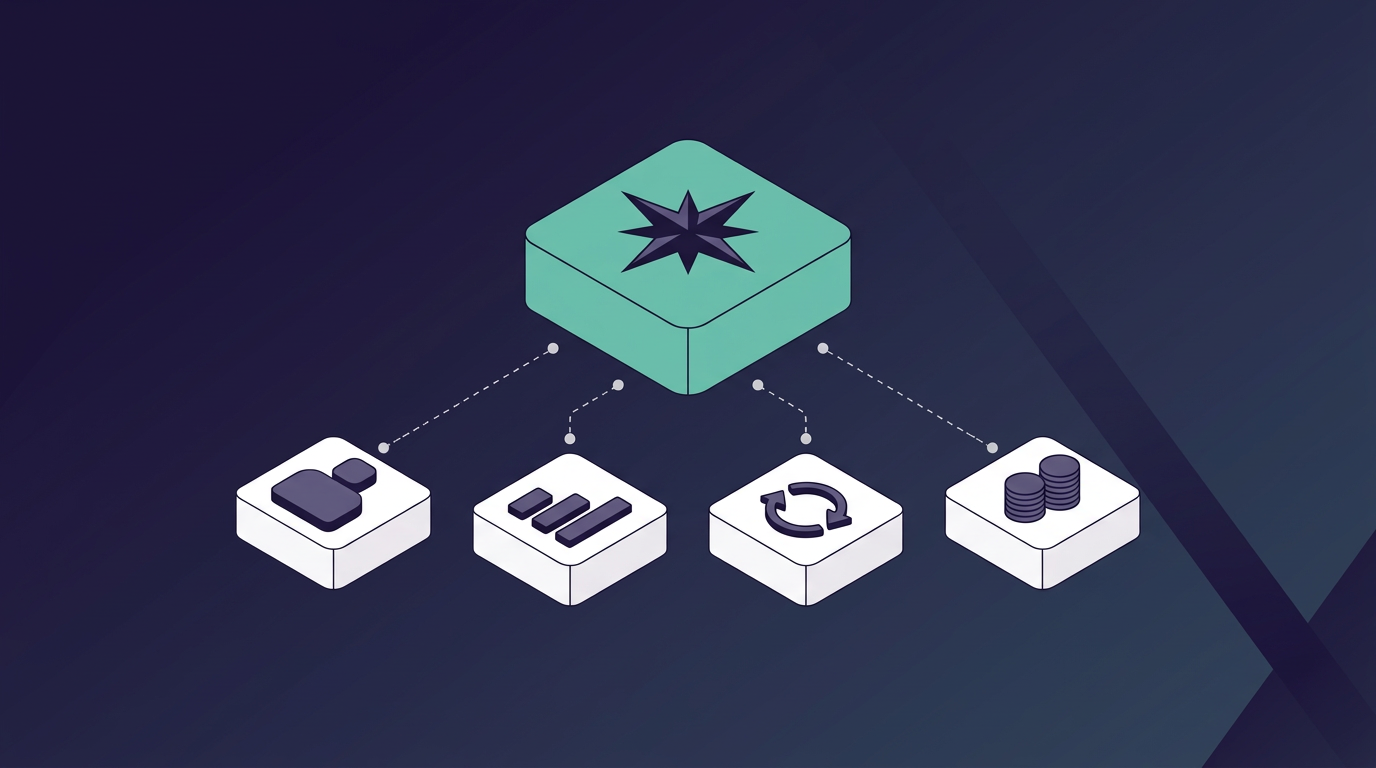
The three components you need are a Growth Strategist, channel specialists, and a shared operating system. Get all three right and the model outperforms a full-time team on speed, adaptability, and cost.
Most early-stage startups need one or two channel specialists, not five or six. The skill set changes as experiments produce data. That's exactly what makes the fractional model worth building.
Step 1: Define the roles you actually need
Before you hire anyone, fractional or otherwise, you need clarity on what the team has to do. That sounds obvious. But most founders skip it and end up with people doing adjacent tasks instead of the right ones.
At minimum, a growth team needs three functions covered: strategic direction, channel execution, and performance tracking. These don't all need to be separate people. But someone has to own each one explicitly.
The Growth Strategist is the most important role. They design experiments, select channels, and interpret data without bias toward any single channel. They're not a channel specialist pretending to be a strategist.
They run the whole process and adjust the team around results. This is the role most startups underinvest in. Without it, you get channel execution with no strategic layer above it.
Channel specialists sit underneath. They're experts in specific acquisition channels: paid search, SEO, content, outreach, or lifecycle email. They come in when experiments call for their skill set.
They step back when data shows a different channel needs more resources. This adaptability is the entire point. A fixed-headcount team can't do it.
Performance tracking is often handled by the strategist at early stage. As the team scales, it becomes its own role. But to start, the priority is making sure someone owns measurement, not just execution.
Step 2: Decide what to own versus what to outsource
Not everything should be fractional. Some tasks compound over time and benefit from staying close to the business. Others consistently outperform when brought in from outside.
Content and brand voice tend to compound. A person who builds deep product knowledge over 12 months produces better output. Rotating freelancers can't match that accumulation.
For content-heavy strategies, consider whether a part-time content person makes more sense than fractional. It depends on volume and how closely tied the content is to product and customer context. Fractional content works well for specialised formats; foundational brand content usually doesn't.
Channel execution and strategy are where fractional wins. A paid media expert running your Google Ads doesn't need to sit in your office. An SEO specialist building your keyword architecture doesn't need to be on payroll.
The rule of thumb: own what compounds, outsource what you can precisely specify. If you can write a clear brief for it, you can fractionalise it. If it requires a continuous institutional context to do well, keep it internal.
Step 3: Find and vet fractional experts properly
This is where most founders go wrong. Finding a fractional growth expert is easy. Finding a good one is harder than it looks.
The market is full of people who call themselves growth marketers. Most of them are channel executors, not strategic thinkers. Some are neither, but have enough confidence to position themselves as both.
The vetting framework that works has three parts:
- Past experiments, not past campaigns. Ask them to walk you through a specific experiment they ran, with a defined hypothesis, a timeline, and a success metric set before it started.
- References from high-ambiguity situations. Ask specifically: "Describe a time they got something wrong and how they handled it." That question tells you more than any case study.
- A structured brief, not just a portfolio review. Give them a real scenario and see how they approach the problem. You're looking for structured thinking, not polished presentations.
A good fractional expert explains what they expected, why, and what they changed based on the results. Listen for that structure. It tells you whether they're running experiments or just running campaigns.
Step 4: Build the process that holds the team together
For platforms, specialist marketplaces carry better vetting than open boards. Toptal vets the top 3% of marketing talent and runs a structured screening process before anyone reaches the platform. Contra is a newer option for independents building fractional portfolios.
But the most reliable route isn't a platform at all. It's working with a partner network that has done the vetting already. Built on years of real working relationships, not cold assessments.
Cold platforms optimise for supply. A curated network optimises for results. That distinction matters when the wrong hire costs you months of runway.
A fractional team without a shared process is just people working in parallel. The process is what turns parallel work into coordinated output.
The minimum viable process for a fractional growth team has four parts:
- A shared experiment backlog, where every proposed test has a brief with expected outcome, the reasoning behind it, and the success metric. Nothing enters the backlog without all three.
- A defined sprint cadence, usually monthly at early stage. Long enough to generate meaningful data, short enough to adapt before wasting budget.
- A weekly update format that keeps execution on track without creating meeting overhead. One shared update beats five separate check-ins.
- A kill threshold for each experiment, set before it starts. Define what failure looks like before you begin. If you hit the threshold, stop, document the learning, and move on.
The kill threshold is the most underused part of the process. Most teams move the goalposts when results disappoint. That destroys your ability to learn anything useful from the experiment.
That discipline keeps resources focused on what's generating signal. And it forces your team to think clearly about what they expect before they spend.
Step 5: Bring the right people in at the right time
The fractional model only delivers its full value if you actually adapt the team as data comes in. Most founders know this in theory. Fewer do it in practice because swapping out a specialist feels uncomfortable even when the results are clear.
Think of your channel mix as a live question, not a fixed answer. In the first three months, you're running experiments across several channels simultaneously. Paid, content, outreach, SEO.
You're not committing to any of them yet. The point is to generate signal, not to scale.
By month three to six, the data will have spoken. One or two channels will be outperforming the others. That's the point where you deepen your resource on what's working and pull back on what isn't.
This level of adaptability is structurally impossible with a full-time team. A full-time paid media hire doesn't gracefully step back when the data says SEO is the better bet. But a fractional specialist does, because the engagement is defined by the experiment, not the employment contract.
Step 6: Run the whole system with a proper operating system
Spreadsheets don't cut it once you're running multiple experiments across multiple channels with multiple specialists. The coordination overhead becomes the bottleneck. The strategist spends their time chasing updates instead of interpreting data.
A growth operating system replaces ad hoc coordination with a structured workflow. Experiments are tracked, hypotheses logged, and results visible to the full team. Next steps are clear without a three-email thread.
GREX is the operating system we built to run exactly this model. It includes AI-powered experiment generation, pre-built growth playbooks, sprint management, and a Kanban workflow for tracking experiments across channels. It's also available as a standalone platform for teams that want to run this model independently.
Without something like it, the fractional model creates coordination drag. With it, the team runs like a purpose-built system. Not a group of contractors checking in when they feel like it.
The operating system is what separates a functioning fractional team from a chaotic one. It's not optional if you're running more than one or two experiments at a time. Think of it as the connective tissue that holds the whole structure together.
The Growth Division model
>Disclosure: Growth Division is our own agency. We've included this section because we believe our model genuinely belongs in this discussion, but you should know we're not a neutral party.
Growth Division, our growth marketing agency, was built specifically around this problem. Most of our clients came to us after a bad experience. A full-time hire that didn't work out, an agency pushing its own channels, or freelancers harder to manage than expected.
The model removes all three failure modes. A channel-agnostic Growth Strategist runs the process and designs the experiments. Channel specialists come in based on what the data shows, not on what we happen to sell.
And GREX tracks everything so the team adapts in near-real time. The result is a growth function that moves like a startup, not an agency. Fast to start, fast to learn, fast to change direction.
Every engagement starts with a Bullseye Call. That's a structured session where we map your Go-To-Market (GTM) strategy before any execution begins. You're not spending on channels until there's a clear hypothesis in place.
The team adapts as your data does. If paid social isn't generating signal after six weeks but outreach is, the team shifts. There's no politics around budget lines or headcount.
We've worked with 130+ startups across the UK, US, and Europe. Musiversal scaled from $100,000 to $1.2 million ARR in 12 months. They generated 2,000 leads per month at $30 Cost Per Lead (CPL).
Lee at Eat Sleep Cycle generated €1 million in extra sales in six months, with monthly revenue growing four times. Sasha at Unlock booked 100+ demos in the first three months and closed 14 new customers.
If you want to build a growth team without full-time overhead, the Bullseye Call is where to start. Begin the conversation at growth-division.com.
Frequently asked questions
How much does a fractional growth team actually cost?
A typical fractional growth team costs between £5,000 and £10,000 per month. That covers a Growth Strategist and two or three channel specialists. Annualised, that's £60,000 to £120,000, broadly comparable to one senior full-time hire.
But you get multiple specialists, a faster start, and far lower cost of getting it wrong. The failure cost of a fractional model is one month's notice, not £120,000 to £170,000. At seed stage, that risk difference is significant.
How is a fractional team different from a traditional agency?
A traditional agency is a fixed team working across multiple clients. They're usually biased toward the channels they sell. A fractional growth team is assembled around your specific needs and adapts as your data changes.
The key difference is the channel-agnostic strategy layer. A good fractional team will tell you when something isn't working, even if that means reducing its own scope. A traditional agency rarely does that.
How do I keep quality consistent when people aren't full-time?
Process is the answer. A shared experiment backlog, a defined sprint cadence, and a clear update format create accountability without micromanagement. The strategist's job is to hold the process together.
If the process is solid, quality follows, whether or not someone sits in your office every day. The biggest quality risks come from unclear briefs and absent feedback loops, not from people working fractionally.
What if a channel specialist doesn't perform?
This is one of the structural advantages of the fractional model. Replacing a specialist who isn't performing takes days, not months. There's no HR process, no notice period while someone checks out.
And no sunk cost bias pushing you to keep someone in the seat longer than warranted. Act on what the results tell you. That speed of response is something a full-time model structurally can't match.
When should I transition to a full-time team?
The transition makes sense when you've validated one or two channels reliably generating growth. At that point, you need to scale execution within those channels, and a full-time hire starts to make sense. That's usually somewhere between Series A and Series B.
Before that, the fractional model gives you more flexibility at lower risk. Hiring before channel clarity means locking in a skill set before you know which skill set you need. That's the mistake most early-stage founders make.
Do fractional teams work for B2B as well as B2C?
Yes, and fractional is arguably a stronger fit for B2B. B2B growth typically involves longer sales cycles, complex buyer journeys, and higher sensitivity to channel fit. Those conditions reward the experiment-led, channel-agnostic approach.
The majority of our clients at Growth Division are B2B tech startups. Multi-channel experimentation works especially well when no single channel dominates the buyer journey. That's almost always true in B2B.
How quickly can a fractional growth team get started?
With a structured onboarding process, a fractional team can be running experiments within one to two weeks. That compares to four to nine months for a full-time hire to reach the same level of independent output. For a startup working against an investor timeline, that gap matters enormously.
Is the fractional model suitable for pre-seed companies?
Yes, but with one important condition: you need a defined product and at least some early customer signal. If you're still building the product or haven't found product-market fit (PMF), fractional marketing is premature. But once you have a product people use and a channel hypothesis to test, fractional marketing fits well.
Conclusion: Build the right team for the stage you're actually at
The instinct to hire full-time for growth comes from a good place. You want commitment, continuity, and someone who cares. But at early stage, before you know which channels work, those virtues come at too high a price.
A fractional growth team gives you multiple specialists, a faster start, and the adaptability a fixed headcount never can. You learn fast and change fast. That's exactly what the discovery phase of growth requires.
If you're a tech startup seeking scalable channels without full-time overhead, we'd be glad to help. Start with a Bullseye Call at growth-division.com.



.png)
.png)