
Over the past month, I’ve noticed an interesting trend among startup founders:
They want to go all in on cold outreach, and cold outreach alone.
Maybe it’s the year drawing to a close, and the pressure to hit quota (relatable and understandable). Maybe it’s the hum of economic uncertainty, the always-increasing pressure teams are under to do more with less budget, or some combination of all of the above.
And I absolutely get it. But I still do not recommend that scaling startups go for a pure cold outreach approach – even if it has worked well for them until now.
Hear me out on this one.
🤖 First, let me introduce Marcus and Alex. We’re testing whether an AI-generated presentation of this blog post makes it more engaging. Do you love it? Hate it? All feedback welcome!
First, an important caveat: I do think you should be doing direct outreach
A lot of B2B startups start out with direct outreach only, and this makes a lot of sense. It’s the route I would actually recommend.
You can target your ICP very specifically, with hyper-personalised messaging, and you’ll get fast feedback – collecting key objections, identifying gaps in your product, understanding what message resonates, and converting all-important early leads.
AI has made outreach simultaneously easier and much more difficult, with inboxes more competitive than ever (I’m sure your own inbox is evidence enough of this).
But teams that take the time to do it smartly do still get good results this way. And quickly, too – which is where the lure of carrying on with cold outreach alone can really take over.
But once you’re sure in your offer, have established product-market fit, and are looking to scale things further, you need to branch out.
Longer-term plays – SEO, content marketing, community building – can feel like nice-to-haves that can be kicked down the line. In a like-for-like ROI battle, they don’t stack up well – but those figures don’t tell the whole story, as we’ll examine later.
📕 Up next: Freelance vs Agency vs In-house: how to structure your startup growth team
The problem: cold outreach works on your timeline, not theirs
The major flaw in relying on cold outreach alone is the issue of timing. You can know a lot about your potential leads: their key demographics, where they work, how long they’ve worked there for, and much more.
- But you can’t predict the moment they come out of a meeting with their manager, having been given the budget to look for [insert your B2B solution here].
- And no data points can show you the moment they decide, after yet another evening working into the night, that something needs to change.
Very occasionally, you’ll strike gold and land in the right inbox at the exact right time; you message one of the 3% that are actually ready to buy from you, right now.
This is especially true at the start, when you’re targeting your very best fit ICPs – and I’ve seen this skew founders’ predictions for how this channel is going to scale.
And for the 97% that aren’t ready? Without a bigger marketing ecosystem, your message is unanswered and forgotten. You’ve lost them.
(See also the 95/5 Rule, which shares very similar thinking).
But when outreach works as part of a larger strategy, you stay top of mind for when that moment does roll around.
Kerry, one of our content marketing channel experts and co-founder of Roo & Eve, has built her whole business around the question:
How can you serve that 97%? How can you get yourself top of mind for when they do want to buy?
💡Answer: by creating content that builds trust, and sharing expertise without strings attached.
“Right-fit, right-size prospects are written off just because they aren’t “ready for a demo." Those 97% are your future customers. They need time, helpful information, and a brand that respects their timeline, instead of forcing them into a funnel they don’t fit.” – Kerry Leach, Co-Founder of Roo & Eve
The second problem: what happens when the lists run dry?
Alex heads up direct outreach at Growth Division (note the intentional title of direct outreach, rather than cold outreach!).
What he doesn’t know about this channel is not worth knowing. I’ve lost count of the number of times I’ve sat on calls with founders who told us they “tested outreach and it doesn’t work for them”, only for Alex to change their minds with a few sharp insights on what he’d try in their place. Needless to say, with him on board, the results inevitably follow.
Having handled direct outreach for 50+ startups at this point, both over LinkedIn and email, Alex has seen firsthand the difference that having more going on outside of this channel makes to the result.
Time and time again, he has seen:
- How the follow-up LinkedIn message lands so much better when the founder has recently posted genuinely useful content on their profile.
- How much easier the conversation is to move along when you have great case studies, research reports, and considered editorial content to send across.
- How much better the conversation goes when the prospect is even vaguely aware of your product because they’ve already seen content elsewhere.
“Without additional inputs, your direct outreach success is going to dry up, even if it doesn’t feel like it right now. Eventually, you’ll simply have nothing new to say, and nobody new to say it to.” – Alex Dawson, Head of Direct Outreach, Growth Division
The frustrating part here, as ever, is the attribution. It’s painfully hard to detangle and build a case for the ROI of channels like community building (organic posting on LinkedIn and other social channels), but we know they play a crucial supporting role. When you pull the plug on them – or fail to put budget into them in the first place – other areas inevitably suffer.
Case study: Retain International
Retain came to Growth Division looking for a long-term partner for growth. And over two and a half years later, our partnership is still going strong.
🎯This is a perfect example of how different channels strengthen direct outreach, and vice versa. Our community-building team helps Retain’s leaders engage thoughtfully with resource managers on LinkedIn, establishing them as trustworthy voices in the space. Meanwhile, with Kerry at the helm, our content marketing team is interviewing industry experts, and sharing meaningful written content that helps make resource managers’ lives easier. Our LinkedIn ads team is helping Retain stay top of mind, and our direct outreach team is still able to drive conversions with this channel 2.5 years later – in no small part because of all the work going on outside of the inbox.
✅ Within just 6 months of working together, we had brought over 150 qualified leads to Retain, with the very first sale delivering +193% ROI on their total marketing spend.
“Growth Division have transcended the typical marketing agency role and truly feel like an integral part of our team.” – Rahat Ahmed, Marketing Manager, Retain International
The data point we all know, but maybe need reminding of
I will rarely purchase a high-ticket item or subscription on the spot – and I’m willing to bet you’re the same.
We ponder. We research. We discuss, we rethink, then we run the numbers again, and we think some more.
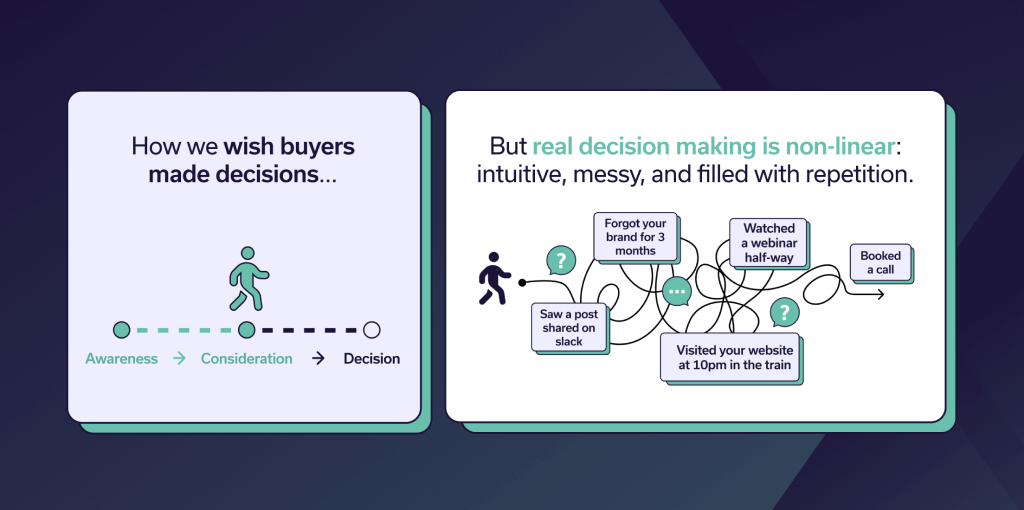
There’s a reason that the ‘7 sales touchpoints’ concept has, like the 3% ready-to-buy statistic, become something we now accept as a given in marketing. While we’d love prospects to stick to our planned (and preferably short) funnel, real-life journeys are a lot messier.
📕Up next: What is The AARRR Framework (Pirate Metrics)?
It’s an inconvenient truth, isn’t it?
Because seven touchpoints take time, and they take money (or at least come with an opportunity cost) – neither of which a startup believes it has. When you need results fast, there’s a temptation to just ramp up the outreach volume and leave everything else behind (I’ve definitely been there).
But I will tell you what I have told several founders this month: you will never believe you have enough time and money to start. That ‘breathing room’ you think is coming after the next quarter, the next round of fundraising, the next hire? It’s all a myth!
(Take it from someone who built their own startup and runs a growth marketing agency, speaking to founders every single day.)
The benefits of good organic content compound, and they start strengthening your direct outreach efforts from the first day.
So start small if you need to, but start now. Post about what you’re building, or what you’re struggling with. Spend 10 minutes adding genuinely helpful comments on other people’s posts.
And work with true experts in these channels (preferably on a more flexible fractional or freelance basis) as soon as you can.
“When it comes to building their own personal brand, I find that founders often feel like they don’t think they have anything worthwhile to say. But this is absolutely never actually true! They’re all on their own journey of learning, doing, and growing, and they’re speaking to their customers and community every single day. Sharing their honest journey and in-progress learnings (messy parts and all) isn’t unprofessional; it’s all part of building a genuine, trusting community. So don’t wait until you feel like ‘a real expert’ before you hit send on that first post – start building the habit now.” – Fiona Moucq, Head of Community Building at Growth Division
Looking for advice on which marketing channels to test alongside outreach, and how? Let’s audit your marketing strategy together. We can evaluate your current channel selection, and look at some ideas of what to text next. Book your (free) 30-min call with me.
A peek inside our own LinkedIn direct outreach playbook
Direct outreach remains a big part of how we market ourselves at Growth Division, and this is possible because we’ve built a whole system to support it.
It’s taken us a while to land on a formula that works, and – true to form – we never stop experimenting with it.
But for total transparency, this is what’s working for us right now:
- We have a list of dream clients that our direct outreach reaches out to, either over LinkedIn or email
- Our content team is writing super sales enablement and powerful case studies directed at our ICP to help move these conversations along positively
- Our community building team is engaging with the content from those decision makers (meaningfully, humanly, and selectively) on LinkedIn
- Meanwhile, our LinkedIn ads team is retargeting these same people with our ads
- All the while, my co-founder and I regularly post helpful startup marketing insights from our own accounts, and from Growth Division’s LinkedIn account
Curious to see which experiments are moving the needle for our agency and for our clients?
Subscribe to our newsletter, Thoughts on Growth. Every month, my co-founder and I take turns to share:
⭐ How we’re tracking against our own North Star Metric here at Growth Division
🎯 One growth channel insight
📖 One growth resource we rate
💡 One growth experiment we ran for ourselves or our clients, and the results
Final thoughts
Trying to scale your startup with cold outreach alone is like trying to subsist on only breakfast cereal: delicious and energising at first, but not nourishing or sustainable in the long run.
The sooner you consider the ecosystem that surrounds your outreach efforts, the more successful they will be, and the longer you will be able to rely on it as a channel.
And, as ever, working with true, proven experts in each channel is the best way to shortcut your way through the messy early days and land on a channel mix and strategy that generates real, sustainable growth for your startup.
If you’d like advice on which of the 20 Bullseye marketing channels might be a good fit for your business alongside direct outreach, book a free marketing audit with our team today.



.png)
.png)