Most people don’t plans their marketing stack. A founder signs up for whatever tool a LinkedIn post recommended last week. Six months later, four half used subscriptions are eating the marketing budget.
I've watched this happen at nearly every early-stage company I've worked with. Tool sprawl isn't really the problem. The lack of a reason for each tool is.
This list is the opposite of that. It's ten tools that earn their subscription cost for a startup trying to grow fast. Each one is organised around what it actually does.
The short version
If you read nothing else, here's the shape of a lean marketing stack in 2026. You need something watching how AI search talks about you, and something that turns strategy into execution across channels. You also need a site that converts and a way to capture leads.
You also need a way to reach people directly and a place to publish. And you need a way to show your product without a call. You also need a way to measure it all.
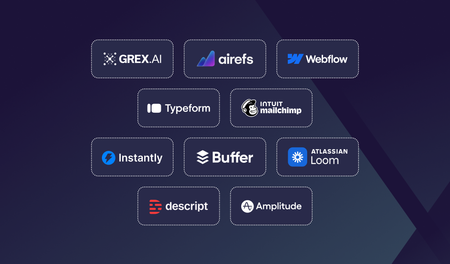
Here's how the ten tools on this list split that work:
- GREX, Growth Division's own AI operating system, runs growth campaigns across channels
- Airefs covers AI visibility
- Webflow builds the site
- Typeform captures the lead
- Mailchimp and Instantly.ai handle email nurture and outbound
- Buffer handles social distribution
- Loom and Descript handle video
- Amplitude tells you what's actually working
Every price above is the entry point. Most of these tools charge more as your list, seats, or usage grow. I've flagged that where it matters.
1. GREX: Growth Division's own AI growth operating system
Fair warning: GREX is our own platform, built by Growth Division, our growth marketing agency for startups. We think it earns a spot here, but we're obviously not a neutral judge.
Most tools on this list handle one job well. GREX is built to run several of them at once, inside a single AI operating system.
It reads your team's knowledge base, connects to the tools you already use, and assembles working campaigns. A human approval step sits before anything goes live.
We built it to run Growth Division's own client work. It's now open to any startup team directly.
What it's built for
GREX connects to your knowledge base, plus tools like HubSpot, Clay, and Apollo. From there, it builds agentic workflows across outbound, paid social, SEO and more.
It ships a library of pre-built expert-vetted systems, so you're not starting from a blank page. Every workflow has an approval checkpoint before it sends or spends anything.
It also tracks real-time metrics and scores results against your North Star metric each week. That's how it decides what to scale and what to cut.
What you'll pay
GREX doesn't (as of writing this article) run on flat self-serve pricing like the other tools here. It's currently offered through a six-month Design Partner programme.
Access starts at £2,500 a month, half the regular rate, and includes weekly calls with the founders and consultation on how to build out and execute the growth systems.
A growth strategist runs a channel from £500 a month, and you can layer on dedicated channel experts to completely own channels to market from £1,000 per month.
Where it wins, where it doesn't
The upside is real leverage. One platform plans, launches, and reports on work that would otherwise need several separate tools and a bigger team.
The trade-off is cost and commitment. This isn't a $20 tool you try for a weekend. It's a bigger investment, built for teams ready to run real experiments.
Who's using it
GREX already powers results at Dreamknit, Super44 and Bearcreak. It’s also been instrumental in running the growth for some of Growth Division’s most successful clients. Musiversal grew from $100k to $1.2M in ARR within twelve months of using it.
Weavr saw a 35x return on ad spend after adopting it, and Position Green booked 118% more demos.
2. Airefs: get recommended, not just ranked
Search behaviour has split. People still Google things, but a growing share now ask ChatGPT or Perplexity instead. Those tools answer with a handful of named brands, not ten blue links.
If yours isn't one of those names, you're invisible to that traffic. Airefs was built for exactly that shift.
It tracks how often your brand gets mentioned when people ask AI tools questions in your category. Then it automates the content and outreach work needed to close the gap.
What it's built for
Airefs runs prompt tracking to monitor where your brand shows up across AI answers. It pairs that with AI crawler analytics, so you can see which bots are reading your site.
On the execution side, it generates articles built for AI citation and traditional SEO. It also surfaces relevant Reddit and forum threads where your brand should be part of the conversation.
A backlink discovery tool connects you with the high-authority sites AI models tend to cite.
What you'll pay
The Lite plan starts at $29 a month for one domain, one seat, and 25 tracked prompts. Pro runs $59 a month for three domains and 60 prompts.
Expert is $99 a month, with unlimited domains and an AEO (Answer Engine Optimisation) strategist included. Agencies managing client sites can start from $49 a month per client. Every plan opens with a free seven-day trial.
Where it wins, where it doesn't
The upside is real specificity. Airefs shows you the exact prompts where competitors outrank you, not just that AI search matters in general.
The trade-off is that it's a newer category than SEO, so the playbook is still forming. Pair it with an established SEO tool rather than replacing one.
Who's using it
Airefs carries a 4.9 out of 5 rating on G2. Catherine, founder of Nashi, said her team ranked top five on Google within three weeks. They also started showing up as the top result in AI summaries.
Thibault of Genlook became the number one recommended brand in ChatGPT for his category. Thirty percent of his new signups now come directly from it.
3. Webflow: a marketing site your team can actually edit
Startup marketing sites get rebuilt constantly in the first two years. A pricing page changes, a case study needs a home, a landing page has to ship before Friday.
Webflow exists so that work doesn't route through an engineer every time.
What it's built for
Webflow combines a visual design canvas with a full content management system. Marketers can update copy, add blog posts, and launch landing pages without touching code.
Under the hood, it outputs clean, production-grade HTML and CSS. It also handles hosting, so there's no separate deploy step once a page is ready.
What you'll pay
The Starter plan is free and fine for testing. Basic runs $15 a month billed yearly, for a custom domain and unlimited form submissions.
Premium is $25 a month for the full CMS, larger bandwidth, and site search. Team and Enterprise plans exist for bigger organisations, but most startups never need to go past Premium.
Where it wins, where it doesn't
Design flexibility is the standout. Webflow sites don't look like templates, and marketers can make real structural changes without opening a ticket.
The trade-off is that the first build takes longer than a drag-and-drop tool like Squarespace. Budget real time for it, or bring in a Webflow specialist.
Who's using it
Webflow is common among startups that treat design as a differentiator. It's also popular with the agencies and freelance designers who build sites on their behalf.
4. Typeform: forms that people actually finish
Standard web forms lose people. A long list of fields dumped on one page reads like a chore. Visitors close the tab before finishing it.
Typeform breaks the same form into one question at a time. That sounds like a small change, and it consistently isn't.
What it's built for
Typeform covers lead capture forms, surveys, quizzes, and interactive product recommendation tools. Its AI form builder can generate a working form from a short prompt.
That speeds up the first draft considerably. Higher tiers add drop-off rate tracking, so you can see exactly which question is losing people.
What you'll pay
The free plan covers 100 responses a month for one user, enough to test the format. Basic is $29 a month for the same limit, with AI form creation included.
Plus is $59 a month for 1,000 responses and three users. A specialised Growth Flow plan at $349 a month adds lead enrichment and native Salesforce integration.
Where it wins, where it doesn't
Completion rates are the reason teams switch. A form that feels conversational gets finished more often than one that feels like paperwork.
Cost is the real constraint, though. Response-based pricing adds up fast at high volume, so model your expected traffic before committing to a tier.
Who's using it
Marketing teams use Typeform for gated content, event registration, and qualification forms ahead of a sales call. HR teams use a dedicated Talent tier for candidate screening.
5. Mailchimp: still the default for a reason
Email remains one of the highest return channels a startup has. You already own the list, and no algorithm change can take it away.
Mailchimp has been the default entry point into email marketing for over a decade. It's stayed there by expanding into a genuinely broad marketing suite.
What it's built for
Beyond email campaigns, Mailchimp includes automation flows, basic CRM functionality, and landing pages. Built-in AI tools help with subject lines and content generation.
It supports up to three audiences even on entry paid tiers. An SMS add-on is available in select markets for teams combining email and text.
What you'll pay
The free plan covers up to 250 contacts and 500 sends a month. Essentials starts at £9 a month for up to ten emails per contact.
Standard is £14 a month, with up to 200 automation flows and custom-coded templates. Premium starts at £260 a month, with unlimited contacts and predictive segmentation.
Where it wins, where it doesn't
Breadth is the advantage. A single Mailchimp subscription can replace an email tool, a landing page builder, and a light CRM. That's a lot for one very early team.
Because it does so much, it's rarely the best tool at any one thing. Teams that outgrow basic automation often migrate to a dedicated platform later.
Who's using it
Mailchimp is common across small businesses, ecommerce brands, and early-stage startups. Most haven't yet justified a specialised email platform.
6. Instantly.ai: outbound without the manual grind
Cold outreach still works when it's targeted. Doing it manually, one email at a time, doesn't scale past a handful of prospects a day.
Instantly.ai automates the sending, warmup, and reply handling that used to eat an SDR's entire morning.
What it's built for
The platform handles multi-inbox sending with automated warmup to protect deliverability. It also includes access to a lead database of over 450 million B2B contacts.
An AI Sales Agent can draft and personalise outreach at volume. An AI Reply Agent on higher tiers can handle initial responses before a human takes over.
What you'll pay
The Growth outreach plan starts at $47 a month for 5,000 emails and 1,000 contacts. Scale bundle plans run $175 a month billed annually for 100,000 emails and 25,000 contacts.
A custom Enterprise tier exists for larger sending volumes. Every plan includes unlimited connected email accounts and warmup, where competitors often charge extra.
Where it wins, where it doesn't
Deliverability tooling is the differentiator. Cold email dies fast when messages land in spam, and warmup exists specifically to prevent that.
The trade-off is that outbound at this volume still needs real list quality behind it. The tool won't fix a bad offer or a poorly targeted list.
Who's using it
Founder-led sales teams, agencies, and SDRs at early-stage B2B startups rely on Instantly.ai. It lets them run outbound at a volume manual sending can't match.
7. Buffer: distribution without the daily grind
Posting consistently across social channels is simple in theory. It rarely happens in practice once a team gets busy.
Buffer schedules posts across channels in advance. Distribution stops depending on someone remembering to post at 9am.
What it's built for
Buffer covers scheduling, a built-in AI assistant for drafting captions, and a hashtag manager. Analytics on post performance rounds out the core toolkit.
A shared content calendar keeps a small team aligned on what's going out and when. Team plans add approval workflows, which matter once more than one person touches the brand's accounts.
What you'll pay
The free plan covers up to three channels, with ten scheduled posts each. That's genuinely usable for a very early startup.
Paid pricing runs per channel. Essentials is $5 a month per channel, for unlimited posts and advanced analytics.
Team is $10 a month per channel, with unlimited members. Annual billing saves 20 percent.
Where it wins, where it doesn't
The per-channel pricing model is unusually fair. You only pay for the accounts you're actually managing, not a flat fee regardless of scale.
It's intentionally focused on scheduling and light analytics, not deep social listening. Heavier social teams sometimes pair it with a dedicated listening tool.
Who's using it
Solo marketers, small teams, and creators use Buffer to keep a consistent posting cadence. It saves them from dedicating a full role to social media.
8. Loom: replace the call nobody wanted to schedule
Plenty of internal updates, product walkthroughs, and sales follow-ups don't need a live meeting. They need five minutes of someone explaining something on screen.
Loom turned that into a category. Record your screen and your face, share a link, done.
What it's built for
Loom records screen and webcam at the same time, and transcribes automatically in over 50 languages. Viewers can drop comments and reactions directly on the timeline.
AI-powered tiers add auto-generated summaries, chapters, and meeting recaps. For sales teams, a quick Loom often replaces a scheduling back and forth entirely.
What you'll pay
The free Starter plan includes 25 videos with five minute recordings, covering casual use. Business runs $18 per user a month for unlimited videos and recording length.
Business plus AI is $24 per user a month, adding auto-editing, auto-summaries, and filler word removal. Annual billing saves up to 17 percent.
Where it wins, where it doesn't
Speed is the whole point. Recording and sending a Loom takes less time than scheduling the call it replaces.
It's not a substitute for real-time conversation, though, when a topic genuinely needs back-and-forth in the moment.
Who's using it
Sales teams use Loom for personalised outreach and demos. Product teams use it for async updates, and support teams use it to walk customers through fixes without a call.
9. Descript: video editing that works like a document
Traditional video editing software has a steep learning curve. Most startup teams don't have a dedicated editor on staff to climb it.
Descript edits video by editing a text transcript instead. Delete a sentence from the transcript, and the matching video clip disappears too.
What it's built for
Beyond transcript-based editing, Descript includes AI tools for removing filler words. It can also generate an AI clone of your own voice. It also translates and dubs content into more than 30 languages.
It's used heavily for podcast production as well as short-form marketing video. A Brand Studio feature on higher tiers keeps fonts, colors, and templates consistent across the team.
What you'll pay
The free plan includes 60 minutes of media a month, with limited AI tools, enough to try the workflow. Hobbyist is $16 a month for 10 media hours.
Creator, the most popular tier, is $24 a month for 30 hours and 4K watermark-free export. Business runs $50 a month and adds team-wide brand controls plus translation and dubbing.
Where it wins, where it doesn't
The learning curve is the main selling point. Editing text is a skill most marketers already have, so the jump to video editing is short.
It's less suited to complex motion graphics or heavily stylised editing. A dedicated tool like Premiere still has an edge there.
Who's using it
Podcasters, content marketers, and founders producing their own demo videos use Descript. It lets them skip hiring an editor early on.
10. Amplitude: know what's actually working
Every tool on this list generates activity. Amplitude is how you find out which of that activity actually moves the business.
It's built for product and marketing analytics together. That matters for startups where the marketing site and the product experience are tightly linked.
What it's built for
Amplitude tracks user behavior across web and product, then layers on cohort analysis and funnel reporting. Session replay lets you watch exactly where users drop off.
AI-assisted analysis can surface patterns a human might miss in a large dataset. Alerts on key metrics flag a sudden drop in signups before it becomes a quarterly surprise.
What you'll pay
The free plan is genuinely generous: up to two million tracked events a month, permanently, with no credit card required. Plus scales with usage from there.
Growth and Enterprise tiers move to custom, event-based pricing, with added security and governance controls. For most early-stage startups, the free tier alone covers a meaningful amount of runway.
Where it wins, where it doesn't
The free tier is the standout. Two million monthly events is enough for most startups to run real analysis long before paying anything.
Because it's built for product analytics first, marketing teams sometimes need engineering help to get event tracking set up correctly.
Who's using it
Product-led SaaS startups lean on Amplitude most. They use it to connect marketing acquisition data to actual in-product activation and retention.
Questions founders keep asking
Do I need all ten of these tools at once? No. Most early-stage startups run four or five of these well before adding more.
Start with whatever addresses your current bottleneck, whether that's visibility, conversion, or measurement. Add the rest as the gaps show up.
What should a startup pay for marketing tools in the first year? It varies by stage. A lean stack covering AI visibility, email, forms, and analytics typically lands between $150 and $400 a month, before any paid advertising spend.
Free tiers on tools like Amplitude and Webflow can stretch that further in the earliest months.
Is AI search visibility worth tracking yet, or is it too early? It's early, but the shift is already measurable. Airefs customers report meaningful inbound traffic from ChatGPT and AI Overviews within weeks of starting.
That suggests the window to build an early lead is now, not later.
Should I pick one all-in-one platform instead of several specialised tools? Both approaches work. An all-in-one platform like Mailchimp or GREX reduces the number of subscriptions to manage.
Specialised tools like Typeform or Instantly.ai usually go deeper on their specific job. Most fast-growing startups end up somewhere in between.
How do I know when to upgrade from a free plan? Watch the actual limit, not the calendar. When you're regularly hitting the cap, whether that's Amplitude's two million events or Typeform's 100 responses, that's the real signal.
What's the biggest mistake startups make with their marketing stack? Buying the tool before defining the process it supports. A tool doesn't create a growth channel on its own.
It just makes an existing process faster, once you actually have one.
So which tools should you actually pay for?
If you're pre-revenue and still finding your first channel, start light. Webflow's free plan, Typeform's free tier, and Amplitude's free plan cover website, lead capture, and measurement, without spending anything yet.
If you've found a channel and you're ready to scale execution, pair Airefs with GREX. Airefs gets you found in AI search, and GREX turns that strategy into running campaigns across every other channel.
If you're past that and building a real outbound motion, Instantly.ai and Mailchimp cover outbound and nurture. Buffer, Loom, and Descript keep distribution and content moving without needing a dedicated team yet.
None of this replaces a strategy. Tools execute a plan, they don't create one.
That's the harder part. It's what we spend most of our time on with our clients, GREX or not. If your stack is sorted but your channel strategy isn't, get in touch. We'll walk through what's actually holding growth back.



.png)
.png)