Most founders think a go-to-market strategy is something you build for a product launch. It isn't. It's the system you use to find scalable customers, and it runs long after launch day.
The problem is that "GTM strategy" gets used to mean almost anything. Pitch decks, launch campaigns, channel plans, positioning docs. Everyone calls their thing a GTM strategy.
That vagueness is expensive. When a term means everything, it guides nothing. And startups without a clear GTM strategy burn budget on channels that don't convert.
What is a GTM strategy?
A go-to-market (GTM) strategy is a plan for bringing a product to a defined market and acquiring customers. It covers who you're selling to, why they should choose you, which channels you'll use, and what success looks like.
The emphasis matters. A GTM strategy is not a product roadmap or a brand deck. It's an acquisition plan grounded in a defined customer and a testable channel hypothesis.
A GTM strategy aligns sales, marketing, and RevOps around a shared plan. That alignment is what separates disciplined GTM approaches from ad hoc channel selection.
GTM strategy vs. a marketing plan
These two terms get conflated constantly, and the confusion is costly. They're not the same thing.
A GTM strategy is the strategic layer. It answers who you're selling to and why they'll buy. A marketing plan sits underneath it, specifying the campaigns, budgets, and timelines to execute that strategy.
Think of it this way. The GTM strategy is the destination and the route. The marketing plan is the vehicle, and you need the strategy before the plan makes sense.
The five core components of a GTM strategy
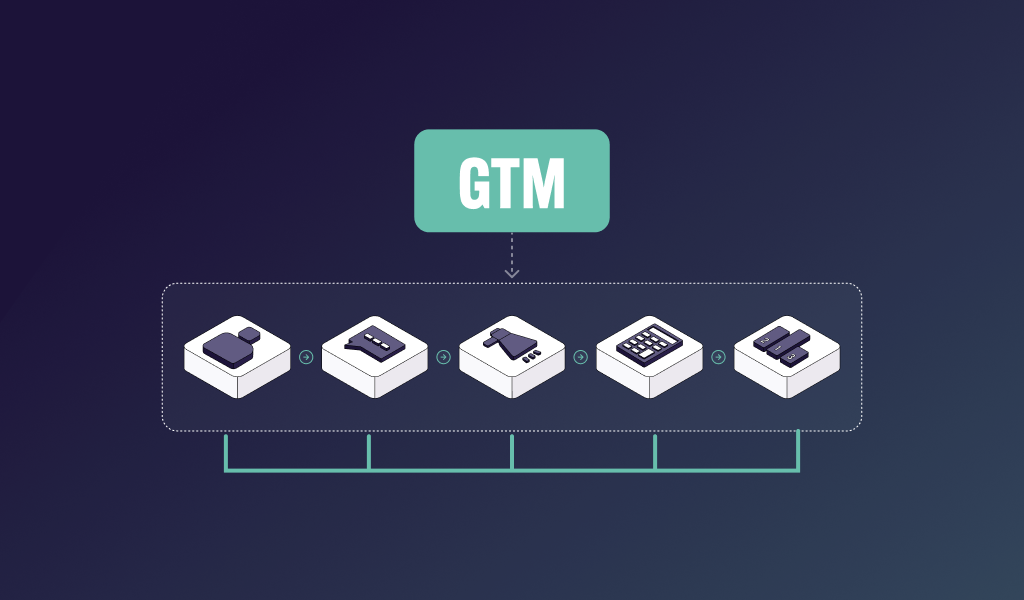
Not every GTM strategy looks the same. But the strongest ones share five components.
1. Ideal Customer Profile (ICP)
This is the most important decision in a GTM strategy. Your ICP defines exactly who you're targeting, their specific pain, and their buying behaviour. Vague ICPs produce vague results.
"SMBs in Europe" is not an ICP. "Seed-stage B2B SaaS founders in the UK who've just raised £250k and are under investor pressure to hit growth targets" is an ICP. The specificity is the point.
Only 23% of B2B companies hit their first-year revenue targets after launch. An unclear ICP is cited in 68% of GTM failures. Define yours before you touch anything else.
2. Positioning and value proposition
Positioning is why your specific customer should choose you over every alternative, including doing nothing. It's not your tagline. It's the argument you make before someone ever sees your ad.
Most founders write their positioning once, early, and never revisit it. But positioning should evolve as you learn from real customer conversations. If your experiments aren't converting, positioning is usually the first place to look.
A simple test: can you describe your ICP's specific problem in their exact words, not yours? If not, you haven't talked to enough customers yet. Run positioning as a hypothesis before you commit it to ad creative or outbound copy.
3. Channel strategy
Channels are how you reach your ICP. The mistake most founders make is picking channels based on what worked for other companies in other markets. That's imitation, not strategy.
A real channel strategy starts with hypotheses. Which channels could scale, which are cheapest to test, and which will signal fastest? Then you run structured experiments and let the data decide.
📕 Our GTM framework for startups covers how to run channel discovery using the Bullseye Framework.
4. Sales motion
Your sales motion is how a prospect moves from first contact to closed deal. For a product-led growth (PLG) company, that might be a free trial that converts to paid. For B2B SaaS with a high average contract value (ACV), it's likely a demo, a proposal, and a multi-stakeholder sign-off.
Getting the sales motion wrong is one of the most expensive GTM mistakes. If you're running a PLG motion but your pricing needs a sales conversation, you have a structural problem. The motion has to match the product and the buyer.
5. Success metrics
A GTM strategy without metrics isn't a strategy. It's a plan to stay busy. Define what success looks like at each phase: customer acquisition cost (CAC), time to first conversion, and monthly qualified leads.
These metrics do two things. They tell you when to declare an experiment a success or failure. And they give you the data to make confident decisions about where to scale spend.
GTM strategy models
Before looking at examples, it helps to understand the three most common GTM models. The right one depends on your product, your ACV, and who your buyer is.
Product-led growth (PLG). The product itself drives acquisition, with users signing up and either converting to paid or inviting colleagues. This works when your product delivers fast value and the buyer can make the purchase decision without a lengthy approval process.
Sales-led growth (SLG). A sales team drives acquisition through a defined process. Marketing generates interest, sales qualifies and closes. This works for complex products with high ACV, long sales cycles, and multi-stakeholder buying decisions.
Channel-led growth (CLG). Partners, resellers, or marketplaces drive acquisition on your behalf. This is often underused by early-stage startups, but it can accelerate growth in industries with established distribution. The risk is dependency on third parties you can't fully control.
Most startups blend two of these models as they scale. But it's worth deciding early which one is primary. That decision shapes your hiring, your tech stack, and how you structure experiments.
GTM strategy examples
Theory is useful. You learn faster from seeing how GTM strategies play out in practice. Here are four examples, from well-known companies to early-stage practice.
Slack: product-led growth
Slack launched in 2013 with a GTM strategy built entirely around product adoption. The hypothesis was simple: if teams could try it for free, they'd convert to paid. The channel was word of mouth, accelerated by a freemium model.
Acquisition happened inside organisations as one team member brought colleagues onto the platform. The ICP wasn't defined by company size but by collaboration pain: teams frustrated with email. That specificity shaped the messaging, the onboarding, and the referral mechanic.
Slack's product-led strategy generated 500,000 daily active users in 24 hours of public launch. One clear hypothesis, one channel, one well-defined ICP.
What made Slack's GTM defensible over time was the network effect baked into the acquisition model. As more colleagues joined, switching cost increased. The GTM strategy and the product reinforced each other, which is the highest-leverage growth dynamic you can design.
Dropbox: referral-led acquisition
Dropbox's GTM strategy had one core channel: referrals. Sign up, refer a friend, get more storage. The ICP was anyone who needed to sync files across devices, which in 2008 was nearly everyone with a laptop.
The value proposition sold itself, but the GTM decision that made it work was the incentive structure. Referrals gave both parties something valuable, which made sharing feel like a favour, not a sales pitch.
Dropbox grew from 100,000 to 4 million users in 15 months after launching the referral programme. One channel, one incentive, one clear ICP.
The broader lesson isn't that referrals work. It's that one channel executed with exceptional incentive design beats ten channels with average execution. Most startups spread thin trying to be everywhere. The ones that scale fastest usually perfect one channel before adding another.
HubSpot: content as the GTM channel
HubSpot's original GTM strategy was to make content the channel. They built a blog, offered free tools, and positioned SEO as their primary acquisition engine. The ICP was small business owners and marketers frustrated by outbound advertising.
The channel wasn't just a traffic strategy. It was a positioning statement. HubSpot taught inbound while selling inbound software, and that consistency between message and channel created lasting trust.
That strategy took years to compound. But it became a durable organic growth engine in B2B SaaS, and it's still running today.
The lesson is about channel-message fit. HubSpot's content wasn't just driving traffic. It was attracting buyers already pre-sold on the problem HubSpot solved. When your GTM channel and your value proposition are in genuine alignment, conversion improves at every stage of the funnel.
An early-stage startup using the Bullseye Framework
At Growth Division, our growth marketing agency, we see a different kind of GTM challenge every week. Most seed-stage founders arrive with a hunch about which channel will work. Usually it's wrong.
The Bullseye Framework starts by mapping every possible channel and ranking them by three criteria: scale potential, cost to test, and speed to signal. The founder's hunch might rank third or fourth. Experiments run in order of that ranking, not the founder's intuition.
What typically happens next surprises people. The obvious channel underperforms. A channel they hadn't seriously considered, often direct outreach or content, generates the first real signal. That's the point: structured experimentation replaces assumption with evidence.
How to build a GTM strategy
If you're starting from scratch, here's the order of operations that works.
Start with the ICP. Don't write a positioning statement before you've defined who you're selling to. Talk to your best existing customers if you have them. If not, profile the buyer you're most confident you can reach and close.
Write your positioning before touching channels. Positioning answers: why should this specific customer choose you, in their language? If you can't answer that clearly, no channel will work. The creative and copy have nowhere to anchor.
Rank channels before testing. Use a simple scoring system: scale potential, cost to test, speed to signal. The channel at the top of that ranking is your first experiment, not your favourite one.
Run small, structured experiments. Each experiment needs a hypothesis, a timeline, and a success metric. State what you expect to happen and why, before you start. If it doesn't hit your threshold, stop and don't move the goalposts.
Document everything. Failed experiments that are documented are more valuable than successful ones you can't explain. The learning compounds over time. When you bring in specialists later, they need that evidence base to make good decisions.
Build the team around the data. Don't hire a Head of SEO because SEO sounds right. Hire for the channels the experiments are already validating. The team should follow the evidence, not assumptions.
Common GTM strategy mistakes
These patterns show up repeatedly in startups that struggle to find scalable growth.
Picking channels before defining the ICP. If you don't know who you're selling to, you can't know which channel will reach them. This is the most common and most expensive GTM mistake.
Confusing a launch with a strategy. A product launch is an event. A GTM strategy is a system. Most launch campaigns generate a spike, then a plateau, and a real GTM strategy is what pushes through that plateau.
Scaling before you have signal. There's a meaningful difference between a channel that's working and one that's ready to scale. Scaling before you've reduced your CAC burns budget fast.
Changing everything at once. When experiments underperform, the instinct is to change the channel, the message, and the audience simultaneously. That destroys your ability to learn. Change one variable at a time.
Treating GTM as a one-time exercise. A GTM strategy isn't something you build before a launch and file away. It's a living system that should evolve as you learn more about your customers. Markets shift, ICPs narrow, and new channels emerge, so the best GTM teams revisit their strategy quarterly, not annually.
Frequently asked questions
What does GTM stand for?
GTM stands for go-to-market. A GTM strategy is the plan for bringing a product to a defined market and acquiring customers at scale.
What's the difference between a GTM strategy and a business plan?
A business plan covers the entire business: finances, operations, team, product, and market. A GTM strategy focuses specifically on customer acquisition, covering ICP, positioning, channels, and sales motion. You need both, but they serve different purposes.
How long does it take to build a GTM strategy?
Expect 3 to 4 months at seed stage, longer at Series B and beyond. The temptation is to shortcut it. A strategy built in a week is usually a set of assumptions dressed up as a plan. The planning time isn't wasted. It's the difference between a channel stack built on evidence and one built on gut feeling.
Do I need a GTM strategy if I already have customers?
Yes. Early customers often come through founder networks, not repeatable channels. Getting from 10 customers to 100 requires a system, not just relationships.
What is a GTM motion?
A GTM motion is your sales and acquisition model. Product-led, sales-led, and channel-led are the three most common. The right one depends on your product, your ACV, and your buyer's decision process.
How is GTM strategy different for B2B vs B2C?
B2B GTM strategies typically involve longer sales cycles, multiple stakeholders, and higher-touch sales motions. B2C strategies rely more on volume, brand, and short conversion paths. Both need a clear ICP and testable channel hypotheses; the mechanics differ, the principles don't.
When should a startup hire for GTM execution?
After you've defined your ICP and positioning, and ideally after your first experiments have produced some signal. Hiring before you have signal locks you into one skill set before you know which skills you need. That's one of the most common causes of early-stage hiring regret.
What's the difference between a GTM strategy and product-market fit?
Product-market fit (PMF) is evidence that a specific customer segment wants your product. A GTM strategy is the plan for reaching that segment at scale. PMF is what you're validating through early experiments. The GTM strategy is what you build systematically once you've found it.
How much budget do I need to test a GTM strategy?
At seed stage, £3,000 to £5,000 per month across two or three experiments is usually enough. That gives you signal without overcommitting to unproven channels. Spend enough to get meaningful data, not enough to scale something unproven.
Conclusion: Build the system, not just the launch
A GTM strategy isn't a document you build once and file away. It's a system for finding, reaching, and converting the right customers at scale. And the founders who get it right don't stumble onto it. They build toward it deliberately.
The founders who build reliable growth aren't the ones who guessed right on channel one. They're the ones who ran structured experiments, learned from the data, and adapted their team and spend accordingly.
If you're a tech startup that wants to find scalable channels without channel bias or wasted budget, we can help. We've helped 130+ startups find scalable channels, using a process built specifically for the growth stage. Growth Division runs the full GTM process, from the first Bullseye Call through to scaling. Book a call to start building your GTM strategy the right way.



.png)
.png)