The pace of change in our industry is exciting, but it can make it feel like it’s hard to hold onto anything… solid. And that’s exactly what a framework promises: something solid and actionable. A plan to follow.
You may already have read me wax lyrical about the Bullseye Framework, which we pretty much built our whole marketing agency around.
Equally, some frameworks have become so entrenched in how we work that we no longer think of them as such: marketing funnels being a prime example. But over the past few years of monitoring growth marketing trends (📩 and writing about them – one useful update every month), one word has started to dominate the conversation: loops.
And that’s why I wanted to write a post explaining Growth Loops, and also touching on HubSpot’s Loop Marketing framework. In both cases, I’ll show you some examples, and I’ll also add my own take as a 2x SaaS co-founder and growth marketing agency co-founder.
Growth Loops explained
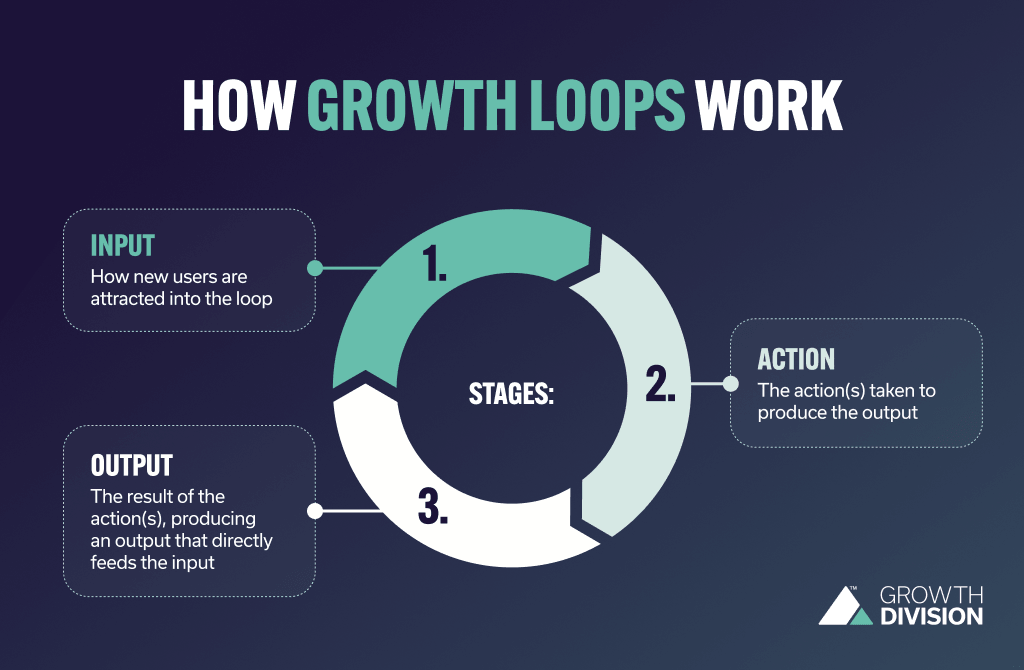
Growth Loops are positioned as an alternative to marketing funnels, or the AARRR Framework (also enjoyably known as Pirate Metrics).
Here’s the idea: instead of looking at your marketing as a process of filling the top of the funnel, then nurturing each lead through each stage, Growth Loops are all about taking actions that, in turn, become a self-sustaining growth cycle. Most often, but not always, this comes from involving existing customers in the process of finding new customers.
While I don’t think Growth Loops have “killed the funnel”, as some headlines would have you believe, I do think Growth Loops are an incredible way to formalise how we think about compounding benefits in marketing.
We know from our own research and experience that growth teams do not struggle to come up with ideas for growth experiments, but they do struggle to prioritise them.
When we can look one step beyond the goal of individual experiments and ask ‘and what happens then?’, that prioritisation feels more straightforward. We fill our sprint boards with activities with compounding benefits, rather than individual ones.
Growth Loops come in several different forms, so let’s go through them one by one.
Viral or Referral Growth Loops
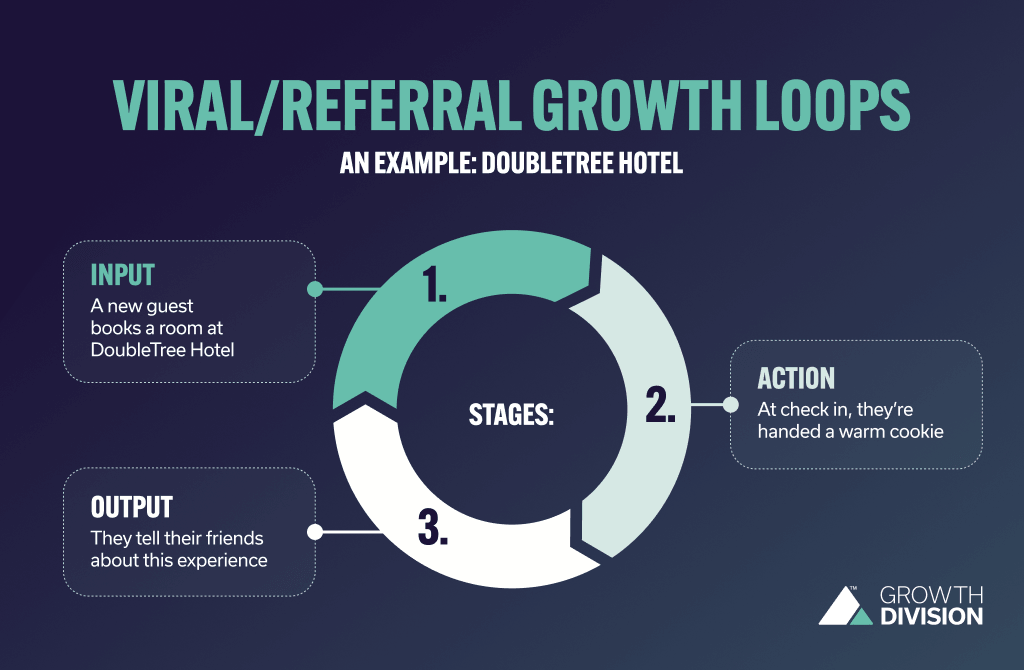
🔧 How it works:
Your existing customers bring new customers to your product or service, either because of a referral incentive or just because they want to recommend you.
🔍 An example:
One of my favourite examples of a referral loop is the DoubleTree hotel chain giving every guest a warm chocolate cookie when they check in – that’s a whopping 75k cookies a day! The benefit? 34% of guests tell their friends about this (in person or online), creating 25k stories about the brand every day. Clever, hey?
💡 My take:
These viral and referral loops are severely underrated. I often speak to business owners who say their main source of new customers is word of mouth, but they don’t feel like they have any control over this as a source of growth. It feels lucky, rather than scalable and repeatable.
But it absolutely can be! And I know from personal experience, because it’s something we’ve managed to foster for our own business here at Growth Division:
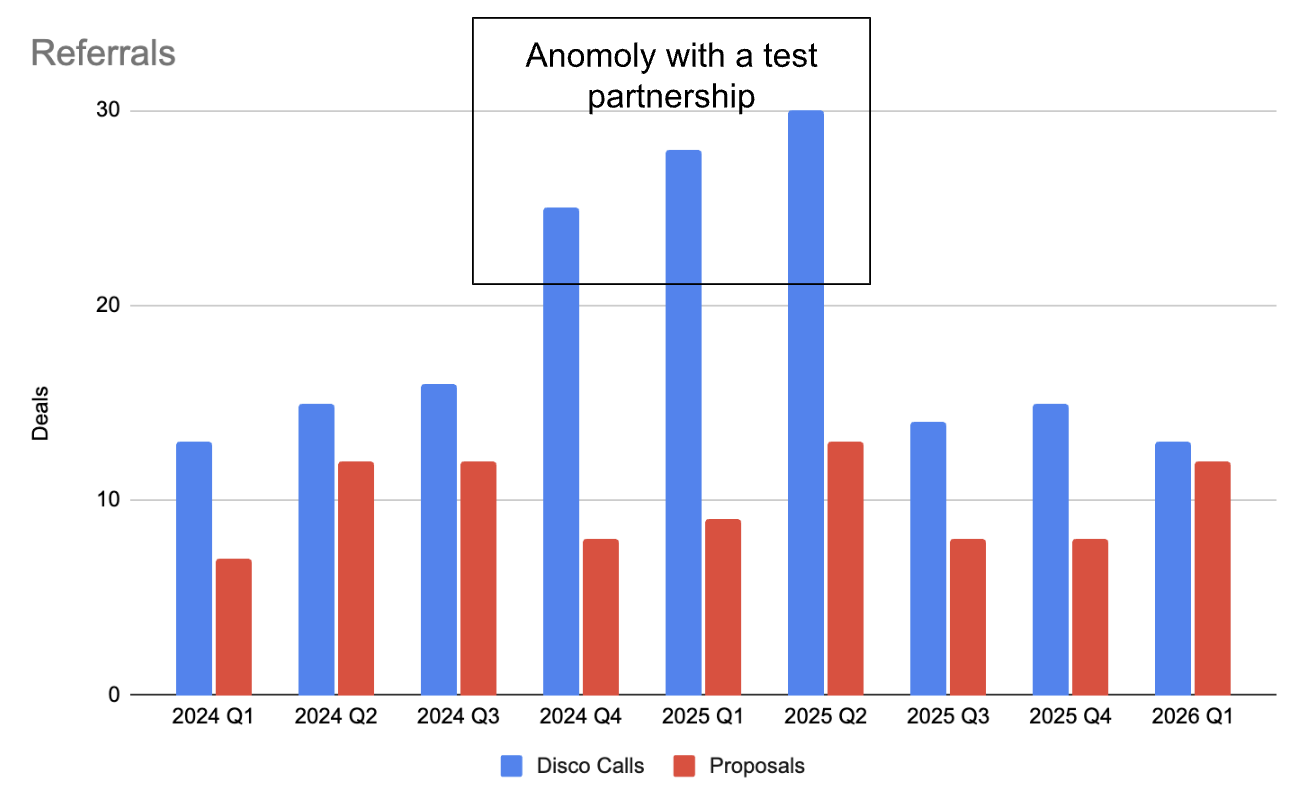
Other than providing a great service or product (most important), here are a few ideas for creating a referral growth loop:
1. Actually ask your customers for referrals. Not just once, build a process to ask customers for referrals. Automate it where you can. Personalise it where you need.
2. Incentivise referrals. If you are willing to pay a £500 acquisition cost on Google, LinkedIn or Meta, why aren't you willing to pay loyal customers £500 for bringing in (likely) very good customers?
3. Leverage technology where you can. Use automated CRM tasks, use automated emails at key WOW moments in the customer journey, and use viral marketing tools such as Viral Loops to track and reward referrals.
4. Test asking for referrals earlier than you might think in the customer journey. Something we've seen is that some customers are willing to refer before they have even seen real value from your product. They are happy to think the concept is cool (hence they signed up themselves or even paid) and refer immediately.
The DoubleTree example also reaffirms the need to track the right metrics and outcomes for your experiments. You can imagine the same experiment having a goal like ‘improve guest satisfaction score by 10%’. I’m sure it would have done exactly that, but the growth this drives is so much less tangible that it would be easy to carelessly cut this practice in the future, not understanding the important ripple effect it offers.
Content or UCG Growth Loops
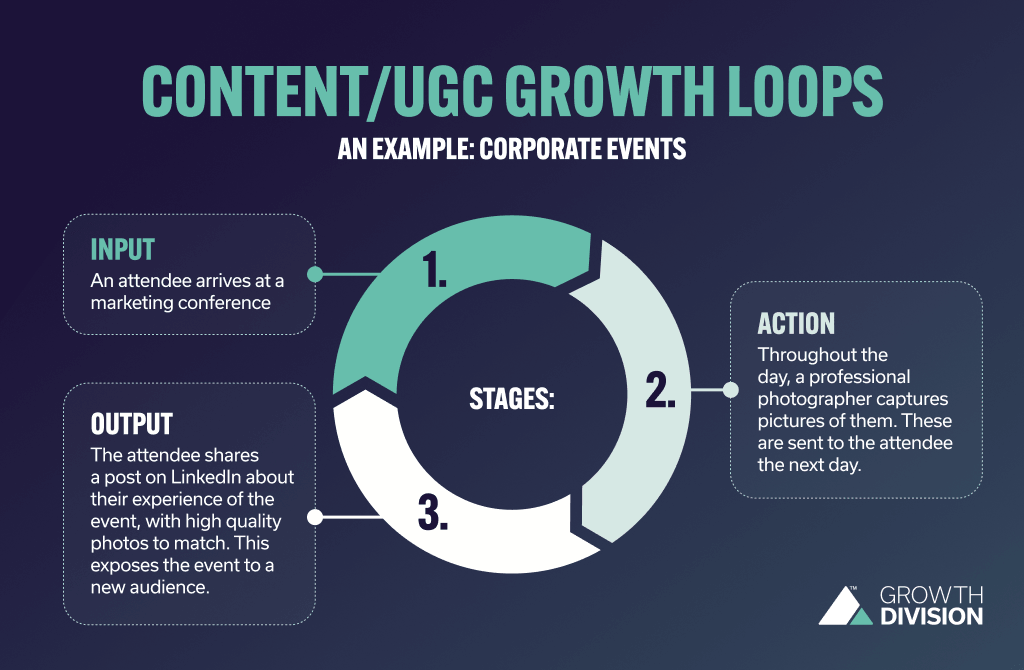
🔧 How it works:
Your existing customers create content, which in turn attracts other customers to your product, platform or service. These customers then create content, which attracts even more customers, and so on.
🔍 An example:
You know when an event just seems to be all over your LinkedIn feed? And you start feeling kind of left out, and like you really need to attend the next one?
I’ve noticed a lot of these events have something simple in common: an excellent photographer. I’ve even seen events chuck in professional headshots as part of their package.
This is a really smart move. We know that adding a photo of ourselves to our posts makes our LinkedIn content perform better, but we all kind of hate it. Having a free bank of photos you feel good about makes you more likely to share your learnings from the event, which in turn gives it a wider audience. Your attendees are happy with their fresh new photos, and they’re also attracting new attendees. It’s a win-win!
💡 My take:
We know good UCG content works (10.38x higher conversion rates than non-UGC posts, according to recent research). We also know that it either comes at a cost or is hard to encourage authentically. And it often isn’t very B2B-friendly.
Experiment with creative ways to achieve this effect outside of influencers. What features could you build into your product or model to encourage sharing in a way that doesn’t feel forced?
Other common types of Growth Loops
1. Product-Led Growth Loops
This is where the product itself creates the loop. As an example, users of Calendly send an invite to the person they want to meet with. This person has such a smooth experience booking this meeting that they then go on to sign up to the platform as well.
Sometimes, this term is also applied to the process of taking user feedback on board to improve your product, which in turn creates a better product, which attracts more users, who then give you more feedback.
2. Sales Growth Loops or Paid Growth Loops
This is typically about using the money generated by the sales team to fund more sales associates, or using the money brought in by paid ads to fund more paid ads.
3. Marketplace Growth Loops
This is where sellers on a two-sided marketplace start attracting buyers, and vice versa. You’ll notice this a lot with wholesale marketplaces, like Faire and Ankorstore. Each has been known to encourage sellers to bring their existing buyers onto the platform by offering to handle all the logistics of future purchases between them, without charging any commission.
4. Network Effects Growth Loops
This is where the overall value of a community becomes greater for each new person who joins it, creating a kind of snowball effect where more people want to join it, and the community continues to become more valuable. Social networks are a great example of this.
HubSpot’s Loop Marketing framework
I’m naturally sceptical of any new framework I come across (let’s face it, we’re not short of them!). But when HubSpot, the business that more or less birthed the idea of inbound marketing, releases its own? Now that’s likely to be worth our attention.
HubSpot’s Loop Marketing framework, released in September 2025, has several parallels to the concept of Growth Loops that I covered already. It’s a ‘funnel alternative’, and it’s… well, a loop.
But it’s ultimately quite different, because instead of focusing on how to use your customers as a lever for your own growth, it focuses on using AI.
🔧 How HubSpot’s Loop Marketing framework works:
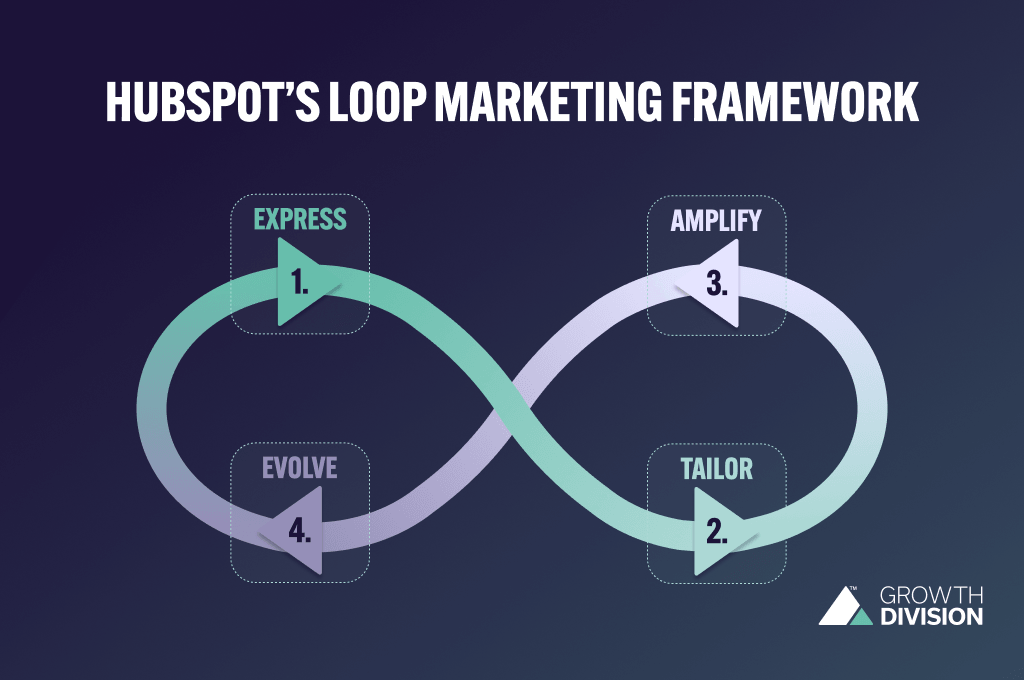
The four stages of HubSpot’s Loop Marketing framework are:
Step 1: Express who you are.
Who is your ICP, what is your value prop, and what is your messaging?
Step 2: Tailor your approach.
Use AI to build personalised customer journeys and interactions.
Step 3: Amplify your reach.
Optimise your channel mix to get the right content in front of the right people.
Step 4: Evolve your strategy.
Run rapid experimentation to learn what works and optimise your campaigns.
🔍 A (first-hand) example:
LUX Rewards came to Growth Division with a big challenge. They were pivoting their company from a consumer-facing app to an enterprise card-linking solution. Suddenly, they needed to reach an entirely new audience, who required an altogether different approach.
We worked with LUX Rewards on a hyper-targeted, highly curated campaign focusing on partnership managers of banks. We ran direct outreach for this client, supported with AI tools for personalisation, A/B testing messaging, and enriching customer data.
We landed LUX 5 meetings with their ICP, one of which turned into a £25 million deal (a tasty 50,000% ROI on their spend with us!). Read the full story here.
💡 My take:
I really like the Loop Marketing structure. It very much aligns with my view on how a growth team should be operating.
Working at speed is important, but it’s about knowing where you can afford to invest less time.
Step 1 is too important; you need skilful, strategic human oversight to get these fundamentals in place. Distinctiveness is essential, and this is something AI famously struggles with.
Step 2 is where it makes sense to use AI. You can build prospects a rich and tailored journey, without the time drain of doing this manually.
And then, for step 3, you need the strategic human brain back. Get the right channels in place, ideally using the Bullseye Framework. And from there you’re into step 4, optimising, experimenting, and tinkering.
Final thoughts: Growth Loops & Loop Marketing
I’d go as far as to say that most marketing frameworks aren’t worth your time – but these two are.
Growth Loops encourage us to prioritise marketing moves that compound, and put our customers and audience at the centre of how we grow.
Loop Marketing encourages us to approach marketing in short, looping cycles, rather than simply ‘strategy then execution’. And it shows us where we can afford to use AI to make this a reality.
If you enjoyed this breakdown, you’ll love Thoughts on Growth, our monthly newsletter written by my co-founder or me, where we unpack one growth resource, one growth experiment, and one growth channel insight. Subscribe, and then drop me an email to let me know what you thought of this post!



.png)
.png)