Over the past 6 years, Growth Division has helped grow over 130 exciting startups by structuring our client work around the Bullseye Framework. At this point, we have a process we were really proud of, and one that drives great results for our clients.
Over the past couple of years, my co-founder and I began systematically exploring if and where this process could be enhanced by using AI. In 2024, we ran an internal hackathon to explore the different use cases, and we’ve been building and experimenting ever since.
This post is a summary of what we learned so far about using AI for growth marketing.
If you enjoy this post, you’ll love Thoughts on Growth, our monthly newsletter sharing:
⭐ How we’re tracking against our own North Star Metric here at Growth Division
🎯 One growth channel insight
📖 One growth resource we rate
💡 One growth experiment we ran for ourselves or our clients, and the results
Our 3 core growth marketing commandments
Our explorations with AI were framed around 3 key growth marketing learnings that underpin how we work at Growth Division:
- Systemised, rapid growth experimentation is the best way to unlock fast and sustainable growth channels for startups and high-growth companies.
- Testing 3-6 channels at once produces better results than trying to be everywhere at once. If a channel doesn’t work, pause it and test another.
- Having channel experts, rather than generalists, run your marketing channels is the best way to shortcut your learning curve and draw meaningful conclusions about what actually works.
📕 Up next: The Exact Process I Used to Choose the Marketing Channels for 200+ Startups
Where can AI fit into the growth marketing process?
We combed through our conversations with founders and growth leads, and surveyed several others, to spot where AI tools could potentially support. Let’s go through each part of the growth marketing process:
1. Ideation & hypothesis development
When looking to inject AI into the growth marketing process, ‘ideation’ seemed like a sensible place to start. A lot of people use AI as a brainstorming sparring partner in their day-to-day lives, after all.
But when we surveyed and spoke to growth leads, the feedback was almost unanimous: only 3% cited a lack of growth ideas as their main blocker to getting their team to adopt growth marketing process.
So marketers do not struggle to come up with ideas. Instead, the issues arise downstream. Specifically, you have your list of ideas, and now you have to decide: which shall we start with?
Priorisation frameworks, like the ICE score, bring a logical process to this stage (especially when experienced channel managers are doing the scoring and making use of their honed gut instinct). But ultimately, what we have here is an educated guess: I think this has a good chance of working, and I think it has a good chance of working well.
There lies our second issue. A proper growth experiment requires choosing a trackable metric and setting a target outcome. But what’s reasonable here? A 15% uplift is a classic go-to, but a statistically significant ‘good’ result looks different according to the volume and how much testing has been done already.
For Uber, a proven 0.5% uplift on some metrics could mean millions. For a young startup, it may well not even be statistically significant.
💡The takeaway: Growth leads don’t need help generating more ideas. But they do need help with prioritising the ones they have, and setting realistic targets. Because most growth experiment logs are internal, this information is difficult or impossible for LLMs to access without being trained on this data elsewhere.
📕 Up next: Why Startups Aren’t Happy With Their Growth Experimentation Process
2. Execution
“I have some spare time on my hands. What experiment shall I run next?” said no startup growth lead or founder, ever.
When BAU feels more than busy enough, carving out the time to launch, run, track, and log experiments (which have no guarantee of working) quickly falls down the priority list.
For as much as these leaders believe in the growth marketing process and understand the importance of systemised experimentation, this is an activity that’s still squeezed into the margins of a team’s week.
There’s less accountability for experimentation, too. Growth leads often tell us their team doesn’t have much experience with following a growth process, and it’s harder to track and bake into objectives and KPIs.
But completely ‘handing over execution’ to AI feels unwise, too. Aside from concerns about quality, this requires having an AI system that’s truly integrated into your martech stack (a well-documented issue for startups), and has all the context to understand your business on a deeper level.
💡The takeaway: Teams find it hard to find the time to run growth experiments, even though they understand they’re important; spending time on something that might not work is painful when everyone is so busy. Outsourcing part of the execution to AI felt like a good goal to aim for, provided there’s close oversight from channel experts, and there’s deep context given.
3. Reporting
Isolating the impact of different activities is something we know teams find difficult. It’s something we find difficult for our own business.
When you run proper experiments, you can see how much each activity impacts your target metric. What’s harder is to see how it impacts your North Star Metric.
Let’s say, in one two-week sprint, you complete 5 winning growth experiments. The next step would be to double down on those results: to up the budgets and keep testing.
Each expert in the team is putting forward their case for the extra budget, but how do you, the leader, know where to distribute those resources?
Most often, you don’t. And this is where the problem lies. Given AI’s ability to identify patterns (and breaks in patterns), the potential here feels huge, provided the data from multiple sources can be converted into a digestible format.
💡The takeaway: It’s easy to see which experiments have been ‘successful’ by your chosen metrics, but harder to see how they impact your North Star as a whole. This felt like a strong use case for AI, provided the data can be made digestible.
4. Learning
Something growth leads admitted to us is that they know they should be logging the results of their growth experiments (48% said this was ‘very important’), but this is something they don’t find the time to do in practice. Or, they’re committed to the logging and reporting, but it’s taking up a huge chunk of their execution time.
Learning from your experiments is perhaps the most important step of the growth marketing process. Without it, your team is destined to repeat the same (failed) experiments and not capitalise on the insights they do gain. It’s a communal waste of time, so this stage needs to be built into how a team works.
We saw huge potential for AI assistance here. AI doesn’t have the same “but this is how we’ve always done things” bias that can creep into your team. And it may hallucinate when it doesn’t know the answer, but it doesn’t forget what it does actually know.
When an AI tool can store all the information about what has been tried previously, it can become a valuable living knowledge base of what works for your business. Taking it one step further, it can become an experienced sounding board for new ideas or even propose the next experiments based on past successes. And helps your learning truly compound over time.
💡The takeaway: Growth marketing only works if you learn from what you have tried already. With enough information, an AI tool could become a living knowledge base and stress tester for future ideas, helping your learning to compound over time.
The AI growth tools we built in response
Taking everything we know about growth marketing, and where we know teams struggle to form a repeatable process, here’s what we made:
1. GrowthEX, the first version of GREX AI
GrowthEX was essentially an experiment logging tool, but one that learns from all the experiments recorded, and is therefore able to offer new suggestions based on what’s worked for other startups.
We built this tool and now use it across all the clients at our agency. It brought renewed focus to the experimentation process (clients and experts could clearly see which experiments were running, which were up next, and which had or hadn’t been successful).
All the while, the tool is getting smarter and making better suggestions. To date, we’ve logged over 1,300 growth experiments in it.
2. GREX AI
GrowthEX was a brilliant tool for teams that need help systemising their experimentation process, visualising their work, and prioritising ideas.
But our conversations with founders kept coming back to the execution and tracking elements. The question remained: what specific activities are moving the needle on our North Star Metric?
So the next evolution of our building came in the form of GREX AI: our AI growth operating system for startups.
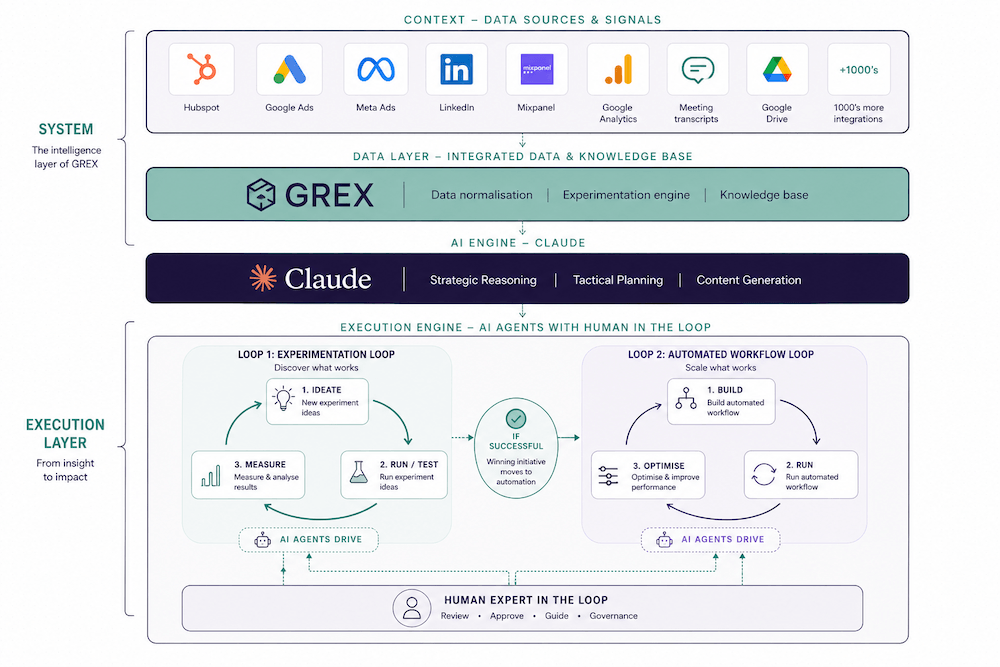
GREX’s strength lies in execution and reporting. It unifies your team’s knowledge, metrics and tools, then builds and runs personalised growth workflows for you. It stores all your organisational knowledge gained from experimentation, meaning your learning compounds over time.
We designed GREX to drastically speed up execution, both for experimentation and for automating the stuff that’s been proven to work. And because it brings together all of your usually fragmented data sources, it can tie every activity back to your North Star Metric with total precision.
AI for growth marketing: what startups should prioritise
I speak to AI-forward startups every week. But if I were to ask them: ‘Does your stack/analytics layer allow you to measure successful outcomes with AI?’, the answer would typically be ‘no’. If you’re one of them, this is the place to start.
When marketing teams have better visibility over what works and what doesn’t, and the ‘but how will you measure the ROI?’ pushback is no longer a blocker, more creative campaigns naturally follow. And it’s this space for human creativity that will come to set you apart.
🎯 If your startup’s marketing is at a crossroads and you’re debating your options (agency? freelancers? in-house?) and wondering how AI could/should fit into it all, let’s talk. Book a call with my co-founder here.

.png)

.png)