Growth Experimentation Frameworks for UK SaaS Startups
A practitioner's guide to building a growth experimentation framework for UK SaaS startups: replacing opinion with hypothesis testing, the metrics that guide scaling, how to structure a specialist-led team, what it costs and the red flags to avoid.

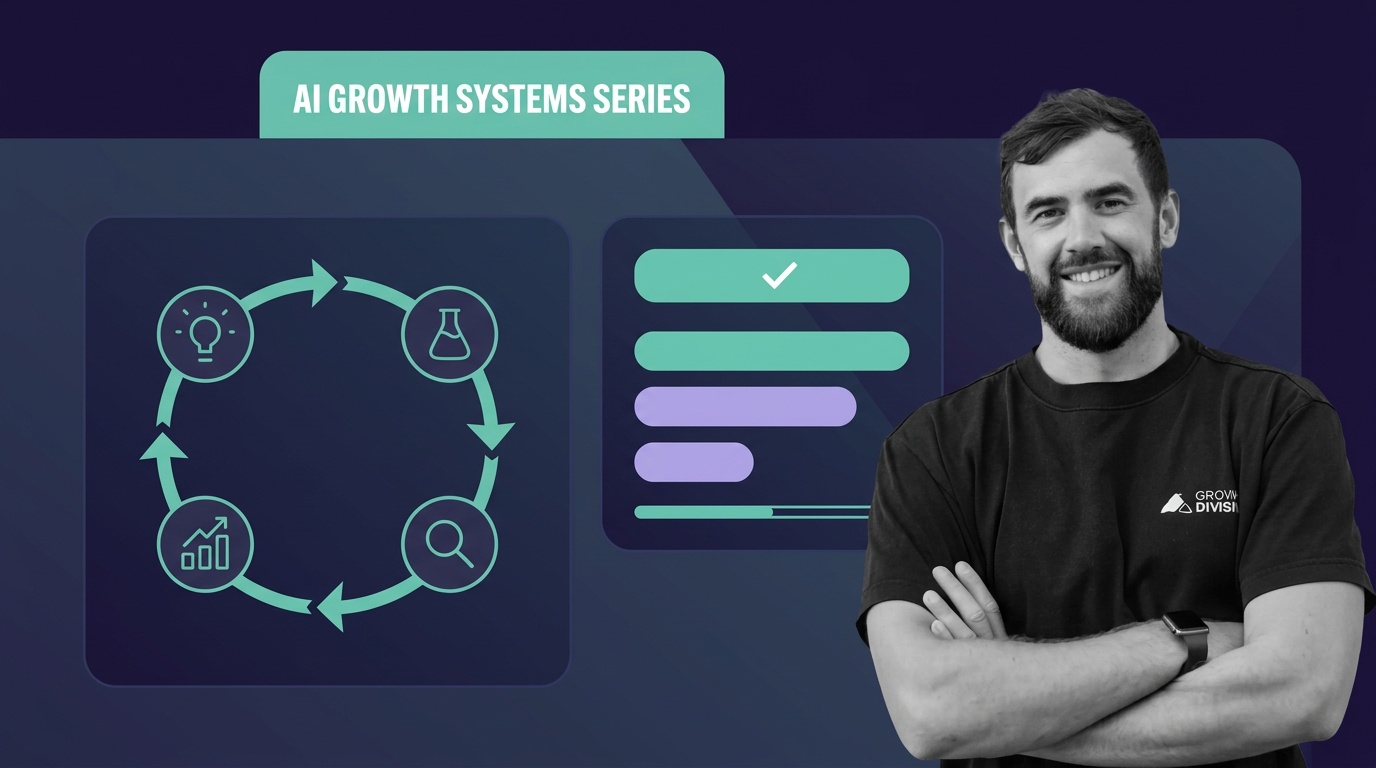
The short answer: A growth experimentation framework for a UK SaaS startup has five parts: one North Star metric with a handful of input metrics; a prioritised backlog of written hypotheses; a fixed test cadence (typically two-week sprints); a decision rule agreed before each test starts; and a shared learning log. Choose channels with the Bullseye Framework, test in sprints, and only scale what the data supports.
We say this from the practitioner's side: Growth Division has grown 130+ startups using a test-and-learn process, selecting channels with the Bullseye Framework and executing through a network of senior channel specialists directed by a growth strategist. After an internal AI hackathon in 2024 we built AI into that process, later productised as GREX AI. This is the framework we actually run.
How do you build an effective growth experimentation framework?
A growth experimentation framework is a repeatable system for deciding what to test, running the test properly, and acting on the result. Its job is to replace opinion-based marketing ("I think customers want a free trial", "we just need to send more emails") with structured, data-backed hypothesis testing. Startups rarely lack ideas; they lack a process that shows which ideas were right.
- Set one North Star metric. Pick the single number that best represents value delivered to customers, such as weekly active accounts, then map three to five input metrics that drive it. If you cannot say whether the business is better this month than last, this step is missing.
- Diagnose the funnel before you brainstorm. Use a pirate-metrics view (AARRR: acquisition, activation, retention, referral, revenue) to find the largest leak. Experiments aimed at the biggest constraint return far more than experiments spread thinly.
- Write hypotheses, not tasks. Every backlog item should read: "We believe [change] for [segment] will move [metric] by [amount] because [evidence]." If the evidence line is blank, it is a guess and should be scored as one.
- Prioritise with a simple score. ICE (impact, confidence, ease) is enough for most teams. Rank the backlog and take the top items into the next sprint, even when the founder's favourite idea sits lower down.
- Run fixed sprints with pre-agreed decision rules. Two-week cycles suit most SaaS teams. Before launch, write down what result means "scale", "iterate" or "kill", which prevents post-hoc rationalisation.
- Log every learning. A shared record of what was tested and what it showed stops the same debates recurring every quarter.
For how this sits inside a full growth function, see building a growth marketing framework that scales your startup.
How do you design effective growth experiments for SaaS?
An effective growth experiment isolates one variable, targets one metric, and runs long enough to produce a result you would act on. For SaaS, design around your real traffic and sales-cycle length rather than copying consumer A/B testing playbooks.
- Size the test to your traffic. Early-stage SaaS rarely has the volume for statistically significant conversion tests. The honest alternative is to test for larger effects (a new channel, offer or segment) rather than button colours, and accept directional evidence for smaller changes.
- Match duration to the buying cycle. If trial-to-paid takes 21 days, a seven-day test on sign-ups says nothing about revenue. Pick a leading indicator readable within the sprint and confirm against the lagging metric later.
- Test the message before the medium. Landing-page and ad-copy tests are cheap and show which pain point resonates before you scale a channel.
- Keep a control. Hold back a comparable segment or period to separate the experiment's effect from seasonality and product changes.
Which marketing agency frameworks deliver the fastest ROI for SaaS companies?
The frameworks that deliver the fastest return for SaaS are the ones that narrow effort quickly: the Bullseye Framework for channel selection, ICE scoring for prioritisation, and sprint-based experimentation for execution. Frameworks that widen effort, such as "always-on" activity across six channels from day one, typically return slowest because budget is spread too thin to learn anything.
The Bullseye Framework, popularised by the book Traction, asks you to list every plausible channel, rank them into outer, middle and inner rings, then run cheap tests on the inner three before committing serious spend to one or two. We use it first in every engagement because it answers "where should the money go?" within weeks rather than quarters. The method is explained in our Bullseye Framework guide.
Be wary of any agency that calls its framework proprietary but cannot explain it on one page. Good frameworks are simple; the value is in disciplined execution.
How do you scale a SaaS startup in the UK market?
Scaling a SaaS startup in the UK means establishing measurable performance indicators first, then increasing spend only on channels whose unit economics hold at higher volume. Build UK realities into those indicators: a relatively small domestic market, so many UK SaaS companies must prove an international channel early; procurement-heavy mid-market buyers with longer sales cycles; and GDPR and PECR rules that shape outbound and email programmes. The indicators to track weekly are:
- Customer acquisition cost (CAC) by channel, fully loaded to include agency or team time, not just media spend.
- CAC payback period, trending towards a range your cash position can tolerate.
- Activation rate: the share of new sign-ups reaching the first moment of value in the product.
- Trial-to-paid or demo-to-close conversion, segmented by channel to show which sources bring buyers rather than browsers.
- Net revenue retention, because acquisition experiments are wasted if the bucket leaks.
Scaling then becomes an experiment in itself: increase budget on the winning channel in steps and stop when marginal CAC crosses your payback threshold.
What are the best data-driven marketing strategies for startups?
The best data-driven marketing strategies for startups treat every channel as a hypothesis with a budget cap and a kill criterion. In our experience the channels most often worth testing first for B2B SaaS are intent-led paid search, LinkedIn (founder content plus targeted paid), search and answer-engine optimisation for high-intent questions, targeted outbound to a tightly defined ICP, and partnerships with adjacent tools. Which wins is unknowable in advance, which is why the framework matters more than the list. Real examples are in our case studies.
How should you structure a growth team to sustain SaaS growth?
A sustainable growth team pairs one person who owns strategy and the experiment backlog with specialists who each own a channel. The strategist decides what to test and why; the specialists decide how to execute well. Generalists running every channel execute poorly everywhere; specialists without a strategist optimise their own channel whether or not it should exist.
For most startups below roughly £5m ARR, hiring that structure in-house is unaffordable. The realistic options are a fractional growth lead plus contractors, an agency, or a hybrid. The common objection to agencies is dependency on freelancers who may disappear. The fair response is to ask how the network is managed: whether specialists are long-standing, who directs them, and what happens if one leaves. Our model is a growth strategist directing senior channel specialists, with the strategist accountable for continuity. For the trade-offs, read hiring your first growth lead: full-time or fractional and what a growth partner actually is.
What does a specialist-led growth engagement cost in the UK?
A specialist-led growth marketing engagement in the UK typically costs £3,000 to £10,000+ per month, excluding media spend. The lower end usually covers a strategist plus one or two channels tested in sprints; the upper end covers several channels in parallel with content and analytics. Pricing should be transparent: know what pays for strategy, what pays for execution, and what the media budget is before signing. On retainers, look for an initial fixed period (commonly three months, enough for the first channel tests to conclude) followed by rolling monthly terms rather than a twelve-month lock-in.
What are the red flags and common mistakes in growth experimentation?
- Testing without a hypothesis. "Let's try TikTok" is an activity, not an experiment.
- Calling results early. Ending a test the day it looks positive is the commonest way to scale something that does not work.
- Vanity metrics. Impressions and follower counts are not input metrics unless they demonstrably move the North Star.
- Never killing anything. If every channel from the last year is still running, the framework is decorative.
- Opaque agency reporting. If you cannot see the raw data behind the summary, you cannot audit the conclusions.
What questions should you ask an agency or growth lead before committing?
- Which framework will you use to choose channels, and can you explain it in five minutes?
- What is the sprint cadence, and what will I see at the end of each one?
- Who exactly will execute each channel, and how long have they worked with you?
- What is included in the monthly fee, what is separate, and what is the minimum term?
FAQs
How long does it take for a growth experimentation framework to show results?
In our experience, the first channel tests produce a clear scale, iterate or kill decision within two or three sprints, so roughly six weeks. Meaningful revenue impact typically follows once a winning channel has been scaled for a further two to three months. Longer sales cycles push both out.
Can a very early-stage SaaS startup run growth experiments with little traffic?
Yes, but test big things: new channels, segments, offers and messaging. Small conversion-rate tests need volume that pre-seed and seed-stage companies rarely have. Use qualitative evidence, such as sales calls and onboarding interviews, alongside the numbers.
Should we build the framework in-house or use an agency?
Build it in-house if someone can own strategy full-time and you can fund at least two channel specialists. Otherwise, a fractional or agency model is usually cheaper and faster to stand up, provided the framework, data and learning log remain yours and are handed over at the end.
Full disclosure: Growth Division is an AI-enabled growth marketing agency, so we have an obvious interest in you choosing a specialist-led model. The framework above is complete enough to run without us. If you would rather talk it through with a strategist, book a strategy call.



.png)
.png)