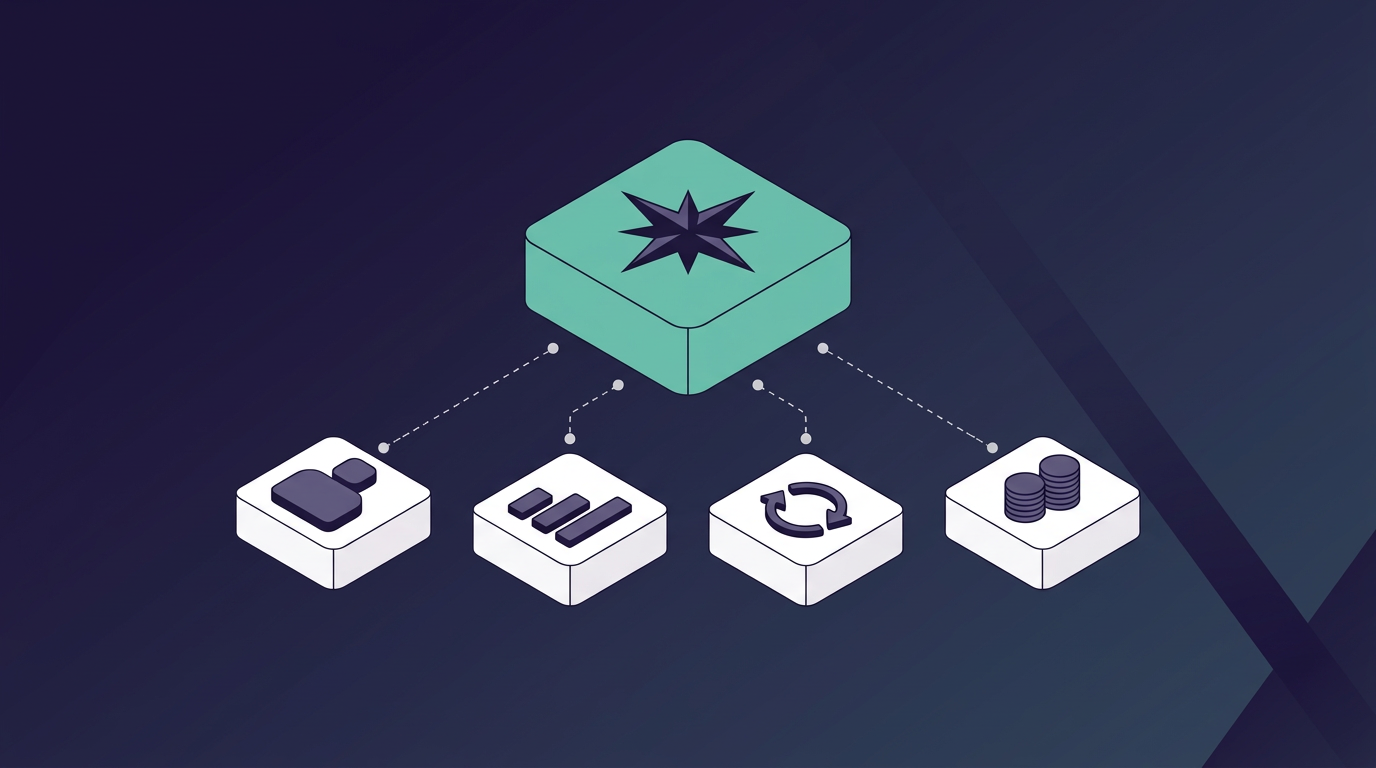
You're ready to invest in marketing. Three options are on the table: hire someone in-house, bring in an agency, or work with a fractional CMO.
Each one sounds reasonable. Each one is right for a different situation. And each one has a failure mode that nobody talks about upfront.
This post breaks down all three honestly, what each costs, how fast it starts, where it breaks down, and which stage it fits best.
The three models: a quick overview
An in-house marketer is a full-time employee on your payroll. An agency is an external team you engage on retainer or project basis. A fractional CMO (Chief Marketing Officer) is a senior marketing leader who works part-time across multiple clients.
Each model solves a different problem. Picking the wrong one doesn't just waste money - it costs months of momentum when momentum matters most.
| Model | Time to Start | Monthly Cost | Strategy | Execution | Flexible Terms | Best Stage |
|---|---|---|---|---|---|---|
| In-House | 2–6 months | £3,000–7,500 (prorated salary) | Only if senior | Yes | No | Series A+ |
| Agency | 4–8 weeks | £3,000–20,000+ | Limited / biased | Yes | Rarely | Channel validated |
| Fractional CMO | 1–2 weeks | £1,500–4,000 | Yes | No | Yes | Series A+ (with team) |
| Growth Division | 1–2 weeks | £5,000–10,000 | Yes (unbiased) | Yes | Yes | Seed–Series B |
In-House Marketing
Hiring in-house is the default choice. It feels like the responsible move: one person, fully committed, building institutional knowledge over time.
The reality is slower. From job post to productive output, the typical UK hiring cycle takes 2-6 months. You're paying employer costs before you see channel results.
Once you've hired, you're locked in. If you brought on a content marketer and the data says you need paid media, you can't pivot quickly. That mismatch costs startups months of runway.
What you get
- A dedicated person with full context on your business
- Compounding institutional knowledge over time
- Full-time alignment with company goals and culture
What you lose
- Speed: 2-6 months before meaningful output.
- Flexibility: Locked into one skill set before you have channel data.
- Agility: If the hire is wrong, fixing it takes another 3-6 months.
What it costs
A junior-to-mid digital marketer in the UK costs £35-55k per year in base salary. Add 20-25% for employer National Insurance, benefits, and equipment. A senior marketer or Head of Growth runs £60-90k+.
A full-time CMO: £100k+ before bonuses. For a startup on a 12-18 month runway, that's a meaningful commitment. And it's largely fixed - you can't dial it down if experiments show you need a different skill set.
When in-house works
In-house makes sense when you've already validated a channel and need someone to own it long-term. You have clarity, and you just need execution capacity to scale it.
It also works at Series A and beyond, when you can afford multiple hires and a strategic layer above them. One marketer in isolation rarely scales.
When in-house fails
In-house fails when you don't yet know which channel will scale. Most seed-stage startups hire for one channel before they have data to support it. When the channel doesn't perform, the fix requires another hiring cycle.
By the time you've corrected course, you've burned 12-18 months discovering what structured experiments find in 6-8 weeks
Marketing Agency
Agencies offer something in-house hiring can't: a team with multi-channel capability, available in weeks. They bring established processes, tools, and experience running experiments across multiple clients simultaneously.
The upside is speed and breadth. The downside is bias.
A PPC agency will always recommend PPC. An SEO agency will always recommend SEO. Their delivery model depends on running the channel they know, and that bias shapes every recommendation they give you.
What you get
- Multi-channel execution capacity without a hiring cycle
- Established processes and tooling from day one
- Experience across similar clients in your vertical
What you lose
- Channel objectivity: Agencies recommend what they know how to sell.
- Cost efficiency: You're paying for offices, account managers, and margins.
- Control: Strategy is often led by the agency, not the client.
What it costs
Boutique growth agency retainers start at £3,000-5,000 per month. Full-service agencies with senior teams run £8,000-20,000+ per month. Premium agencies won't engage below £20,000 per month.
Most agencies also charge a management fee on top of media spend - typically 10-20% of ad budget. At £10,000 per month in paid spend, that's another £1,000-2,000 on top.
When agencies work
Agencies work best when you know your channel and need specialist depth in it. If paid social is already driving pipeline, a specialist paid media agency has the depth to scale it.
They're also useful as a bridge while you're building an in-house team - providing execution capacity without a headcount commitment.
When agencies fail
Agencies fail when they're channel-biased, and you haven't confirmed your channel yet. They'll push what their model is built around - and you pay the cost of discovering the wrong channel.
By then, you've spent 3-6 months on a channel the data didn't support. Switching agencies means another onboarding cycle on top of the sunk cost.
Fractional CMO
A fractional CMO is a senior marketing leader who works part-time across multiple clients. They provide strategic direction - channel prioritisation, positioning, funnel architecture - without the cost of a full-time hire.
Engagements are typically 3-5 days per month. Some fractional CMOs go deeper for companies in active growth phases: 10-15 days per month.
What you get
- Senior marketing strategy at a fraction of full-time cost
- External perspective from working across multiple businesses
- Leadership that aligns marketing with commercial objectives
What you lose
- Execution: Most fractional CMOs advise - they don't run campaigns.
- Continuity: They're splitting their time across multiple clients.
- Depth: 3-5 days per month limits how embedded they can get.
What it costs
A fractional CMO in the UK charges £1,500-4,000 per month for a meaningful engagement - roughly £300-800 per day. Senior operators with strong track records charge more.
Compare that to a full-time CMO at £80-150k per year. The cost case for early-stage companies is clear. The gap is execution capacity underneath them.
When fractional CMOs work
Fractional CMOs work when you need a strategic layer and already have execution capacity. If you already have a marketing team or agency on execution, a fractional CMO fills the strategic gap precisely.
Series A and Series B companies get the most value here. They have enough in-house resource to act on strategic direction.
When fractional CMOs fail
Fractional CMOs fail at seed stage when there's no execution team underneath them. A strategy without execution is a document. It doesn't move the needle.
If you're pre-Series A without a marketing team, a fractional CMO gives you direction and nothing else. That's an expensive way to produce a strategy that sits unrealised.
A fourth option: the hybrid model
None of the three models above is optimal for most seed-stage tech startups. In-house is too slow; agencies are biased; fractional CMOs don't execute.
Growth Division is our agency, I built it with Tom Dewhurst after making exactly this mistake as a founder. We committed to one channel before we had the data to back it.
The model Growth Division runs combines what the other three can't do individually. An unbiased Growth Strategist sets the direction. A vetted fractional expert network executes, and channel experts are swapped in and out as experiment data comes in.
The strategist is channel-agnostic. The recommendation is driven by what the data shows is working, not by what the agency needs to sell. Channel experts are people we've worked with for years, not cold freelancers.
It starts in 1-2 weeks. It costs £5,000-10,000 per month. And it's built specifically for tech startups at Seed to Series B - with flexible terms and no long lock-ins.
Growth Division has worked with 130+ startups, including Weavr, Musiversal, Addland, and Eat Sleep Cycle. Clutch: 4.7/5 across 30 reviews.
"Growth Division have transformed our marketing from a cost centre into a value driver."
- General Manager, Tutorful
How to choose: a decision framework by stage
Pre-seed / bootstrapped
Budget is the constraint. You need channel discovery, not deep channel execution. A channel-agnostic model that tests multiple hypotheses quickly - without locking you into one skill set is the best fit.
A fractional CMO without execution support is too theoretical. A specialist agency is too expensive and too biased. A hybrid model or a carefully scoped freelancer with strategic oversight is the practical option.
Seed stage (£250-1M raised)
This is where most founders get it wrong. They hire in-house before knowing their channel, or bring in a specialist agency before validating the model. Neither gives you unbiased channel discovery.
The right choice tests multiple channels quickly and adapts based on data - without locking you in before you have evidence. A hybrid growth model - strategy and fractional execution combined - fits this stage best.
Series A (£1M+ raised)
You have enough budget to build properly. Hire a Head of Growth to own the growth function. Complement with a specialist agency for validated channels and a fractional CMO for strategic oversight.
At this stage, all three models can work. The key is sequencing: strategic layer first, execution capacity second.
Frequently asked questions
What's the difference between a fractional CMO and a marketing agency?
A fractional CMO provides strategic leadership - direction, prioritisation, positioning. An agency provides execution - campaigns, content, media spend. You often need both.
The risk is alignment. Make sure whoever sets strategy also owns accountability for results.
When should a startup hire an in-house marketer?
When you've validated a channel and need someone to own it long-term. Don't hire in-house to discover your channel - that's the most expensive way to run experiments. Validate first with a flexible model, then build in-house capacity around what's working.
How much does a fractional CMO cost in the UK?
Expect £1,500-4,000 per month for a meaningful engagement - roughly £300-800 per day. Senior operators with strong founder-to-founder credibility charge more. That's significantly cheaper than a full-time CMO, but you get strategy only - you'll need separate execution capacity.
What's a hybrid growth model?
A hybrid growth model combines strategic direction with fractional channel execution. Rather than one marketer or one biased agency, you get an unbiased strategist plus specialists who execute based on data. Growth Division operates this model for tech startups at Seed to Series B.
Can a fractional CMO replace a marketing agency?
No - they serve different functions. A fractional CMO sets strategy; an agency executes it. If you want both in one engagement, you need a hybrid model.
That's what Growth Division provides - one engagement that bundles strategy and channel execution together.
What's the fastest way to start marketing as a seed-stage startup?
A hybrid model or a channel-agnostic agency starts in 1-2 weeks. In-house hiring takes 2-6 months; traditional agencies take 4-8 weeks just to onboard. If speed matters - and at Seed stage it always does - avoid models with a long lead time.
Conclusion: choose based on stage, not instinct
Each model exists because it solves a real problem. In-house builds long-term capability. Agencies provide specialist depth; fractional CMOs deliver strategic leadership.
But none of the three is optimal for a seed-stage startup that hasn't confirmed its growth channel yet. You need an unbiased strategy and multi-channel execution together, without the lock-in or the bias.
If you're at Seed or Series A and want to find your growth channel faster, book a call with Growth Division. We'll run a Bullseye Call to surface the highest-probability channels for your product - and tell you honestly whether we're the right fit.



.png)
.png)