The wrong first marketing hire costs a scaleup more than a salary. It costs two quarters of pipeline you can't get back (and nobody gives you those back, sadly!).
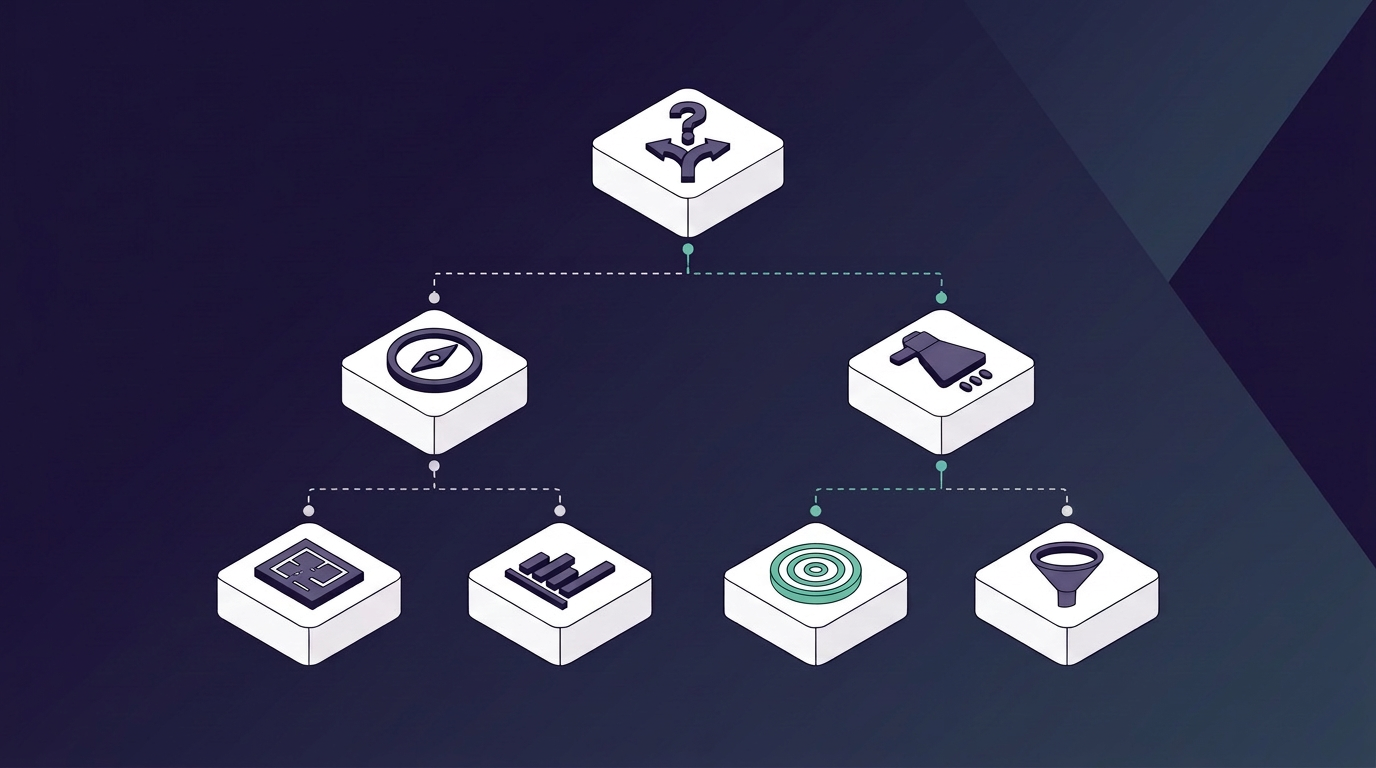
The fork looks simple. A demand generation expert builds pipeline, and a fractional Chief Marketing Officer (CMO) builds the plan. Both are good hires, but only one of them should come first.
So how would I decide? I'll walk through what each role does, what each costs, and the signs that point you one way or the other.
Demand generation expert vs fractional CMO: the short answer
Hire a fractional CMO first when you don't know what to fix. Hire a B2B demand generation expert first when you know the channel and lack the hands. And hire a hybrid team when you need both and can't justify a full-time team yet.
A CMO sells direction, and an expert sells output. Swap them around and you get decks with no pipeline, or campaigns with no plan.
The good news? You aren't choosing forever. You're choosing for the next 90 days.
What a B2B demand generation expert actually does
A demand generation expert creates and captures pipeline in a specific set of channels. Think paid media, outbound, content, search and account based marketing (ABM). They own the numbers: leads, meetings and cost per qualified opportunity.
Good ones also read the funnel. They see where buyers drop out and fix it fast, which is real value when a channel already works.
The upside is speed and depth. The downside is scope. Experts usually optimise inside a plan, and they rarely stop to question the plan itself.
Experts also come in three forms, and how quickly they get going varies a lot. Freelancers can usually start fastest, but the good ones are hard to vet. Agencies take longer to onboard and tend to lean toward the channel they sell (funny that!).
In-house hires take months to land. And you usually hire for one skill when you may soon need another.
Specialist firms show the range. Refine Labs, a Boston demand generation agency, says it typically works with companies above $30M in annual recurring revenue (ARR), with a marketing budget of $1M+ a year and $50K+ a month already going into paid advertising.
Demand Curve sits at a different point. It says everyone on its team is a senior growth expert (no juniors, not even in sales), and it works month to month. For a wider view of how the two disciplines differ, have a read of our growth marketing versus demand generation guide.
What a fractional CMO actually does
A fractional CMO is a senior marketing leader who works for you part-time. They set strategy, pick channels, manage the budget and report to the board. They usually don't run campaigns themselves.
A Marketing Week report on research by The Slice Network and Robert Half Talent Solutions surveyed 113 fractional marketing leaders. Of those, 33.9% said demand grew because companies want senior expertise without a long-term commitment. Only 18.6% cited cost efficiency.
Is that proof? Not really. The respondents were fractional leaders themselves, mostly in the UK, so they're hardly neutral! But it matches what I see: founders hire a fractional CMO for the judgement, and the saving is a bonus.
The downside is hands. A fractional CMO brings judgement and very little capacity, so the plan only works if someone else can run it.
Side by side: expert vs fractional CMO
| Factor | Demand generation expert | Fractional CMO |
|---|---|---|
| Core job | Build and capture pipeline in known channels | Set strategy, choose channels, lead the team |
| Best when | A channel works and needs scaling | Direction is unclear or leadership is missing |
| Owns | Leads, meetings, cost per qualified opportunity | Positioning, budget, hiring, board reporting |
| Typical output | Campaigns, tests, and performance reports | A plan, clear priorities, and team management |
| Main strength | Speed and channel depth | Judgement and a cross channel view |
| Biggest risk | Optimising a flawed plan | A plan with nobody to run it |
| First 90 days | Launch and tune campaigns | Audit, set the plan, fix measurement |
Treat the table as a set of tendencies. Individual people vary a lot, so I'd always judge the person in front of you over the job title on their profile.
What each option costs
Published prices are patchy, so here's what I could verify on each provider's own site. I've kept each figure in its original currency.
- 🎓 Fractional CMO, light touch: Kalungi's CMO coaching starts at around $2,500 a month, depending on the seniority of the coach.
- 🏢 Fractional CMO plus a full team: Kalungi's full service engagement costs $50,000+ a month.
- 📈 Enterprise demand generation: Refine Labs doesn't publish a price, but it's built for companies already spending $50K+ a month on paid ads.
- 🤝 Hybrid team: Growth Division, our growth marketing agency, charges per person per month. Channel experts cost from around £1,000 each, and a Growth Strategist adds £2,000 to £3,000.
- 💷 Typical hybrid total: most Growth Division teams run £5,000 to £10,000 a month (+VAT).
Price isn't the whole story, though. A cheap hire who tests the wrong channel costs more than a pricier one who picks the right one.
Signs you need a fractional CMO first
A fractional CMO is the better first call when the problem is direction and delivery can wait. Watch for these signals:
- 🧭 You can't say which channel produces your best pipeline, and your reports disagree.
- 🥊 Sales and marketing argue about what counts as a qualified lead.
- 🎯 Your ideal customer profile (ICP) or positioning keeps shifting.
- 🧑💻 You have marketers who can execute but lack a senior steer.
- 📊 An investor or board member wants a clear growth plan within a quarter.
- ⚠️ You're about to hire a full-time head of marketing before you know your channels.
If three or more sound familiar, my recommendation is to buy direction before capacity. Fixing the plan first is cheaper than funding the wrong one.
Signs you need a demand generation expert first
A demand generation expert is the better first call when the plan exists and the bottleneck is people. These are the signals:
- ✅ One channel already produces pipeline, and you want more volume from it.
- 📝 The plan is documented, and nobody has time to run it.
- 🔧 You lack in-house skills in paid media, outbound or search.
- 🚀 A funding or launch milestone needs a fast ramp.
- 👀 Your leaders can review results but can't manage specialists.
- 💰 You have budget for the expert and for media spend.
If that's you, hire for the channel that already works. Ask for results from clients at your stage. And ask what happens when the channel stops working (because at some point, it will!).
What goes wrong when you hire in the wrong order
Hire an expert first without a plan, and you get activity without learning. The expert runs the channel they know. If it underperforms, nobody can say whether the channel, the message or the audience was wrong.
Hire a CMO first without anyone to execute, and you get strategy that sits in a document. The plan is sound, but the team can't run six tests at once. So momentum fades while the founder waits.
Both failures are fixable. The cost is time, and time is the one thing a scaleup with a fixed runway can't buy back. That's why I'd rather diagnose first, even when it feels slower.
How your current team changes the answer
Your existing team matters more than your revenue. Here's how I'd read it.
If you have no marketers, start with a fractional CMO or a hybrid team. You need someone to decide what the work is, and someone to do it.
If you have two or three junior marketers, a fractional CMO is usually the strongest first hire. They can execute, but they lack a senior steer, and a good leader multiplies what they already do.
If you have a senior head of marketing but a gap in one channel, hire the demand generation expert. Your leader owns the plan, and the expert fills the capability gap.
That's my rule of thumb, and it'll bend for plenty of companies. Test it against your own bottleneck before you commit.
What the first 90 days look like for each hire
| Period | Demand generation expert | Fractional CMO |
|---|---|---|
| Weeks 1 to 2 | Audit the channel, tracking, and funnel data | Audit ICP, positioning, funnel, and measurement |
| Weeks 3 to 6 | Launch and tune campaigns in the proven channel | Write the plan and rank channels to test |
| Weeks 7 to 12 | Scale what works and report on pipeline | Brief specialists, review tests, and report to the board |
Whoever you hire, tracking comes first. If measurement is broken, every result after it is guesswork.
I'd ask any candidate to describe this rhythm in their own words. If they can't, they're improvising on your budget.
A worked example for a fintech scaleup
Picture a B2B fintech scaleup with 40 staff and an £8,000 monthly growth budget. Outbound books 15 meetings a month, but half come from one salesperson's network. Nobody has tested paid search, content or partnerships.
To be clear, this is an illustration and the numbers are made up. It isn't a client case.
Hire an expert first, and they'll tune outbound. Meetings will probably rise, and that will feel like progress. But the dependence on one person's network stays hidden.
Hire a fractional CMO first, and they'll audit the sources and flag that dependency. They'll also rank a handful of channels to test, and then you can hire an expert for the winner. That order costs a few weeks and can save a quarter.
Why order matters: tuning comes after choosing
Order matters because most budgets already chase what's easiest to measure. Gartner's 2026 CMO survey of 401 marketing leaders found 62.6% of media spend now goes to awareness and conversion. Loyalty and retention fell to less than 15%. That's a lot of money chasing acquisition!
Gartner also suggested less mature organisations may over index on the channels that are easiest to measure. A Gartner analyst warned that "optimization is not the same as strategy."
Does a survey of CMOs at established marketing teams apply to a scaleup? Partly. Your budget is smaller, but the trap is identical. You tune what you can measure and skip the harder question of what to measure in the first place.
The hybrid option: a CMO's judgement with an expert's hands
There's a third path, and I'd pick it for many scaleups. A fractional team pairs a senior strategist with channel specialists, so you skip the overhead of a full agency or full time hires.
(Yes, I'm biased here. This is what we sell, so take this section with a pinch of salt!)
That's how Growth Division works. A channel-agnostic Growth Strategist designs the plan, and vetted experts rotate in or out as experiments report back. You can see the model on our fractional marketing services page.
Every engagement starts with a Bullseye Call, a one hour session that maps your go to market (GTM) channels. The team then runs the work on GREX, our AI growth operating system. Growth Division has worked with 130+ startups, scaleups and SMEs, and holds a 4.7 rating on Clutch from 31 reviews.
Speed helps too. We can usually get you a proposal within 7 days and kick off within a few weeks, capacity allowing, which beats the months an in-house hire takes.
Talent networks such as Right Side Up say they can recommend an individual or team in as little as two days, with people in seats within two weeks. So we're hardly the only quick option!
The trade-off is a smaller bench than a full agency. And it isn't built for startups without product market fit (PMF) that are still searching for a product.
Can the founder act as the CMO for now?
Sometimes, yes. Founders know the customer better than anyone. If you've closed your first customers yourself, you already hold the raw material for positioning.
The risk is bandwidth. A founder who is also fundraising, hiring and shipping product can't run weekly channel reviews. So the plan gets revisited quarterly when it needs looking at weekly.
If that sounds familiar, a fractional CMO can take the planning load while you stay close to customers. You keep the insight and hand over the cadence, and that split works well in founder-led companies.
Set the brief before you sign
Whoever you hire, put the brief in writing before day one. I'd include the single metric that defines success (qualified meetings or pipeline value, say), the review date and the rule for what happens if the test fails.
That one page protects both sides. The expert knows what a win looks like, and the CMO knows which decision they're being asked to make.
It also makes switching easier later. If the first hire shows you the real bottleneck, you can change course without a messy contract exit.
Questions to ask before you hire
The best protection against a bad hire is a better conversation. I'd ask each type of candidate a different set of questions.
For a demand generation expert:
- 🧪 Which channel would you test first, and what result would make you stop?
- 📏 How do you report: on leads, meetings or pipeline value?
- 👥 Who else works on my account, and how often will I see you?
For a fractional CMO:
- 🙋 Who will run the plan once you've written it?
- ⏱ How many hours a week will you actually give us?
- 🔀 What would you recommend if the answer wasn't a channel you know?
Listen hardest to the last question in each list. A strong candidate names a channel they don't sell and explains when it would win. A weak one pivots back to their own service within a sentence.
Frequently asked questions
Should a scaleup hire a demand generation expert or a fractional CMO first?
Hire the CMO first if the problem is direction, and the expert first if the problem is delivery. Ask yourself whether you know which channel works. If you don't, start with the CMO.
What if I can only afford one hire this quarter?
Choose by bottleneck. If you can't name the channel that works, hire the CMO and ask them to run one small test. If you can, hire the expert for that channel and book a monthly review with a senior adviser.
Can a fractional CMO run demand generation?
Sometimes, but usually they direct it rather than execute it. Kalungi, for example, pairs its fractional CMO with a full execution team in its full service model. If you need hands on campaigns, plan for a second resource.
Can I hire both at the same time?
Yes, and it's often the best sequence. The CMO writes the brief, and the expert executes it. Just agree up front who owns the plan, so the two don't compete.
How long should I wait before judging the hire?
Give a programme one full quarter. Growth Division's own timeline treats months one to three as testing, and months three to nine as channel clarity. Early results tell you which way things are leaning, and it's too soon for a final verdict.
When does a full time CMO make sense?
Once your channels are proven and the work fills a full week. Before that, you're paying for capacity you can't use. A fractional or hybrid model lets you wait for that point.
Is a hybrid team the same as an agency?
Not quite. A traditional agency sells a fixed team and often leans toward the channel it sells. A hybrid team lets you swap experts as data comes in, with a strategist who doesn't sell a channel.
Still not sure which hire comes first?
Then talk it through before you sign anything. Book a Bullseye Call and in one hour we'll map your channels and tell you plainly which hire comes first, even if the answer is someone other than us!