Want the full 16-page report? Download The Startup & Scaleup AI Adoption Gap report (free, instant PDF).
Our key findings:
- Startups are getting more done with AI; the next test is building a strategic layer so it’s actually driving better decisions. Marketing leaders at scaleups have reservations about trust and context, while founders say it’s a setup time and cost issue.
- Founders and CEOs are driving AI adoption. They’re more likely to describe AI as core to their business and are more confident that they’re adopting AI as well as, or better than, their competitors.
- The smallest startups are the power users. They’re already more likely to be using AI to help with strategy and are most likely to consider AI core to their business. When your team is small and lean, startups are finding it easier to make AI core to their processes.
Smaller startups are the biggest AI power users
41% of all respondents said AI is core to their business, and central to how it runs day-to-day.
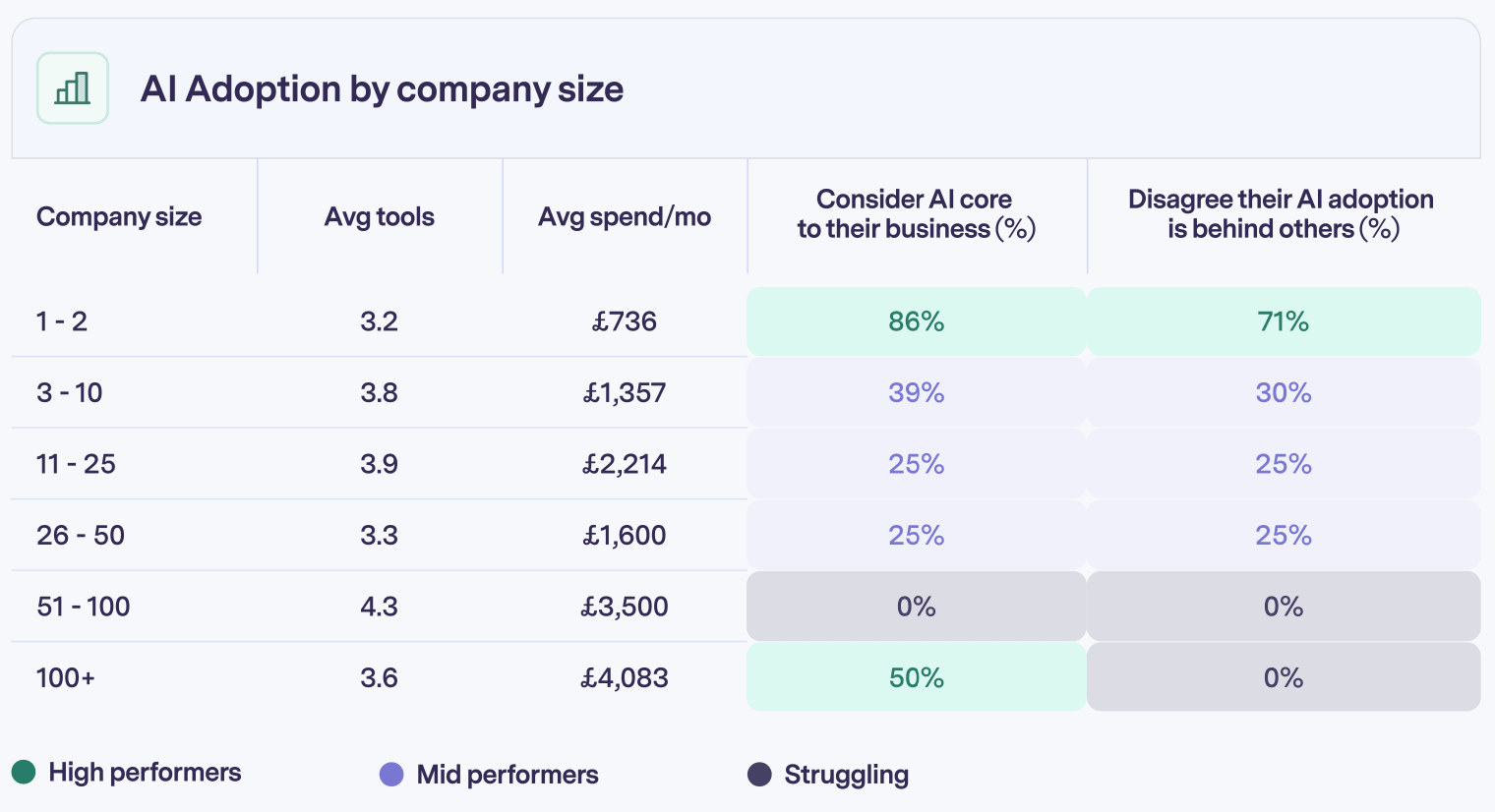
The smallest startup teams are the strongest adopters of AI (based on spend proportional to headcount), and are also much more likely to consider it core to their business, as well as feel confident that they’re keeping pace with their competition.
As the size of the startup increases, spend and tool count are relatively flat, but AI confidence quickly falls off a cliff: only 25% of startups with 11-25 people agree that AI is core to their business, compared to 86% of those at 1-2 person startups.
71% of those at 1-2-person startups also disagree that their AI adoption lags behind competitors (vs 25% of 11-25-person startups).
Higher sprawl & spend produce lower confidence
As we reach a headcount of 50+, the average number of tools increases above 4, and the spend shifts up a gear, with these tools costing £3,500+ per month on average. But confidence in how well these teams have adopted AI, and how core it is to their business, is drastically lowered.
This reflects a lot of the conversations we have with larger businesses. Leaders are keen to bankroll AI adoption, and ‘more tools’ feels like the right answer. But when none of them are connected, there’s no system; they’re just adding chaos to martech stacks that are already unwieldy. Teams end up spending more time on reporting, and nobody can really say for sure what’s having an impact. Confidence takes a nosedive.
Once headcount passes 100, spend is up, the number of tools is down, and confidence somewhat rebounds. This hints at investment in creating such a system.
Founders & CEOs lead AI confidence
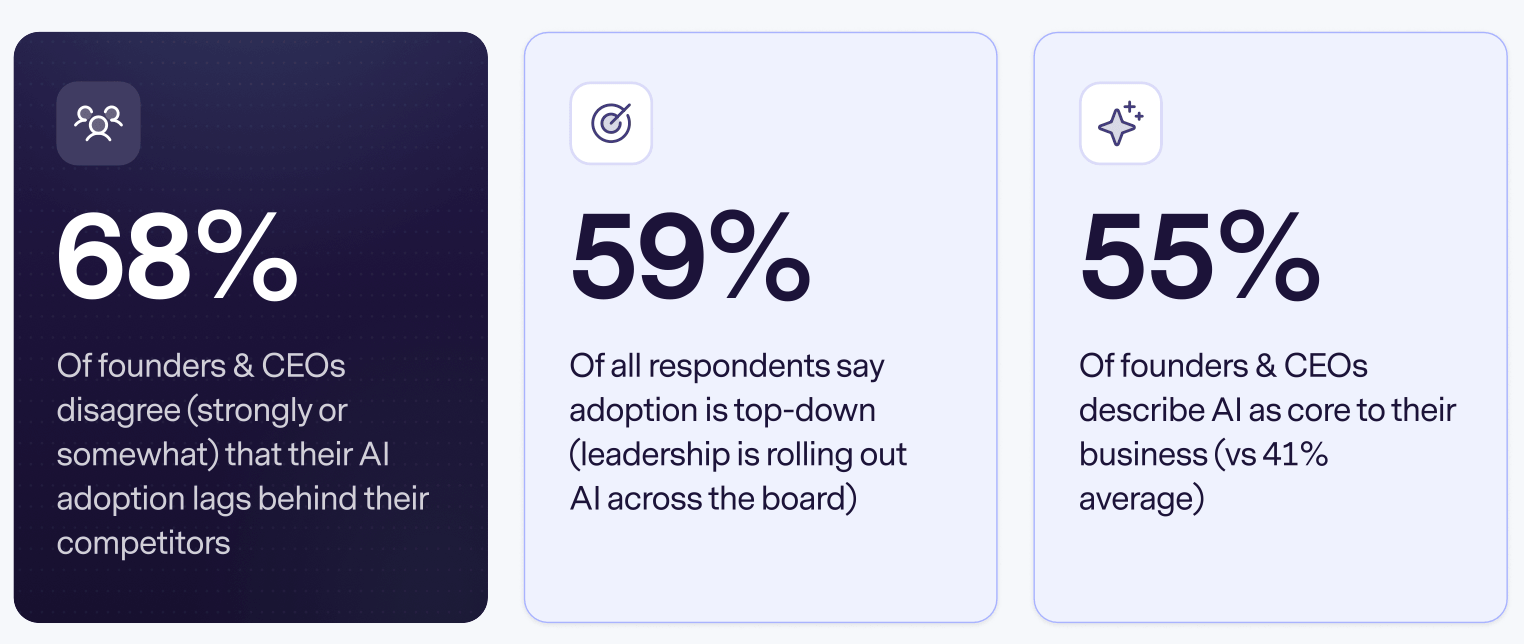
💡 Founders and CEOs were 3.38x more likely to strongly disagree that their AI adoption lags behind that of their competition.
Of course, this is in part tied to the insights on team size: more of the respondents from 1-2 person startups described themselves as a founder. But the trend continues as the startup’s headcount rises, too, with a clear picture emerging: founders and CEOs are pushing AI more strongly and are more confident that their business is doing a good job of adoption. Founders and CEOs were also 1.84x more likely to say AI is core to their business.
Teams are using AI to work faster
If we look at the most common AI use cases for startups, they can be summarised with two words: output and efficiency.
The problem is that when everyone is using AI tools to achieve these two outcomes, they effectively cancel each other out. Yes, there’s an incentive not to fall behind (aka for your output to drop below that of your competitors), but the benefits of volume alone quickly start to wane.
Teams may feel productive because they are producing more, and they’re doing it quickly. But are the right numbers actually moving? And now we’ve collectively cracked volume, where does the next AI advantage come from?
The next advantage: tying output to results (working smarter)
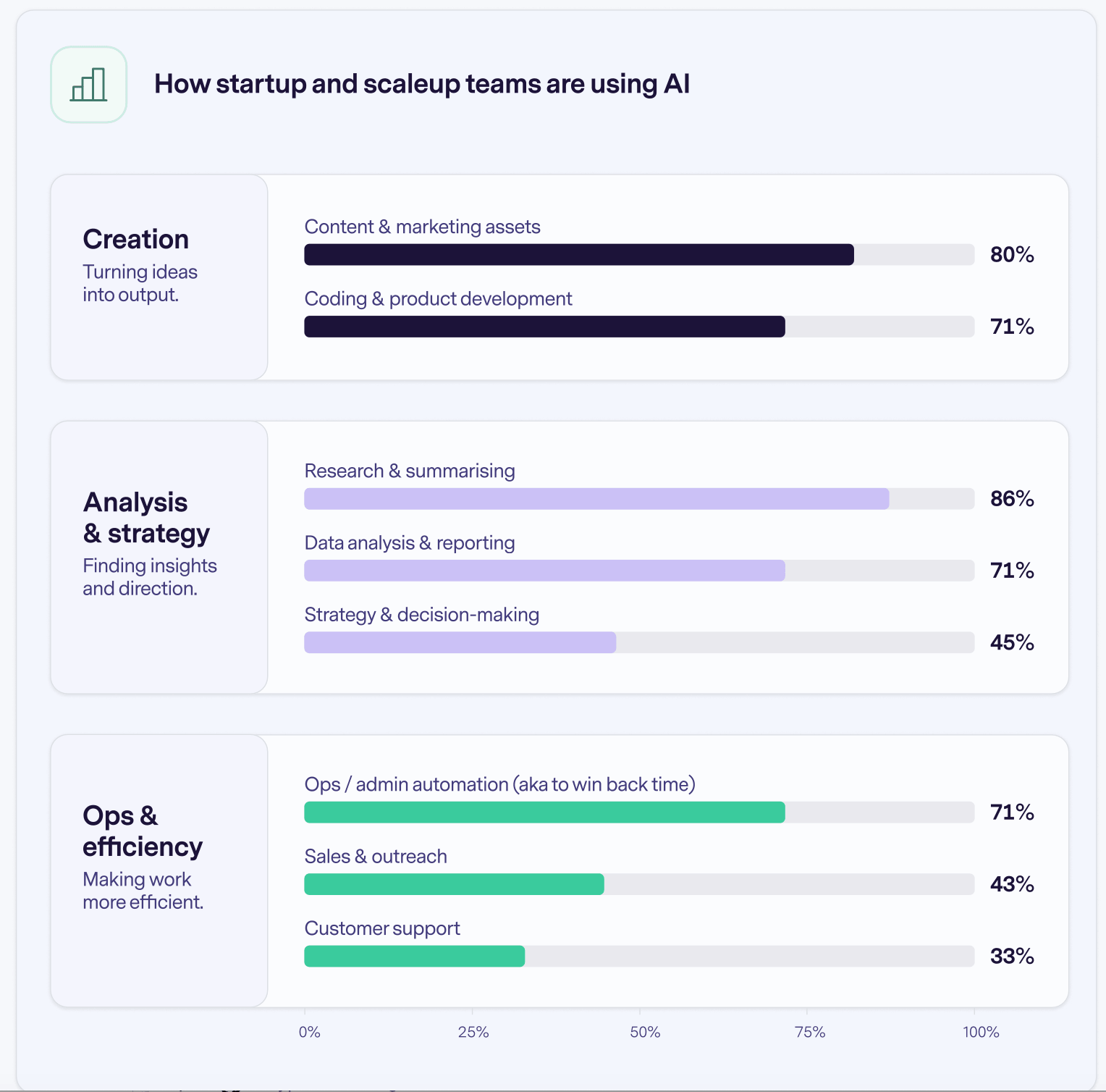
Only 45% of respondents are using AI for strategy and decision-making. This was the third least common use of AI among startups (the least common being customer support at 33%).
As our collective output increases, what many startups lack is a way to actually cut through the (increased) noise and decipher what’s actually driving results.
Teams are using AI to create content (80%) and for data analysis and reporting (71%). But the fact that far fewer use it for strategy and decision-making (45%) indicates that the learnings from this extra output aren’t feeding back into the decision-making process. These teams may lack the ability to tie outputs to real results and make smarter decisions about which channels to run, and how.
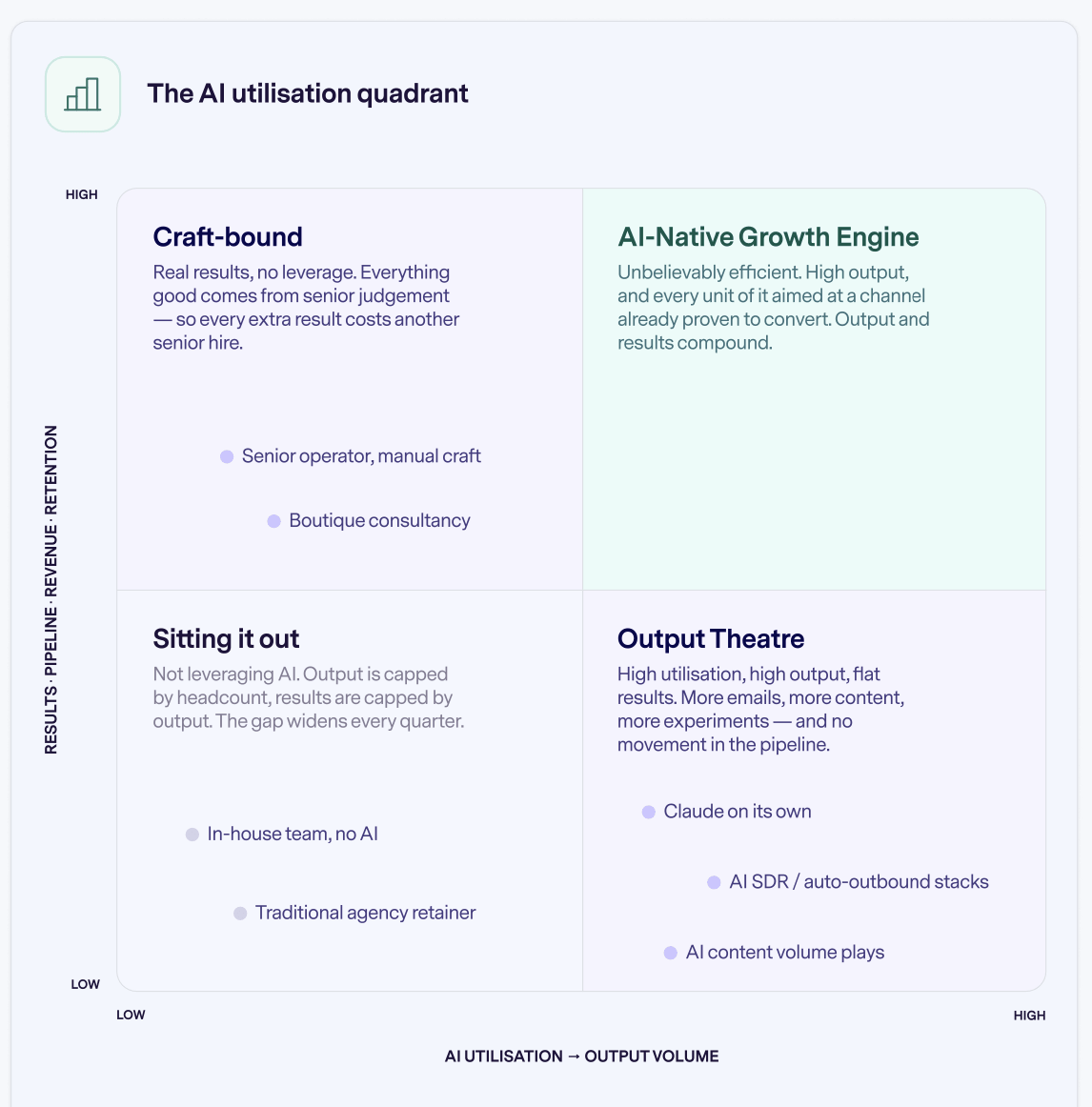
Not linking marketing activities to outcomes is the key adoption gap we’re seeing. Some startups are building a meaningful strategic layer with AI, forming a real system of learning as well as doing, while others are stuck on a creation hamster wheel. Knowing what activities drive outcomes is the missing piece for teams in 2026.
The gap exists, but the shift is coming
The data suggests that this adoption gap is starting to close. Founders and CEOs are pushing for it, and the smallest startups are making it work out of necessity.
Closing the gap requires investing in the setup, getting more sceptical internal leaders on board, and spending time now to save time (and usage credits) later.
Get the full report
This post covers the headline findings. The full 16-page report breaks down spend, tool count and confidence by company size, the four ways teams use AI (and which one compounds), and the blockers holding founders and marketing leaders back.
Download the free AI Adoption Gap report
Want the same lens on your own business? Book a strategy call.